:::::::::::::::::::::::::::::::::::::::::::::::::::::::::::::::::::::::::::::::::::::::::::::::::::::
Flowers, blossoms and translating "hana" (花)
The Japanese character for hana 花
can be translated in various ways in to other languages.
In haiku it refers only to the cherry blossoms.

Photo Gabi Greve
.................................................................................
A word of caution :
hana 花 translated as:
The English words flower, blossom, bloom or the German Blume, Blüte with no further addition does not convey this strong meaning of the Cherry blossoms.
So if you use only the word "FLOWER" in an English haiku, it is not synonym for "cherry blossoms" and thus NOT a kigo.
ブロッサム【blossom】burossamu, flowers on a tree
ブルーム【bloom】 buruumu
フラワー【flower】furawaa
In "Haiku World", William Higginson
advises for Renku linked poetry that the participants have to decide to accept the word
blossom as any spring-blossoming tree or not.
.................................................................................
As a kigo, "hana 花" always represente the
Cherry Blossoms (sakura no hana) .
Hana can of course also be a beautiful lady and Hanako 花子, Flower Girl, is a common name.
A clouded sky during the Cherry blossom season, blossom haze, is "hanagumori", 花曇, only in this season used as a kigo for late spring and never used for other flowers in haze or clouds.
Viewing flowers, hanami, 花見, is of course only used for viewing the Cherry flowers and is a pleasure enjoyed in daily life in Spring.
... ... ... ... Do not mix up these two in Japanese
spring flowers, haru no hana 春の花
kigo for spring
"spring of the flowers", hana no haru 花の春
kigo for the New Year
:::::::::::::::::::::::::::::::::::::::::::::::::::::::::::::::::::::::::::::::::::::::::::::::::::::

summer flowers -
not knowing your names
do I know less ?
© Photo and Haiku by Gabi Greve
:::::::::::::::::::::::::::::::::::::::::::::::::::::::::::::::::::::::::::::::::::::::::::::::::::::
Snow, Moon and Blossoms, Setsugekka 雪月花
setsugetsuka
Japanese Art and the Japanese View of Nature
To the Japanese mind, nature is more than just physical scenery.
The Japanese love of the imperfect stems from an acknowledgment of the inherent limitations of human creative powers.
© SETSUGEKKA, by Isamu Kurita, MOA
..... Do not miss to read the full essay .
:::::::::::::::::::::::::::::::::::::::::::::::::::::::::::::::::::::::::::::::::::::::::::::::::::::
Here are some more compounds with HANA, the Cherry Blossoms.
花の雨 はなのあめ blossom rain [i.e., rain falling on cherry blossoms, or at cherry blossom time]
花の山 はなのやま hana no yama blossoming mountains/hills
花便り はなだより hanadayori blossom news / tidings of blossoms [whether carried in person or by media]
花の昼 はなのひる hana no hiru blossoms at midday
花の雲 はなのくも hana no kumo clouds of blossoms / blossom clouds [figurative]
花盛り はなざかり hanazakari blossoms in full bloom / blossoms at their peak
花埃 はなぼこり hanabokori blossom dust / blossom pollen
花の宿 はなのやど hana no yado blossom inn [i.e., an inn where people go to see the cherry blossoms in the region; an inn nestled among blossoming cherry trees]
"capital of blossoms", hana no miyako 花の都
Read : Edo or Kyoto, a discussion of the meaning
:::::::::::::::::::::::::::::::::::::::::::::::::::::::::::::::::::::::::::::::::::::::::::::::::::::
a different temple
for each season -
flowers of Kamakura
Look at the Flower Calendar of Kamakura !
Gabi Greve, former resident of Kamakura
- Backup Copy - !
:::::::::::::::::::::::::::::::::::::::::::::::::::::::::::::::::::::::::::::::::::::::::::::::::::::

http://www.hana300.com/nanoha.html
Other flowers use "hana" in the name too, but only in context with other words, for example the rape flower, celery cabbage, na no hana 菜の花.
Daphne (Jinchooge, Japan) is written 沈丁花、where the character for flower is read GE.
Peach blossoms (momo no hana 桃の花) and others are especially mentioned too, nashi no hana 梨の花 (Japanese pears), anzu no hana 杏の花 (apricots) and so on.
. momo no hana 桃の花 peach blossom art motives .
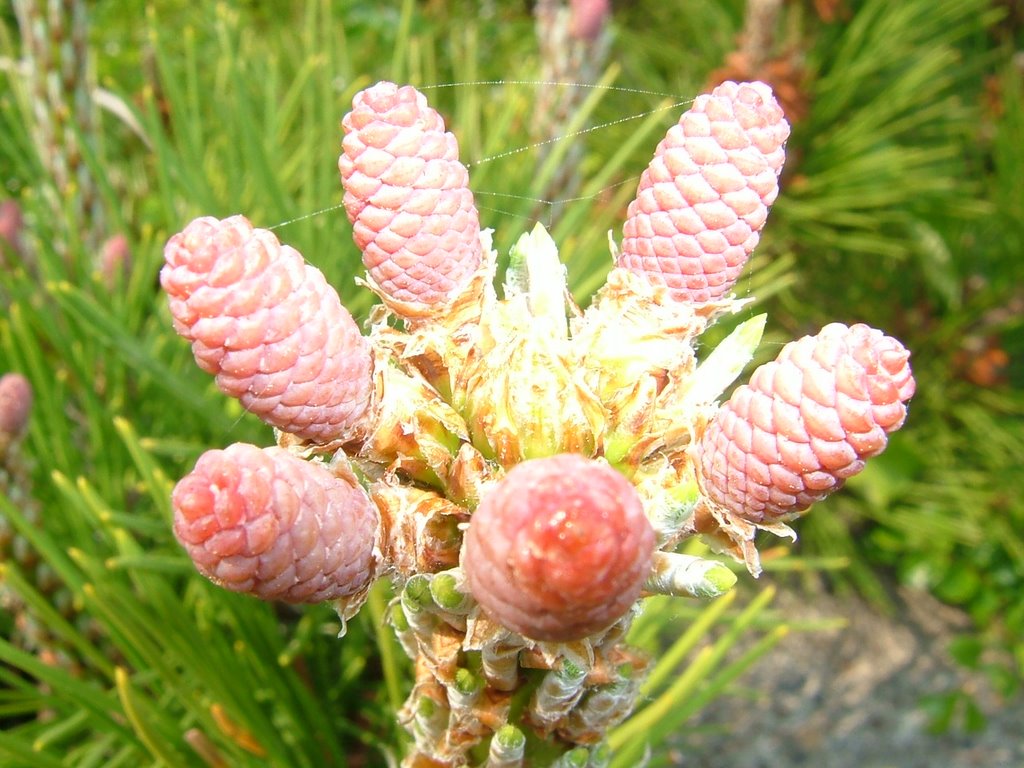
The Pine (matsu, Japan) has flowers, matsu no hana 松の花, but also delivers its pollen to us, especially in 2005 in the spring causing a lot of allergies. The pollen is called "Matsu kafun", here KA is the character for flower 松花粉.
blogs.dion.ne.jp/cafe_m/archives/cat_43147.html
... ... ... ... ...
Another lovely spring flower, almost a weed in the rice fields before plowing in my area of Okayama, is the milk vetch with its pink patches providing food for our local bees. The Astralagus family of clover is also called
gegebana 五形花 or rengesoo 蓮華草.
Here the character used for GE, indicating the flower, is a beautiful old traditional Chinese one.
Rengesoo has been wrongly translates as "Lotus Flower" by some translators unfamiliar with this haiku name, but that is of course not correct. Just imagine honey from the real lotus flowers!
Even if RENGE 蓮華 means lotus,
the lotus flower is something else, as you can see below.

© Photo Gabi Greve
xxxxxxxxxxxxxxxxxxxxxxxxxxxxxxxxxxxxxx
We also have fiery flowers in the summer sky, hanabi, 花火,
Firework Display (hanabi, Japan )
:::::::::::::::::::::::::::::::::::::::::::::::::::::::::::::::::::::::::::::::::::::::::::::::::::
In Autumn,
the fields are filled with flowers, hanano 花野, flower moors.
Here HANA is a general name for all the different plants flowering in autumn.
花野道 hananomichi flower-field path and
花野風 hananokaze, flower-field wind/breeze(s) belong to these Autumn flowers.
The Autumn wildflowers are also called
kusa no hana 草の花 . "Flowers of the weeds",
"Flowers of the grass" is another translation.
chigusa no hana 千草の花 "a thousand wild flowers"
道問はば微笑み返る草の花
Asking how to go,
she smiles at me
by the flowers of weeds.
© Wada Yoshio
Check out this page for more bilingual Haiku and superb photos.
http://wadaphoto3.web.infoseek.co.jp/haiku.htm
..... .....
空に迄仏ましまして草の花
sora ni made hotoke mashimashite kusa no hana
even in the sky
Buddha dwells...
wildflowers
Issa
Issa and the Wildflower Haiku, tr. David Lanoue=
..... .....
One of the "kusa no hana" is the
wild pink carnation, nadeshiko.
草の花は、なでしこ 撫子.
Used already by Sei Shonagon 清少納言 (Sei Shoonagon) in her Poetry.
. Flowers and plants in AUTUMN
.................................................................................
Wild flowers from Uruguay, flowering now in April.
Haiku by Carlos Fleitas.
wild flowers -
spreading yellow and pink
why call it autumn?
colorful noon -
leaves wither and pass by
yet wild flowers
Read more of Carlos' wildflower haiku here:
- yahoo.com/group/happyhaiku/message/1440
..........................
. The seven flowers / herbs of autumn,
aki no nanakusa 秋の七草 .
Flowers blossoming
in autumn fields -
when I count them on my fingers
they then number seven.
The flowers of bush clover,
eulalia, arrowroot,
pink, patrinia,
also, mistflower
and morning faces flower.
Yamanoue Okura (C. 660 - 733)
Manyoshu: 8:1537-8
http://www.urasenke.org/flowers/
Nora ni saku na wa kore made zo kusa no hana
Flowers of the grass:
scarcely shown, and withered
name and all.
Asei
http://www.ski.org/SPMcKee_lab/yury/index.html?Hobbies_files/haiku_engl.html
Haru no Nanakusa 春の七草
. The Seven Flowers / Herbs of Spring .
:::::::::::::::::::::::::::::::::::::::::::::::::::::::::::::::::::::::::::::::::::::::::::::::::::
Early winter
Sometimes, the cherries and others start flowering in winter again
nidozaki, nido zaki 二度咲(にどざき)
"flowering for a second time"
these crazy flowers, kurui-zaki 狂い咲き.
kaerizaki, kaeri-zaki 帰り咲 (かえりざき) crazy blossoming
They are also called "flowers coming back" or
"retruning flowers" kaeribana 帰り花 / 返り花 (かえりばな)
forgetful flowers, wasurebana 忘れ花 (わすればな)
. . . . .
The soft fluttering snowflakes are sometimes called "wind flowers", kazahana 風花.

© Photo Gabi Greve
http://happyhaiku.blogspot.com/2005/04/sunbeam-for-us-all.html
:::::::::::::::::::::::::::::::::::::::::::::::::::::::::::::::::::::::::::::::::::::::::::::::::::
Flowers and Renku
Chris Drake
The following are regarded by renku poets as "true flowers/blossoms, 正花 (shooka)" although they are not what we ordinarily call flowers. This is because they express the basic life force that makes botanical flowers possible:
* Spring: hana-guruma, a cart carrying or decorated with flowers, also a blossom-viewing carriage; hana-gokoro, or flowers' heart-mind, that is, the heart/mind of blossoms, and also the heart/mind of humans when it blooms with creative, blossom-like thoughts and actions; hana-goromo, a blossom-robe, that is, a flowery or floral-design robe; hana-ikada, or flower raft, a dense area of fallen blossoms that remains floating on the surface of a body of water, etc.
* Summer: hana-midoo, or flower hall, a stand with a base, four pillars, and a small roof covered with flowers in which a statue of the baby Buddha is placed and displayed on his birthday; yoka, or late blossoms of certain cherries and other flowering trees and bushes; wakaba no hana or blossoms among new green leaves; hana-goza, a reed mat woven with a colored floral design in it; hana-goori, or ice with a flower frozen inside it, etc.
* Autumn: hanabi, 'fire flowers,' or fireworks (now mainly a summer word); hana-odori, or flower dance, that is, a dance done with flowers in your hat (also spring); hana-momiji, 'blossoms and colored leaves,' that is, the concept of beauty that includes both, and also colored leaves that are as beautiful as spring blossoms; hana-zumoo, or blossom sumo, that is, a special sumo match outside the regular schedule in which the wrestlers are rewarded only with gifts of flowers/blossoms, a metaphor for wrapped gifts of money from fans; hana-tooroo, or stone lantern towers that are decorated with flowers, etc.
* Winter: kaeri-bana, or flowers that bloom out of season during a winter warm spell; mochi-bana, or rice-cake flowers, that is, small, usually round brightly colored rice cakes placed on sticks or bush or tree limbs in early spring as a prayer for a good crop during the coming year, etc.
* Non-seasonal: hana-yome/-muko or flower bride/groom, that is, brides and grooms at the height of their attractiveness and fertility; hana-gatsuo, flower bonito, that is, broth containing pieces of dried bonito shaved as thinly as blossoms; hana-mushiro, flower mat, that is, a straw mat woven with a colored floral design in it; tsukuri-bana, or artificial flowers (often said to be loved by the gods); hana-nuri, or flower finish, a method of applying lacquer without polishing; hana-kairagi, or flower stingray skin, a method of decorating sword handles and sheaths; hana-gata, a) a flower design and b) a famous actor who is the "flower" of the kabuki troupe; tooka no hana, the flower-like tip of a lantern flame, etc.
* "False blossoms" that can be used as "true blossoms": hana no nami, waves of blossoms; hana no taki, a waterfall of blossoms, that is, a tree with many flowering branches hanging downward like a willow, and also: a falls as beautiful as falling petals or one with many petals floating in it at the bottom; hana no yuki, snow or blizzard of falling blossoms; cha no de-bana, first flower tea, that is, the delicious, fragrant tea made from the first fresh leaves of the year; ai no debana, the beautiful first dyeing of cloth using fresh, new indigo dye.
* There are also some borderline images, such as hi-bana, fire flowers, that is, sparks, that are often given as false blossoms that shouldn't be used.
To sum up, as Basho is quoted as saying in Nijuugo kajoo (二十五箇条), On Haikai: Twenty-Five Points,
"Blossoms (hana) are the flowering (hana)
of the heart-mind of all the myriad things."
So perhaps "true blossoms," both seasonal and non-seasonal, could be paraphrased as heart-mind blossoms as opposed to botanical blossoms.
- - - - - - - - - -
Further Reading in our Library :
Plants of Greek Myth
:::::::::::::::::::::::::::::::::::::::::::::::::::::::::::::::::::::::::::::::::::::::::::::::::::::
The complete PLANT SAIJIKI - - - start from HERE
. Plants in Spring ... SAIJIKI
:::::::::::::::::::::::::::::::::::::::::::::::::::::::::::::::::::::::::::::::::::::::::::::::::::::
. Doing Business in Edo 江戸 .
hana-uri, hana uri 花うり / 花売り flower vendor

. . . CLICK here for more Photos !
Flowers were grown in the outskirts of Edo and carried to the townspeople for sale.
The six most loved flowers of Edo
tsubaki 椿 camellia, shakuyaku 芍薬 peony, hanashoobu 花菖蒲 iris, asagao 朝顔 morning-glory, kiku 菊 chrysanthemum, sasanka 山茶花 camellia sasanqua
The Tokugawa clan preferred Tsubaki, the Lord of Kumamoto loved 菖 Ayame iris . . .
Seasonal flowers were used for Ikebana and as offerings at temples and shrines.
花売の花におくや露の玉
hanauri no hana ni oku ya tsuyu no tama
on the flower vendor's
flowers...
pearls of dew
花うりのかざりにちるや今朝の露
hana uri no kazari ni chiru ya kesa no tsuyu
dripping from
the flower vendor's display
morning dew
Tr. David Lanoue
. . Kobayashi Issa 小林一茶 .

source : runomi.at.webry.info/201502
Photo from the early Meiji Period.
hanayasan 花屋さん flower vendor, flower shop
uekiyasan 植木屋さん gardener
. uekiya 植木屋, niwashi 庭師 gardener .
Edo no engei 江戸の園芸 Gardening in Edo
:::::::::::::::::::::::::::::::::::::::::::::::::::::::::::::::::::::::::::::::::::::::::::::::::::::::::::::::::::::::::::
[ . BACK to DARUMA MUSEUM TOP . ]
[ . BACK to WORLDKIGO . TOP . ]
- #hanablossomflower -
:::::::::::::::::::::::::::::::::::::::::::::::::::::::::::::::::::::::::::::::::::::::::::::::::::::::::::::::::::::::::::


 Posts
Posts



7 comments:
Blumensymbolik auf Deutsch
::::::::::::::::::::::::::::::::::::::::::::::::::::::::::::::::::::::
.
by a mountain stream
catching a chill...
out-of-season blooms
yama-gawa no ushiro tsumetashi kaeri-bana
山川のうしろ冷し帰り花
by Issa, 1803
(Tr. David Lanoue)
"Out-of-season blossom" (kaeri-bana) is a winter seasonal expression.
http://cat.xula.edu/issa/
::::::::::::::::::::::::::::::::::::::::::::::::::::::::::::::::::::::
.
The cherry blossom in a court of its peers,
by Amy Chavez
.
What a great photo instruction for making hana flowers. I was always afraid of making them. I should give it a try now. Thank you!
japan has so many flowers that are very unique and when i look at it, i already know it's from japan.
Singapore friend
天麩羅にかぎる魚や花曇
tenpura ni kagiru sakana ya hanagumori
this fish is best
as Tempura . . .
cherry blossom haze
綾部仁喜 Ayabe Jinki (1929 - 2015)
.
MORE about tempura
.
花曇り都の隅の飛鳥山
hanagumori miyako so sumi no Asukayama
blossom haze -
in a corner of the capital
is Asukayama
. Masaoka Shiki 正岡子規 .
.
https://edoflourishing.blogspot.com/2018/10/kita-ward-asukayama.html
.
Post a Comment