:::::::::::::::::::::::::::::::::::::::::::::::::::::::::::::::::::::::::::::::::::::::::::::::::::::
Swallow (tsubame)
***** Location: Japan, other countries
***** Season: Various, see below
***** Category: Animal
*****************************
Explanation
. hatsu hibari 初雲雀 first lark .
and more kigo with the LARK, skylark, hibari
Japanese skylark, fam, Alaudidae
:::::::::::::::::::::::::::::::::::::::::::::::::::::::::::::::::::::::::::::::::::::::::::::::::::::
tsubame ツバメ(つばめ) 燕 swallow、martin
fam. Passeriformes
... ... ... Kigo for SPRING
barn swallow, tsubame 燕, 乙鳥, 玄鳥, 天女
..... tsubakurame つばくらめ
..... tsubakuro つばくろ / tusbakura 乙鳥(つばくら)
Hirundo rustica
swallows in flight, hi-en, hi en 飛燕
first swallow of the season, hatsu tsubame 初燕
:::::::::::::::::::::::::::::::::::::::::::::::::::::::::::::::::::::::::::::::::::::::::::::::::::
... ... ... Kigo for SUMMER
tsubame no su 燕の巣 (つばめのす) nest of the swallow
..... sutsubame 巣燕(すつばめ)
Schwalbennest
swallow babies, tsubame no ko 燕の子 (つばめのこ)
baby swallow, kotsubame 子燕(こつばめ)
parent swallow, oya tsubame親燕(おやつばめ)
Summer swallow, natsu tsubame 夏燕 (なつつばめ)
..... natsu no tsubame 夏の燕(なつのつばめ)
Swallow in the rain, ame tsubame 雨燕 (あまつばめ)
..... hari-o ame tsubame 針尾雨燕(はりおあまつばめ)
:::::::::::::::::::::::::::::::::::::::::::::::::::::::::::::::::::::::::::::::::::::::::::::::::::
... ... ... Kigo for AUTUMN
migrating swallows, ki-en, ki en 帰燕
departing swallows, inu tsubame 去ぬ燕, いぬつばめ
swallows going back to the south, tsubame kaeru 燕帰る
remaining swallows, nokoru tsubame 残る燕
swallows of autumn, autumn swallows, shuu-en, shuu en 秋燕
:::::::::::::::::::::::::::::::::::::::::::::::::::::::::::::::::::::::::::::::::::::::::::::::::::
... ... ... Kigo for WINTER
swallow on its way, tooshi tubame 通し燕 (とおしつばめ)
"swallow over winter" ettoo tsubame 越冬燕(えっとうつばめ)
"swallow over the new year" otsunen tsubame
越年燕(おつねんつばめ)
"swallow left behind" nokori tsubame
残り燕(のこりつばめ)
If they build a nest under the eaves of a farmhouse in the spring, the family will be blessed throughout the year (and not only with the excrements, but with good luck …)
Gabi Greve
:::::::::::::::::::::::::::::::::::::::::::::::::::::::::::::::::::::::::::::::::::::::::::::::::::::
.. .. .. .. .. .. .. The Barn Swallow

The popular and attractive Barn Swallow, found worldwide, is the most widespread of the swallows. In the western hemisphere, it winters in South America, but migrates northward to breed over most of North America. A round trip may cover 14,000 miles. They prefer open country, and readily nest on man-made structures. They perform an important economic function as they cruise low over lawns, fields, lakes, and ponds, consuming large numbers of flies, aphids, beetles, bees, moths, mayflies, dragonflies, grasshoppers, caterpillars and other insects.
Historically, Barn Swallow populations have suffered from competition with House Sparrows. The use of pesticides and the resulting reduction of insects has also contributed to their decline. Unusually cold weather during the nesting season also reduces the availability of insects and may lead to starvation of young and adults. Fortunately, Barn Swallows readily adapt to man's artificial structures. Their populations are doing well in many regions, but in some regions declines are still occurring.
Read a lot more interesting information about this animal
http://www.wbu.com/chipperwoods/photos/barnswallow.htm
xxxxxxxxxxxxxxxxxxxxxxxxxxxxx
Europead Bird's Guide about the Swallow
Swallows are the very epitome of summer.
In Britain they are distributed throughout the whole country.
In Europe swallows breed northwards as far as the Arctic Circle. During spring successive waves leapfrog northwards over each other. In fact pioneers in southern Europe will have reared first broods to the flying stage before the last migrants pass through to reach the most northerly breeding areas in early June.
Flying, the swallow is most graceful. Its effortless twisting and turning in search of food is a delight to watch. The ceaseless flight is occasionally interrupted by a brief stall to intercept an insect which has nearly — but not quite — passed. The long tail is used to good effect to accomplish the intricate manoeuvre.
The swallow's close relation, the house martin, usually feeds at a considerably greater height than the swallow, as does the swift. In fact only during cool, wet or windy conditions will all the hirundines and the swift be found feeding together low over a broad or in the lee of woodland from which insects may be blown or where food may be sheltering.
http://www.birdsofbritain.co.uk/bird-guide/swallow.htm
The swallow is a beneficial bird that is found almost worldwide. There are many varieties of swallows, and they have interesting nesting and feeding habits.
The silhouette of a swallow is unmistakeable with its sharply pointed, angled wings and forked tail. They are often seen darting swiftly across the sky, catching insects in midair. According to the book "Peterson First Guides: Birds", written by Roger Tory Peterson and published in 1986 by Houghton Mifflin Company, there are seventy-five types of swallows worldwide. Eight of the seventy-five species can be found in Canada and the United States. The same article says five additional species are considered strays.
Read more:
http://arar.essortment.com/birdsswallows_rkfy.htm
*****************************
Worldwide use
England
Last week in the south of England, another look at the swallows in transit, the "local" swallows having already left. Swallows are definitely (for me at least) a kigo for the European spring (arrival) and the European autumn (departure).
Dewy grey morning,
swallows whirling and feeding --
-- passing in transit.
Isabelle Prondzynski
Autumn 2004
:::::::::::::::::::::::::::::::::::::::::::::::::::::::::::::::::::::::::::::::::::::::::::::::::::::
Kenya
But of course, their disappearance from Europe brings about their re-appearance in Africa. I have seen them in the highlands of Kenya, far from Nairobi, enjoying themselves, living it up during the European winter months. My mother (in Ireland) wonders what the people must think about such birds, which turn up and make merry, then disappear for many months of the year...
Schwalbe, in Kenya
baust du kein Nest, tanzt du nur --
was meint man von dir?
Swallow, in Kenya,
you build no nest, only dance --
then, you fly away...
Isabelle Prondzynski
Autumn 2004
*****************************
Things found on the way
Oscar Wilde's lovely story "The Happy Prince"
One of the two principal characters of the story is the little swallow, late for its return to Egypt for the winter. It takes only about 20 minutes to read.
Highly recommended by Isabelle Prondzynski!
http://www.gutenberg.org/etext/902
xxxxxxxxxxxxxxxxxxxxxxxxxxxxx
Swallows and their Problems with the Human
FLYING IN THE FACE OF HYPOCRISY
Educative Article by C.W. NICOL, 2005
Swallows by Nicol
:::::::::::::::::::::::::::::::::::::::::::::::::::::::::::::::::::::::::::::::::::::::::::::::::::::

Willow and Swallow pattern in Chinese Art
quote
In Chinese art it is customary to show birds in the environment in which they belong: a particular bird is invariably drawn with a particular flower or tree...
Thus the combination in a landscape of the swallows that feed over streams and ponds and the willows that grow along their margins would be natural.
Every Chinese family welcomes the swallow, since it is thought to be very lucky to have a pair of these birds build a nest near a house. The swallows are usually shown in pairs, for according to the Chinese that is the "nature" of the bird.
"Two flying swallows" is a phrase symbolic of a happily married couple, and swallows have come to be emblematic of marital constancy and good luck. A good omen, the swallow appears in some of the earliest myths and legends as a symbol of fertility. It is also associated with marriage and birth rites, the longevity cult, and appears in the Chinese materia medica.
The willow is one of the most popular trees in China and is seen everywhere, clustered about houses in towns and villages or along the banks of streams and ponds. Valued for its usefulness as well as its attractiveness, the willow typifies pliancy and softness. It has special meanings for the Chinese in connection with feminine traits and attributes : a slender waist is "willowy"; arched eyebrows are "like a willow leaf."
The association of swallow and willow is a traditional one among the Chinese and has particular significance for them. A favorite subject in art and poetry, the combination of swallows and willows signifies spring. The double motif also implies the change of seasons from spring to summer, and thus alludes to the passage of time in human affairs. Together, the graceful flight of the swallow and the delicate sweep of willow branches suggest beauty and elegance. Another meaning attributed to this combination is companionship.
The swallow is gregarious and friendly, and the willow growing in the courtyard of the house seems like a close companion.
Also, in the earliest Chinese literature the swallow is used with meanings of ease and comfort; the willow with restful, tranquil feelings, shade, and an invitation to rest.'
http://www.archive.org/stream/bulletin34chic/bulletin34chic_djvu.txt
:::::::::::::::::::::::::::::::::::::::::::::::::::::::::::::::::::::::::::::::::::::::::::::::::::::
. Kamitsubame, kami tsubame 紙つばめ paper lark .
amulet at temple Jako-In at Inuyama 寂光院 犬山
. Amulets and Talismans from Japan .
*****************************
HAIKU
naku hibari 啼く雲雀 the voice of the skylark
. Matsuo Basho 松尾芭蕉 - Archives of the WKD .
:::::::::::::::::::::::::::::::::::::::::::::::::::::::::::::::::::::::::::::::::::::::::::::::::::::::

© Photo by Gabi Greve, In my Home in Japan
yuu-tsubame ware ni wa asu no ate wa naki
evening swallows--
no hope for tomorrow
for me
.. .. .. .. ..
baby swallows in the nest--
eyes glued
on the evening sky
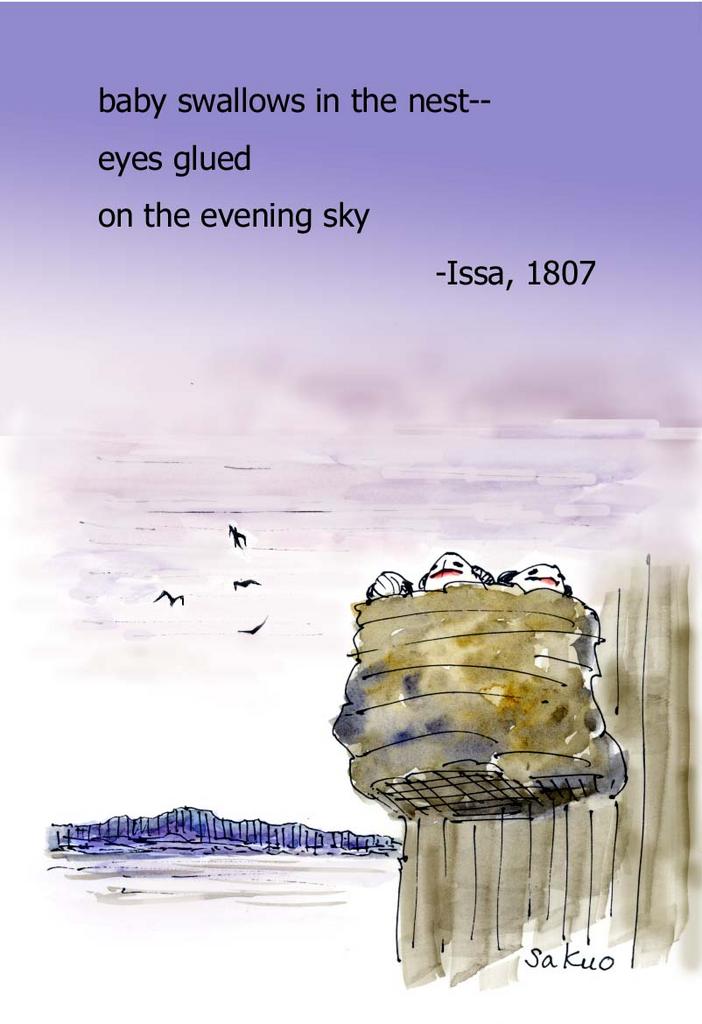
. WKD : Kobayashi Issa 小林一茶 in Edo .
Three more haiku about the swallow by Issa
http://haikuguy.com/issa/advancedsearch.html
© Haiga by Nakamura Sakuo
http://blog.livedoor.jp/sakuo3903/
Another haiku by Issa
いつの間に乙鳥は皆巣立けり
itsu no ma ni tsubakura wa mina su-dachi keri
when did they go?
all the swallows' nests
empty
乙鳥の泥口ぬぐふぼたん哉
tsubakura no doro-guchi nuguu botan kana
the swallow wipes
his muddy mouth...
on the peony
Tr. David Lanoue
乙鳥(つばくら)や人の物いふ上になく
tsubakura ya hito no mono iuu ue ni naku
乙鳥(つばくら)tsubakura, in the dictionary is also read itchoo いっ‐ちょう, otchoo おっ‐ちょう.
tsubame can be written with four different Chinese characters :
燕, 乙鳥, 玄鳥, 天女
They all can give a haiku a slightly different meaning.
:::::::::::::::::::::::::::::::::::::::::::::::::::::::::::::::::::::::::::::::::::::::::::::::::::::
swallow in flight
swooping to take the fly
ripple on the pond
Degasian
http://haiku.cc.ehime-u.ac.jp/~shiki/shiki.archive/html/9908/0610.html
xxxxxxxxxxxxxxxxxxxxxxxxxxxxx

© By Origa, Olga Hooper
xxxxxxxxxxxxxxxxxxxxxxxxxxxxxxxx
hatsu-tsubame ... ... 初燕
yane no kazari ni ... ... 屋根の飾りに
nari ni keri ... ... なりにけり
first swallows -
my roof turned canvas
for modern art
Read the full story with photos by Gabi Greve here
My First Swallow !
xxxxxxxxxxxxxxxxxxxxxxxxxxxxx
> > a straight hit
> > on a bald head -
> > swallow in passing
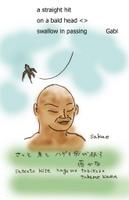
© Haiga by Nakamura Sakuo
ein Volltreffer
auf die Glatze -
Schwalbe im Durchflug
© Haiku by Gabi Greve
*****************************
Related words
***** Swift (Apus apus) Ireland, Europe
:::::::::::::::::::::::::::::::::::::::::::::::::::::::::::::::::::::::::::::::::::::::::::::::::::
BIRD SAIJIKI
[ . BACK to WORLDKIGO . TOP . ]
:::::::::::::::::::::::::::::::::::::::::::::::::::::::::::::::::::::::::::::::::::::::::::::::::::::


 Posts
Posts



17 comments:
Gabi san,
Doumo, arigatou !
it is nice to meet my picture on
the big site as you.
Hot, hot in Tokyo.
sakuo.
I haven’t been able to figure when swallows actually arrive in China or even what variety of swallows appears in China, despite this exhaustive article on swallows published by the amazing Gabi Greve in her compendium of kigo, the seasonal words used in haiku.
You can also find more spring kigo words and my comments on writing seasonal haiku in this newsletter I wrote in April 2005.
Waverly Fitzgerald
.
Here in rainy England the return of the swallows, from their winter vacation in Africa, is THE kigo of summers start in our folk imagination. Also a general kigo of summer - but the start is the key attribute.
THE national kigo of summers start in rainy England!
S.
morning serenity --
day moon on a wire
chirping with swallows
Tomislav Maretić
- - - Kobayashi Issa
Tr. and comment by Chris Drake
子を捨し藪を離れぬ雲雀哉
ko o suteshi yabu o hanarenu hibari kana
staying in the thicket
where they leave their chicks --
skylarks
This hokku is from the 3rd month (April) of 1815, when Issa was back in his home town. It doesn't seem to be about human babies, since ko can refer to the young of many species. Skylark chicks are fed by both parents, so I assume Issa is watching both. He is impressed by the way the parents always keep close to the nest and feed and protect their young until the chicks are able to leave it.
Issa may be envying the chicks, since his mother died when he was very young, and he and his stepmother didn't get along, so his father sent him away to find work in Edo at 14. Two years before this hokku, Issa received his inheritance after a long struggle, but his stepmother remained cold to him.
Chris Drake
巣燕や南宮大社の朱の梁に
sutsubame ya Nanguu Taisha no shu no hari ni
this swallow nest -
in the vermillion beams
of Nangu Grand Shrine
Sunami Eiji 角南英二
MORE about Nangu Taisha
morning yoga -
I balance like this swallow
on the wire
she was hanging onto the wire, in the early morning sun, cleaning her wings and wiggeling so happily.
Looking out of my window, I see into the green valley below, the blue sky above and everything inbetween . . .
Gabi Greve
Matsuo Basho
Hoso Pass 細峠, on the road from Tafu Peak to Ryumon 竜門
雲雀より空にやすらふ峠哉
hibari yori sora ni yasurau tooge kana
higher than the lark
nesting there far in the sky,
Hoso mountain pass
Tr. Chilcott
higher than the lark
I rest in the sky
at this pass . . .
Tr. Gabi Greve
This hokku has the cut marker KANA at the end of line 3.
Basho has climbed quite high and was now resting, enjoying the chirping of the lark below him.
Written in 元禄一年 1688
.
Hasedera
Matsuo Basho
原中やものにもつかず啼く雲雀
haranaka ya mono ni mo tsukazu naku hibari
.
voice of animals
Matsuo Basho
雲雀鳴く中の拍子や雉子の声
hibari naku naka no hyooshi ya kiji no koe
a skylark's singing,
and keeping to its rhythm,
a pheasant's cry
Tr. Barnhill
.
Matsuo Basho
永き日も囀り足らぬひばり哉
nagaki hi mo saezuri taranu hibari kana
all day long
singing and not enough yet -
this lark
Tr. Gabi Greve
Masaoka Shiki
とろとろと左官眠るや燕
torotoro to shakan nemuru ya tsubakurame
soundly, soundly
the plasterer sleeps -
swallows
shakan, the plasterer
Legend from Wakayama
swallow and sparrow
.
https://edoflourishing.blogspot.com/2018/10/ohaguro-haguro-black-teeth.html
.
Legend from Toyama 富山県
婦負郡 / ネイグン Nei gun district
火の用心
If a tsubame ツバメ swallow begins to make a nest under the eaves of the veranda, it is best to be careful of fire.
.
https://heianperiodjapan.blogspot.com/2019/06/hibuse-fire-prevention-legends.html
.
Legend from Aichi
南設楽郡 Minami-Shitara district 長篠村 Nagashino village
aodaishoo, ao daishoo 青大将 Japanese rat snake
Elaphe climacophora
Once a man killed a Japanese rat snake, because it was trying to climb into the nest of a tsubame 燕 swallow. But after that the babies of the swallow did not grow any more.
When he examined the nest, he found many ants trying to eat the baby swallows. The snake had been frigtening the ants away.
.
https://heianperiodjapan.blogspot.com/2019/07/ari-ant-legends.html
.
Tsubakuro-dani つばくろ谷 Tsubakuro valley
Fukushima
and 不動沢滝 Waterfall at Fudosawa / Fudozawa
.
https://fudosama.blogspot.com/2020/02/fudosawa-tsubakurodani.html
.
First swallow in 2025
today
April 12 !!
.
Post a Comment