:::::::::::::::::::::::::::::::::::::::::::::::::::::::::::::::::::::::::::::::::::::::::::::::::::::
Peony (botan)
***** Location: Japan
***** Season: Early Summer and others
***** Category: Plant
*****************************
Explanation
peony, tree peony, botan, bootan
ぼうたん、ぼたん、 牡丹)
Paeonia suffruticosa, Pfingstrose
bootamu ぼうたむ is not used nowadays.
botamu, ぼたむ
It is an old spelling, found by Buson.
shakuyaku 芍薬 (しゃくやく) Shakuyaku peony
"lit. "like a medicine spoon"
Paeonia lactiflora
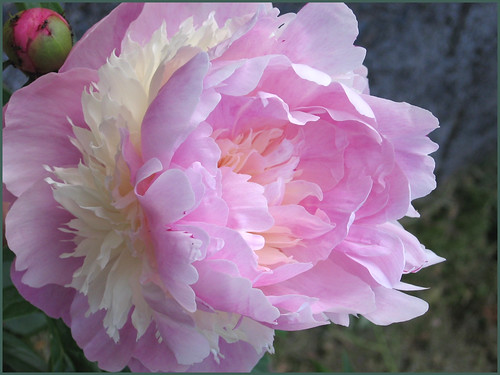
© PHOTO : Gabi Greve, June 2010
white peony, hakubotan 白牡丹
red peony, hi-botan (hibotan) 緋牡丹
peony park, botan-en 牡丹園
Peonies have large, gorgeous flowers, but they last only very short. In haiku, they carry the feeling of permanence and transition, often used as substitute for a beautiful lady.
Their area of origin is North-West China, but they have long been known in Japan. They are also a frequent pattern in Chinese and Japanese art. They were the national flower of T'ang China.
Gabi Greve
Facts in the WIKIPEDIA !
:::::::::::::::::::::::::::::::::::::::::::::::::::::::::::::::::::::::::::::::::::::::::::::::::::::
Famous Peony Parks in Japan are at the temple Hasedera (close to Nara) and the Taimadera.
Hasedera 長谷寺
『立てば芍薬、座れば牡丹、歩く姿は百合の花』
Tateba Shakuyaku
Suwareba Botan Aruku
Sugata wa Yuri no Hana (Otome)
This describes a beautiful woman:
when standing, she is like a a herbaceous peony
(shakuyaku)
when seated, she is like a peony (botan)
when walking, she is like a lily
......................................
Temple Taimadera 当麻寺

*****************************
Worldwide use
Pfingstrose
Noteworthy Characteristics:
The tree peony species is a deciduous, woody shrub that typically grows 3-5' tall with a 4' spread. The true species features large flowers (6-8" across) with pink to white petals, each petal having a purple basal patch. Many cultivars of this species have been developed, with a wide range of petal colors including red, pink, purple, white and yellow. Cultivar flower forms range from single to semi-double to double. Blooms in early spring (May in the St. Louis area). Medium green foliage is deeply divided into oval to lance-shaped leaflets and remains attractive throughout the growing season.
http://www.mobot.org/gardeninghelp/plantfinder/Plant.asp?code=F110
*****************************
Things found on the way

"The Peony Show"
Katsushika Hokusai, about 1799

source : ja.ukiyo-e.org/image
Women Admiring Peonies under a Wisteria Trellis
Hosoda (Chôbunsai) Eishi 細田栄之 (1756-1829)
. Join the Ukiyo-E friends on facebook ! .

..........................................................................
Famous Chinese Opera
"The Peony Pavillion" Botan Tei . . . 牡丹亭
This has been revived in 2008 in a co-performance with Kabuki actor Bando Tamasaburo.
WKD : The Peony Pavillion
*****************************
HAIKU
- - - - - Kobayashi Issa - - - - -
putting up
with my tumble-down house
...peony-
掃人の尻で散たる牡丹かな
haku hito no shiri de chiritaru botan kana
petals scattered
by the sweeper's butt...
peony
Tr. David Lanoue
- - - - -
おのづから頭の下たるぼたん哉
onozukara zu no sagaritaru botan kana
I find myself
bowing to a naturally
bowing peony
Tr. Chris Drake
This apparently gratitude-filled hokku is from the 5th month (June) of 1818, soon after the birth of Issa's daughter Sato, whose death is evoked the next year in Year of My Life. The hokku can be read in two different ways, a complexity that Issa seems to have deliberately put into the hokku in order to suggest that the difference between observer and observed is temporarily displaced if you read the hokku in both ways at (about) the same time. Read literally, the verb sagaritaru, '[head] has dropped down; bowing' in the second line modifies the peony in the last line, creating an image of a peony that faces downward in such a natural way it seems to be respectfully bowing its head in awe or admiration of its surroundings, including people who come near it. As opposed to deliberately bowing or lowering your head, the intransitive verb refers to spontaneous or passively experienced action: you are overwhelmed by respect or admiration and naturally bow your head before you know it in response to this deep feeling.
Onozukara, 'spontaneously, naturally,' intensifies this quality of the verb and is often used together with the verb to describe oneself or others unconsciously and sincerely bowing before Amida or another Buddha. The downward-tilting peony has grown naturally into a very long bow without even knowing it, and in response to this totally sincere and total bowing Issa seems to have discovered himself bowing, too, as if the peony has awakened a very natural part of his mind. Since Japanese often omits explicit subjects of verbs, it's possible to read an implicit subject, such as I, being placed before the beginning of the hokku. In this case, the modifying relationship of the verb to the peony in the last line means something like "the peony which impressed and moved me and unintentionally caused me to find myself unconsciously already bowing to it."
It seems possible that Issa regards this relationship of sudden mutual recognition between different forms of being as a version of "other power" or spontaneous and sincere trust in and reliance on Amida Buddha in all aspects of life that is taught by True Pure Land Buddhism, but there is nothing explicitly about this belief in the hokku.
Chris Drake
. Kobayashi Issa 小林一茶 Issa in Edo .
:::::::::::::::::::::::::::::::::::::::::::::::::::::::::::::::::::::::::::::::::::::::::::::::::::::
. YOSA BUSON 与謝蕪村 (1716 - 1783) .
方八里雨雲よせぬ牡丹かな
ho hachiri amagumo yosenu botan kana
on all sides,
the peony wards off
rain clouds
Tr. Kimiyo Tanaka - shiki
地車のとどろとひびく牡丹かな
jiguruma no todoro to hibiku botan kana
the noisy rumbeling
of festival floats . . .
these peonies
. Jiguruma - festival floats .
the laden wagon runs
bumbling and creaking
down the road
three peonies tremble
source : Peter Beilenson 1955
.................................................................................
牡丹散て打かさなりぬ二三片
botan chirite uchikasanarinu nisanpen
peonies scatter . . .
two or three petals fall
on top of each other
Tr. Gabi Greve
Peony petals fell
Piling one upon another
In twos and threes.
Tr. ?
Peony having scattered
two or three petals lie
on one another.
Tr. ?

source : www.rakanneko.jp/buson074
虹を吐て ひらかんとする 牡丹かな
niji o haite hirakan to suru botan kana
this peony
exhailing a rainbow
while opening up . . .
The cut marker KANA is at the end of line 3.
. Yosa Buson 与謝蕪村 in Edo .
. . . . .
牡丹百二百三百門一つ
botan hyaku nihyaku sambyaku mon hitotsu
one hundred peonies
two hundred, three hundred ...
and only one gate
Awano Seiho 阿波野青畝 (1899-1992)
Maybe he is visiting one of the famous peony temples of Japan.
. WKD : Numbers used in Haiku
:::::::::::::::::::::::::::::::::::::::::::::::::::::::::::::::::::::::::::::::::::::::::::::::::::::

楊貴妃の寝起顔なる牡丹哉
Yooki-Hi no neoki-gao naru botan kana
like the face of Yang Guifei
when she awakens -
this peony
Masaoka Shiki 正岡子規
Tr. Gabi Greve
source : 俳句例句データベース(季語 )
Yang Guifei (Yang Kuifei, Yang Kuei-Fei, Yang Kwei Fei) (719-756) Yookihi
Famous Beauty of Ancient China
Her Lover, Emperor Gensoo, called her face "so beautiful even if she has not slept enough"
寝起きの楊貴妃を「寝たらず」と言った.
Discussion of this Haiku / Translating Haiku Forum
. Princess Yokihi 楊貴妃 .
............................................
sono kuraki yo o shizuka naru botan kana
Kyorai
English is here : Translating Haiku Forum
:::::::::::::::::::::::::::::::::::::::::::::::::::::::::::::::::::::::::::::::::::::::::::::::::::::
near my birthday
the deep magenta
of mother's peonies
Dietmar Tauchner
(GINYU, No.19, July 2003)
xxxxxxxxxxxxxxxxxxxxxxxxxxxxx
Pfingstrosen am Weg –
auf rotem Teppich
zum Geliebten
peonies on the wayside -
on a red carpet
to my lover
(Tr. Gabi Greve)
Roswitha Erler
http://kulturserver-nds.de/home/haiku-dhg/Archiv/Buchbesprechungen/vjs_buch66.html
:::::::::::::::::::::::::::::::::::::::::::::::::::::::::::::::::::::::::::::::::::::::::::::::::::::
In German, the Peonies are called Pfingstrosen, Pfingsten is the name of Pentecost. The following haiku is a play of words in German.
Ach, am Gartenzaun
verblühen die Pfingstrosen
Tage vor dem Fest.
Oh, near the garden fence
the peonies are blooming their last -
days before pentecost
(Tr. Gabi Greve)
Adelheid Treffer
http://www.haiku-heute.de/Galerie/Adelheid_Treffer/body_adelheid_treffer.html
:::::::::::::::::::::::::::::::::::::::::::::::::::::::::::::::::::::::::::::::::::::::::::::::::::::
peonies
in the lattice window
a blaze of colours
Geert Verbeke
http://happyhaiku.blogspot.com/2004/01/friends-geert-verbeke.html
*****************************
Related words
***** Peony in the Cold (kan botan (寒牡丹)
fuyu botan 冬牡丹 (ふゆぼたん) winter peony
kigo for winter
Curtesy to the Japan Times
http://www.japantimes.co.jp/cgi-bin/getarticle.pl5?fe20050120li.htm
冬牡丹千鳥よ雪のほととぎす
fuyu botan chidori yo yuki no hototogisu
. Matsuo Basho 松尾芭蕉 - Archives of the WKD .
. botan kuyoo 牡丹供養(ぼたんくよう) memorial service for peonies
:::::::::::::::::::::::::::::::::::::::::::::::::::::::::::::::::::::::::::::::::::::::::::::::::::::
......... Winter Peony
By LINDA INOKI
(C) All rights reserved

In the stillness,
Between the arrival of guests,
The peonies.
By Buson (1715-83), quoted in "Haiku" by R.H. Blyth (Hokuseido Press)
At this time of year, you wouldn't expect to see peonies in leaf, let alone in bloom. However, the Japanese so loved this plant that they developed the unusual, winter-flowering kanbotan, which literally means "cold peony." Cultivated peonies were introduced to Japan from China in the Nara Period (710-784). The roots provided a valuable herbal medicine for the relief of fever, pain and bleeding. But people also prized the plant for its exquisite blooms, and during the Genroku Era (1688-1703) there was even a "peony boom": One gardening manual listed nearly 500 types of tree peonies.
Peony fanciers competed, trying to grow the most sensational flowers, and townspeople enjoyed gorgeous displays of red, pink, white and yellow blooms in late spring. When someone discovered a remontant, or twice-flowering peony, people could also admire the "king of flowers" in the auspicious New Year season, too. The sight of a peony braving the cold still inspires admiration, and, in Tokyo, the winter peonies at Hamarikyu Garden near Shiodome in Minato Ward are a sight to behold, followed by another fine display there in April and May.
The Japan Times: Jan. 20, 2005
http://www.japantimes.co.jp/cgi-bin/getarticle.pl5?fe20050120li.htm
:::::::::::::::::::::::::::::::::::::::::::::::::::::::::::::::::::::::::::::::::::::::::::::::::::::
The famous Winter Peony Park in Kamakura, Hachiman-Gu
鎌倉の八幡宮、寒牡丹
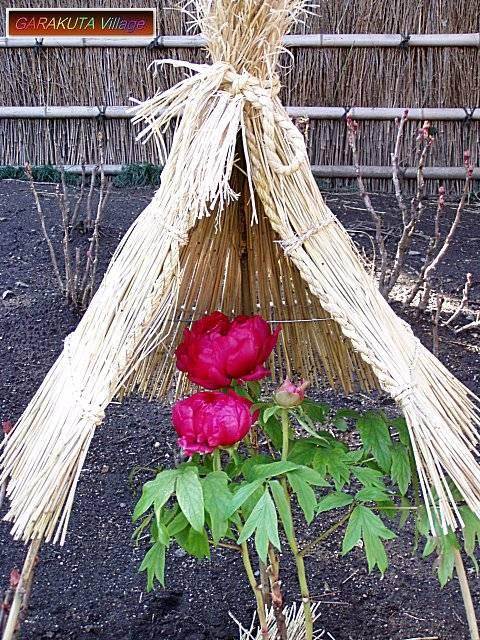
source : isaonaka2.web.infoseek.co.jp

CLICK for more photos !
:::::::::::::::::::::::::::::::::::::::::::::::::::::::::::::::::::::::::::::::::::::

***** Peony Snow, botan-yuki
(botanyuki 牡丹雪)
kigo for winter
Snow falling in huge soft flakes like Peony petals.
:::::::::::::::::::::::::::::::::::::::::::::::::::::::::::::::::::::::::::::::::::::::

***** "Pine-needle Peony", Matsuba Botan
(松葉牡丹), (ポーチュラカ)
kigo for late summer
Rose Moss, Portulaca grandiflora. They flower for a long time and are loved as garden flowers from late summer to autumn.
::::::::::::::::::::::::::::::::::::::::::::::::::::::::::::::::::::::::::::::::::::::::

***** Peony buds, botan no me 牡丹の芽
kigo for early spring
Paeonia suffruticosa
***** botan no newake 牡丹の根分 (ぼたんのねわけ) dividing the roots of peonies
kigo for mid-autumn
:::::::::::::::::::::::::::::::::::::::::::::::::::::::::::::::::::::::::::::::::::::::::::::::::::::
***** "Peony Stew", wild boar stew,
botan nabe 牡丹鍋
kigo for winter

Peony here is used for the meat of the wild boar, arranged in a way it looks like the red and white petals of a peony. This is a dish we can enjoy only in the winter season. It warms body and soul and is very popular in the mountainous areas on a cold evening.
botan nabe - yutaka na mori no megumi kana
.
botan nabe - hatake arashi no batsu no kana
.
wild boar stew -
the fertile woods bestowing
delicious benefits
.
wild boar stew -
devastating the fields
you end up here!
Gabi Greve, 2004
http://groups.yahoo.com/group/happyhaiku/message/775
.................................................................................
杉山の墨絵ぼかしに牡丹鍋
sugiyama no sumi-e bokashi ni botan nabe
the ink painting
of a cedar forest in all gradations -
wild boar stew
Kiuchi Shooshi 木内彰志 Kiuchi Shoshi
(1935 - 2006)
. Sumie paintings and Haiku .
:::::::::::::::::::::::::::::::::::::::::::::::::::::::::::::::::::::::::::::::::::::::::::::::::::::
***** nobotan 野牡丹 (のぼたん) "wild peony"
hime nobotan 姫野牡丹(ひめのぼたん)
kusa nobotan 草野牡丹(くさのぼたん)
ノボタン - Melastoma candidum
kigo for late summer
:::::::::::::::::::::::::::::::::::::::::::::::::::::::::::::::::::::::::::::::::::::::::::::::::::::
***** kusa botan 草牡丹 (くさぼたん) Clematis stans
kigo for ealry autumn
:::::::::::::::::::::::::::::::::::::::::::::::::::::::::::::::::::::::::::::::::::::::::::::::::::::
Clematis クレマチス (kuremachisu)
is a genus of about 300 species within the buttercup family Ranunculaceae. Their garden hybrids have been popular among gardeners, beginning with Clematis jackmanii, a garden standby since 1862; more hybrid cultivars are being produced constantly.
They are mainly of Chinese and Japanese origin.
Most species are known as clematis in English, while some are also known as traveller's joy, a name invented for the sole British native, C. vitalba, by the herbalist John Gerard; virgin's bower for C. viticella; old man's beard, applied to several with prominent seedheads; and leather flower or vase vine for the North American Clematis viorna.
The genus name is from Ancient Greek clématis, a climbing plant, most probably a periwinkle. There are approximately over two hundred and fifty species and cultivars, often named for their originators or particular characteristics.
© More in the WIKIPEDIA !

your picture -
the heady fragrance
of clematis
- Shared by Rosie Mann -
Joys of Japan, 2012
:::::::::::::::::::::::::::::::::::::::::::::::::::::::::::::::::::::::::::::::::::::::::::::::::::::
. kani botan, kani-botan 蟹牡丹 crab and peony
- kamon 家紋 crest patterns .
[ . BACK to DARUMA MUSEUM TOP . ]
[ . BACK to WORLDKIGO . TOP . ]
:::::::::::::::::::::::::::::::::::::::::::::::::::::::::::::::::::::::::::::::::::::::::::::::::::::


 Posts
Posts




14 comments:
The peony does not normally grow in Kenya.
However, Karen Blixen, in her famous book "Out of Africa" tells the story (if I remember it well) that, when she moved from Denmark to Kenya, she took a peony tuber with her and planted it, hoping against hope that it would take. With a lot of care and daily attention, take it did, and after a while, a beautiful flower formed. Karen Blixen cut the flower and enjoyed it in her house for many days. But the plant withered and failed and never produced another flower. It was only later that an expert told her that the first flower of a peony plant must on no account be cut -- indeed, such cutting would end the life of the plant... Karen Blixen, in cutting the flower, had destroyed her own most cherished peony!
I know Karen Blixen's garden well, it is one of my favourite haunts in Nairobi. And when I sit there and reflect, the peony often comes to mind.
Kazuri Beads, a wonderful women's business very close to Karen Blixen's old farm house :
http://news.bbc.co.uk/1/hi/world/africa/801602.stm
The women have even created a bead called "peony" in her honour :
http://store1.yimg.com/I/gmpcatalog_1901_1941855
http://www.globalmarketcatalog.com/peony.html
Still, the peony is no kigo in Kenya...
Isabelle Prondzynski.
Read more about Karen Blixen and the Peony Beads
The Kenya Saijiki
:::::::::::::::::::::::::::::::::::::::::::::::::::::::::::::::::::::::::::::::::::::::::::::::::::::
Here are a few excerpts from the section on peonies, with commentary by R.H. Blyth:
* *
The peonies do not allow
The rain-clouds a hundred leagues round
To approach them.
Buson
This is a fancy, but there is so much imagination put into it that it expresses a truth which the fancy disengages from the mere scientific fact. That is to say, the rain-clouds and the peonies are not connected, ‘really,’ as we say. The fancy supposes that the peonies have the power to prevent the rain-clouds from approaching.
The imagination, seizing on the colour and size of the peonies with the utmost violence, and regarding with defiant eye the encircling banks of thunder clouds piled up on the horizon, perceives that the peonies and the clouds are connected in some mysterious way; that they stand opposed as enemies.
* * *
The stamens and pistil
Of the peony gush out
Into the sunlight.
Taigi
From the pale red petal of the (herbaceous) peony the golden stamens and pistil burst out into the bright sunlight. In this verse we are made to feel a power and glory of the peony which has no reference to that of man.
* * *
The garden is dark
In the night, and quiet
The peony.
Buson
In the original, ‘night’ is put in the objective case with wo, and this faintly suggests a causal relation of quietness between the peony and the night.
* * *
Dusk on the flower
Of the white peony,
That embraces the moon.
Gyodai
The whiteness of the flower seems to draw to itself all the pallor of the moon.
* * *
To the candle,
The peony
Is as still as death.
Kyoruku
The candle burns motionless; its soul of fire does not quiver. The peony, too, not to be outdone, glows immovable, overpowering the candle with its fervent blooming. They are as quiet as the grave, in their burning life.
Quoted from here:
http://knitandcontemplation.typepad.com/spiritual_genealogy/poetry/index.html
:::::::::::::::::::::::::::::::::::
:::::::::::::::::::::::::::::::::::
Kyoroku and the scent of the peony:
http://groups.yahoo.com/group/translatinghaiku/message/948
a bouquet
of home-grown peonies
on my table
my husband's letters
to his mistress
This turned into a tanka all by itself, so to speak ...
'Quiet as the grave in their burning life' -- can that not be said of all that bloom?
short and fierce
this life with you
flaming peony
Tried to post this at the other link you gave, but that was for members only. No problem, here they are ...
meeting
at the peony pavilion
the day moon and I
wearing masks
at the kabuki theatre
two butterflies
:>) Ella
.
Mizubotan, "Water Peony" a sweet for the Tea Ceremony !
Matsuo Basho -
牡丹蘂深く分出る蜂の名残哉
牡丹蘂 ふかく分出る蜂の名残哉
botan shibe fukaku wake-izuru hachi no nagori kana
From deep within
the peony pistils, withdrawing
regretfully, the bee.
Tr. Shirane
(I have stayed at your home and received such friendly welcome, like a bee filled with good honey from the peony, now taking my leave with great regret and wonderful memories.)
Basho compares Toyo with a peony and himself with a bee.
This hokku has the cut marker KANA at the end of line 3.
.
- Hayashi Tooyoo 桐葉 Hayashi Toyo -
Matsuo Basho
風月の財も離れよ深見艸
fuugetsu no sai mo hanareyo fukami-gusa
fūgetsu no zai mo hanareyo fukamigusa
going beyond even
the art of wind and moon:
peony blossoms
Tr. Barnhill
Written in summer of 1693 元禄6年
zai, sai 財 refers to sainoo 才能 talent, gift for, ability to do well
fukamigusa 深見艸 is another name for botan, peony.
Matsuo Basho
風月の財も離れよ深見艸
fuugetsu no sai mo hanareyo fukami-gusa
fūgetsu no zai mo hanareyo fukamigusa
going beyond even
the art of wind and moon:
peony blossoms
Tr. Barnhill
Written in summer of 1693 元禄6年
zai, sai 財 refers to sainoo 才能 talent, gift for, ability to do well
fukamigusa 深見艸 is another name for botan, peony.
.
冬牡丹格子戸暗き民芸館
fuyu botan kooshido kuraki mingeikan
winter peonies -
the dark lattice door
of the Folk Art Museum
Endoo Hiroshi 遠藤比呂志 Endo Hiroshi
Mingeikan
Kobayashi Issa
草庵にほぼつり合ぬぼたん哉
sooan ni hobo tsuriawanu botan kana
these peonies
almost a total mismatch
with my plain house
猫の狂ひが相応のぼたん哉
neko no kurui ga soooo no botan kana
these peonies
twist and turn as often
as a crazy cat
These two closely related hokku are found in this order in Issa's diary for the summer (no months given) of 1824, the year after his wife's death and around the time he remarried, this time with a woman with whom he had little compatibility. The woman, the daughter of a samurai, almost immediately divorced Issa.
These two hokku may be indirect references to his new wife, since they are both about incompatibility, and peonies, originally imported from China in the late ancient period, had an exotic beauty that was often associated with women in Issa's age.
In any case, Issa now seems to feel it was a mistake to grow these large, bright, lush bush flowers near his old farm-style thatched house, since their color and wildly curving petal-edges don't go with his weather-beaten, utilitarian, and wifeless(?) house.
Since there is no personal pronoun in the hokku, it's also possible to read Issa as talking about thatched farmhouses in general and thereby suggesting a reason for not planting them in his yard, but since "grass-thatched hut" is a humble word, it seems likely that Issa is referring to his own thatched house here. The meter of the second hokku is a fairly unusual 7-5-5 -- a meter often used in Kabuki and puppet drama. Perhaps Issa is trying to perform a couple of the flamboyant bends and curves of a peony petal with his meter.
Chris Drake
Tookaichi tsuchi ningyoo 十日市土人形 clay dolls from Tokaichi
botan mochi musume 牡丹持ち娘 girl carrying a peony
.
https://omamorifromjapan.blogspot.jp/2011/07/hiroshima-folk-toys.html
.
Tokyo Botan 牡丹 Botan district
牡丹一丁目 - 三丁目 first to third district
Koto ward
.
https://edoflourishing.blogspot.com/2020/09/koto-ward-districts.html
.
Post a Comment