. kiku 菊と伝説 Legends about chrysanthemum .
:::::::::::::::::::::::::::::::::::::::::::::::::::::::::::::::::::::::::::::::::::::::::::::::::::::
Chrysanthemum (kiku)
***** Location: Japan
***** Season: All Autumn and others, see below
***** Category: Plant
*****************************
Explanation

by Ogata Gekko - Viewing Chrysanthemums
Many Japanese kigo in connection with Chrysanthemums:
hatsugiku 初菊(はつぎく)first chrysanthemum
white chrysanthemum, shiragiku 白菊
yellow chrysanthemum, kigiku 黄菊
fine weather to enjoy chrysanthemums, kikubiyori 菊日和
crowded chrysanthemums, rangiku 乱菊
home full of chrysanthemums, kiku no yado 菊の宿
time for the chrysanthemums, kikudoki 菊時
park with chrysanthemums, sono no kiku 園の菊(そののきく)
friends enjoying chrysanthemums, kiku no tomo 菊の友(きくのとも)
owner of chrysanthemums, kiku no aruji 菊の主(きくのあるじ)
dew on chrysanthemums, kiku no tsuyu 菊の露
- chrysanthemum dew
Chiyomigusa 千代見草 ("live to see 1000 generations")
Manjuugiku 万寿喜久 (Long Life Chrysanthemum)
Kisewata 着せ綿 ("under the cotton blanket")
Koganegusa 黄金草(こがねぐさ)"golden plant"
Yowaigusa 齢草(よわいぐさ)
Shimomigusa 霜見草(しもみぐさ)"plant seeing frost"
..... Hatsumigusa 初見草(はつみぐさ)
kogiku 小菊(こぎく) small chrysanthemum
kiku dairin 菊大輪(きくたいりん)large round chrysanthemum
magaki no kiku 籬の菊(まがきのきく)rough fence with chrysanthemums
kikubatake 菊畑(きくばたけ)field with chrysanthemums
hyakujgiku 百菊(ひゃくぎく)
"one hundred different types of chrysanthemums"

source : facebook
If you look closely, there is only one stem and more than 100 different flowers from the many branches. IT was quite an art to prepare this "tree".
. . . . .
kigo for late autumn
zangiku 残菊 (ざんぎく) remaining chrysanthemum
..... nokoru kiku 残る菊(のこるきく)
..... kiku nokoru 菊残る(きくのこる)
bangiku 晩菊 (ばんぎく) late blooming chrysanthemum
observance kigo for late autumn
kiku kuyoo 菊供養 (きくくよう) memorial ritual for chrysanthemums
18th of October
At the Asakusa Temple in Tokyo.
People by the chrysanthemums offered at stalls and persent them on the altar as an offering to the Kannon deity. Then they take a flower which had been offered by someone else and take it home. This is their amulet for warding off evil influence in the coming year.
. Asakusa Kannon 浅草観音 Tokyo .
:::::::::::::::::::::::::::::::::::::::::::::::::::::::::::::::::::::::::::::::::::::::::::::::::::::
observance kigo for mid-autumn
sometimes placed as late autumn of the new calendar.
chrysanthemum festival 菊の節句 (きくのせっく) kiku no sekku
September 9, the ninth day of the ninth lunar month
. chooyoo 重陽 (ちょうよう) chrysanthemum festival, double nine festival
Chrysanthemen-Fest
Observance kigo for late autumn

Chrysanthemum-Dolls 菊人形 kiku-ningyoo
They are displayed in many temple grounds and prizes are given for the most beautiful ones.
. . . CLICK here for more Photos !
悪役の菊人形がよく匂ふ
akuyaku no kiku ningyoo ga yoku niou
a chrysanthemum doll
playing the bad guy
smells strong
Tr. Fay Aoyagi
Kanno Tadao 菅野忠夫
. Daruma as Chrysanthemum Doll
:::::::::::::::::::::::::::::::::::::::::::::::::::::::::::::::::::::::::::::::::::::::::::::::::::::
plant kigo for all winter
karegiku 枯れ菊 . 枯菊 (かれぎく) withered chrysanthemum
kiku karu 菊枯る (きくかる) chrysanthemums wither
..... kiku karuru 菊枯るる(きくかるる)
kare nokoru kiku 枯残る菊(かれのこるきく)withered chrysanthemums left
itegiku 凍菊(いてぎく) chrysanthemum in the cold
kangiku 寒菊 (かんぎく) chrysanthemum in the cold
shimo no kiku 霜の菊(しものきく) chrysanthemum in frost
fuyugiku 冬菊 ふゆぎく winter chrysanthemum
.... fuyu no kiku 冬の菊(ふゆのきく)
other names for the chrysanthemum in winter
hatsumigusa 初見草(はつみぐさ)"plant first seen"
shimomigusa 霜見草(しもみぐさ)"frost viewing plant"
yukimigusa 雪見草(ゆきみぐさ)"snow viewing plant"
akinakgusa 秋無草(あきなぐさ)"plant without autumn"
nokorigusa のこり草(のころぐさ)"left over plant"
寒菊や醴造る窓の前
kangiku ya amazake tsukuru mado no saki
寒菊や粉糠のかかる臼の端
kangiku ya ko nuka no kakaru usu no hata
. Matsuo Basho 松尾芭蕉 - Archives of the WKD .
.................................................................................
plant kigo for mid-winter
kiku no toojime 菊の冬至芽(きくのとうじめ)
chrysanthemum budding at the winter solstice
:::::::::::::::::::::::::::::::::::::::::::::::::::::::::::::::::::::::::::::::::::::::::::::::::::::

by Tsuchiya Koitsu
:::::::::::::::::::::::::::::::::::::::::::::::::::::::::::::::::::::::::::::::::::::::::::::::::::::
Chrysanthemums have been cultivated in Japan since the Nara period. At the Heian court, Chrysanthemum shows and poetry assemblies were very popular.
Chrysanthemums became the symbol of the imperial family of Japan at the time of Emperor Gotoba 後鳥羽 (1180-1239), who loved this flower very much.

As a symbol for long life, the chrysanthemum was already popular in ancient China. Together with Buddhism and other cultural topics the flowers were brought back to Japan by the ambassadors to China (kenzuishi, kentooshi, see below).
To collect the dew on the chrysanthemum petals and drink it would bring you long life (chooju 長寿). The Flower Festival on the 9th of September is also one to celebrate one's wish for longevity 不老長寿.
As an auspicious symbol of long life (kisshoo monyoo 吉祥文様) the chrysanthemum was used for many decoration, on embroydered kimono and as sweets (wagashi).
The Chinese boy Kikujidoo 菊慈童 (きくじどう)drank the dew of the chrysanthemum and lived to gain immortality without ageing, or rather to the ripe age of 800 years. This legend was later incorporated into a famous Noh drama.
To grow big chrysanthemums for the autumn exhibitions is rather difficult. You have to care for the flower in special ways.
Look at : Big Round Heads, atsumono 厚物
They are said to imitate the Buddhist symbol of a wishfulfilling jewel (hooju 宝珠).
Three flowers from one stem are called "sanbon jitate 三本仕立". They represent Heaven, Earth and Man (ten chi jin 天地人). This is a symbol for "all things shinra banshoo 森羅万象", the cosmos, nature and human society.

Another type looks like "hanging from a cliff", kengaigiku 懸崖菊
(click for some photos) .
kigo for late autumn
Here are some photos from "one thousand flowers from one stem "one thousand flowers from one stem" senrinsaki 千輪咲き .
Chrysanthemums start to flower after the autumn solstice. They need long hours of darkness, before they start producing their buds. They flower long into winter and enchant us with their manyfold colors and forms.
. kikuzuki 菊月(きくづき)chrysanthemum month
... kikuzakizuki 菊咲月(きくざきづき)
kiku no aki 菊の秋(きくのあき)autumn with chrysanthemums
kiku makura 菊枕 (きくまくら) "chrysanthemum pillow"
Gabi Greve
:::::::::::::::::::::::::::::::::::::::::::::::::::::::::::::::::::::::::::::::::::::::::::::::::::::

purple chrysanthemums, murasaki mum
murasakigiku 紫菊
In memory of the Tale of Genji by Murasaki Shikibu.
. The Tale of Genji, Genji Monogatari ... and haiku
*****************************
Worldwide use
Romania
Crizanteme
The floral autumn kigo par excellence.
the chrysanthemums—
left alone under the clouds
withstanding the wind
the owner is late
three chrysanthemums are left
on the piano
she will catch a cold:
watching the chrysanthemums
she forgot her coat
Cristian Mocanu
Romanian Saijiki
:::::::::::::::::::::::::::::::::::::::::::::::::::::::::::::::::::::::::::::::::::::::::::::::::::::
the butterfly grown old,
its spirit plays
with the chrysanthemums
Seifu Enomoto
*****************************
Things found on the way
Sweets and the Chrysanthemum, the Culture of Kyoto
Manjuugiku and then Chiyomigusa, another name for the Chrysanthemum with the wish for a long life, is also the name of a small sweet Japanese cake made by in Kyoto.

"Under the cotton blanket", kisewata 着せ綿, reminds of a custom in the Heian period to put a cotton blanket over the flowers at night and then wipe their own body with this in hope to gain longevity.
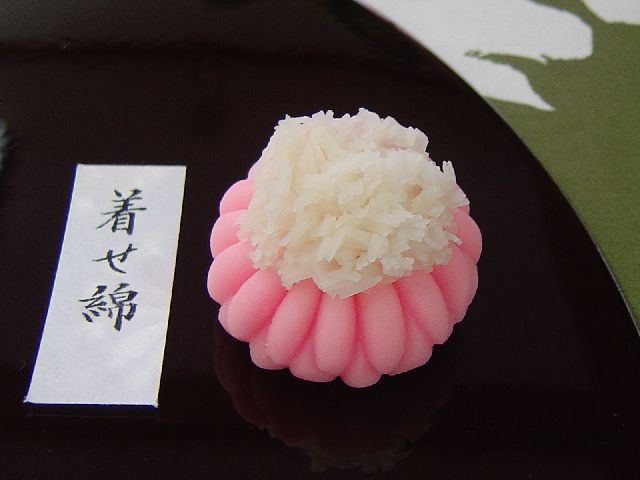
www.kaho-fukuoka.co.jp/image/2004-10/kisewata.jpg
This is a cake in honor of the "Chinese Chrysanthemum Boy (kiku jidoo)"
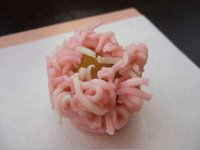
Photo of the Manjuugiku sweet cake for Long Life
Click HERE to look at more sweet cakes with chrysanthemums !
xxxxxxxxxxxxxxxxxxxxxxxxxxxxxxxxxx
chrysanthemum:
the last-ing taste of
blowfish flesh
Chibi
Chibi is referring to Fugu, a poisonous fish prepared in this manner:

http://www.daifuku.net/ft-02.html
:::::::::::::::::::::::::::::::::::::::::::::::::::::::::::::::::::::::::::::::::::::::::::::::::::::
isogiku いそぎく(磯菊) silver and gold chrysanthemum
a wild kind. Ajania pacifica, chrysanthemum pacificum.
. . . CLICK here for Photos !
磯菊に林檎を乗せるあぶない夜
isogiku ni ringoo o nosete abunai yo
placing an apple
on the isogiku chrysanthemum ...
a dangerous night
Noraneko
Tr. Gabi Greve
*****************************
HAIKU
- - - - - Matsuo Basho 松尾芭蕉
朝茶飲む僧静かなり菊の花
asacha nomu soo shizuka nari kiku no hana
drinking morning tea
the monk becomes peaceful -
chrysanthemum flowers
Tr. Gabi Greve
A monk sips morning tea,
It's quiet,
the chrysanthemum's flowering.
Tr. Hass
At temple Soozuiji 祥端寺, Katada 堅田, Otsu town 大津市
. . . CLICK here for Photos of the stone memorial !
菊の香や庭に切れたる履の底
kiku no ka ya niwa ni kiretaru kutsu no soko
chrysanthemum fragrance—
in the garden, the sole
of a worn-out sandal
Tr. Addiss
元禄6年10月9日 - 1693, October 9
This is just one month after the famous Chrysanthemum Festival.
Basho and his disciples had a late celebration at the home of Yamaguchi Sodoo 山口素堂 Yamaguchi Sodo. They saw the sole of a straw sandal with a broken thong.
They seemed to enjoy the contrast of the elegance of the Chrysanthemum festival with the lost sandal in the garden.
Chrysanthemum Haiku by
. Matsuo Basho 松尾芭蕉 - Archives of the WKD .
:::::::::::::::::::::::::::::::::::::::::::::::::::::::::::::::::::::::::::::::::::::::::::::::::::::::
- Yosa Buson 与謝蕪村 Translations at terebess
asamashiki momo no ochiba ya kikubatake
kangiku ya hi no teru mura no katahotori (1768)
kangiku ya itsu o sakari no tsubomigachi (1768)
kiku no ka ya tsukisumi shimo no keburu yo ni (1776)
. kiku no tsuyu ukete suzuri no inochi kana .
(autumn) chrysanthemum. dew. ink stone
kikutsukuri nanj iwa kiku no yakko naru (1774)
kiku wa ki ni ame orosokani ochiba kana (1777)
mura hyakko kiku naki kado mo mienu kana
shiragiku ni shibashi tayutau hasami kana
shiragiku ya hana ichirin to yubekari
shiragiku ya niwa ni amarite hatake made
. Yosa Buson 与謝蕪村 in Edo .
:::::::::::::::::::::::::::::::::::::::::::::::::::::::::::::::::::::::::::::::::::::::::::::::::::::::
. Kobayashi Issa 小林一茶 in Edo - Chrysanthemum .
With translations and comment by Chris Drake
大名を味方にもつやきくの花
daimyoo o mikata ni motsu ya kiku no hana
薮原や何の因果で残る菊
yabuhara ya nan no inga de nokoru kiku
and more

:::::::::::::::::::::::::::::::::::::::::::::::::::::::::::::::::::::::::::::::::::::::::::::::::::::
酒臭き黄昏ごろや菊の花
sake kusaki tasogare goro ya kiku no hana
the smell of sake
around about dusk...
chrysanthemum
The Chrysanthemum had special importance to Issa, especially after his 1814 marriage to Kiku, who was named after this flower.
ISSA - Translations by David Lanoue
There are 44 haiku on this ISSA link:
- source : haikuguy.com
:::::::::::::::::::::::::::::::::::::::::::::::::::::::::::::::::::::::::::::::::::::::::::::::::::::
ものいはず客と亭主と白菊と
mono iwazu kyaku to teishu to shiragiku to
nobody talks -
guests and host and
a white chrysanthemum
niemand spricht -
Gaeste und Hausherr und
eine weisse Chrysantheme
Oshima Ryota 大島蓼太
September 9. 1718-1787
Discussing the various translations
Haiku Forum
:::::::::::::::::::::::::::::::::::::::::::::::::::::::::::::::::::::::::::::::::::::::::::::::::::::
残菊の黄をとじこめし氷かな
zangiku no ki o tojikomeshi koori kana
the yellow
of late chrysanthemums all locked up
in ice
Tsuji Momoko 辻桃子
:::::::::::::::::::::::::::::::::::::::::::::::::::::::::::::::::::::::::::::::::::::::::::::::::::::
A wren drinks
from white chrysanthemums -
morning fog
Zhanna P. Rader
:::::::::::::::::::::::::::::::::::::::::::::::::::::::::::::::::::::::::::::::::::::::::::::::::::::
chrysanthemums
her cold wedding ring
in his pocket
Petar Tchouhov, Bulgaria, 2007
Origa writes
A poignant and haunting moment of high significance.The direct yet suggestive picture painted in this haiku shows in a symbolic meaning an ambient harmony of the wedding ring and the seasonal flowers offered to the dead wife. In many countries in Europe, chrysanthemums are the flowers for the dead, they are often seen in cemeteries. Chrysanthemum is also a symbol of longevity in Japan, and as such, in this haiku they suggest that the death/departure survived by a long lasting love and memory of the husband/widower.
Multilayered, skillfully composed, "classic" haiku, with obvious relations to the theme and dedication of this contest -- and needless to say, with such an immediate striking effect on the readers. I would suggest (and I kept it in mind while translating) ellipses at the end of L1, both in English and in Russian versions: it will reinforce the effect of the last departure painted by words in this haiku. Bravo, Petar!
RESULTS of the Sixth Calico Cat haiku contest.
Read more Chrysanthemum haiku from the contest HERE
Origa (Olga Hooper) 2007
:::::::::::::::::::::::::::::::::::::::::::::::::::::::::::::::::::::::::::::::::::::::::::::::::::::
sunshine -
in grandmother's window
a chrysanthemum
Alex Serban, Romania
*****************************
Related words
..... Wild Chrysanthemum (nogiku 野菊
婦人会 皆花の咲く 野菊かな
all so active
in the Village Ladies Club -
wild chrysanthemum
Look at the phots by Gabi Greve, September 2006
:::::::::::::::::::::::::::::::::::::::::::::::::::::::::::::::::::::::::::::::::::::::::::::::::::::
***** Spring Chrysanthemum
shungiku 春菊 (しゅんぎく )
leaves of chrysanthemum, kikuna 菊菜(きくな)
..... shingiku しんぎく
Shungiku is often used as food. See WASHOKU SAIJIKI.
seedlings of the chrysanthemum, kiku no nae
菊の苗 (きくのなえ)
kigo for late spring
buds of chrysanthemum, kiku no me 菊の芽(きくのめ)
fresh green of chrysanthemums, kiku no wakaba
菊の若葉 (きくのわかば)
hinagiku 雛菊 (ひなぎ) English daisy
:::::::::::::::::::::::::::::::::::::::::::::::::::::::::::::::::::::::::::::::::::::::::::::::::::::
***** Summer Chrysanthemum
(natsu no kiku, natsugiku 夏菊)
kigo for all summer
Some early blooming types, with white or yellow flowers.
Haiku
夏菊やかるき昼餉の手打そば.. .. ..
natsugiku ya karuki hirumeshi no te-uchi soba
summer chrysanthemums -
for a light lunch
handmade buckwheat noodles
(Tr. Gabi Greve)
Usui Musoko (臼井無窓子)
http://www5.ocn.ne.jp/~turu/kukai/g_200407.html
.................................................................................
kigo for early summer
matsubagiku 松葉菊 (まつばぎく) "pine needle chrysanthemum
sabotengiku 仙人掌菊(さぼてんぎく)
Lampranthus spectabilis
yagurumasoo 矢車草 (やぐるまそう) "windmill plant"
yagurumagiku 矢車菊(やぐるまぎく) Rodgersia podophylla
.................................................................................
kigo for mid-summer
jochuugiku 除虫菊 (じょちゅうぎく) nsect powder chrysanthemum
Chrysanthemum cinerariaefolium
.................................................................................
kigo for late summer
Ezogiku 蝦夷菊 (えぞぎく) chrysanthemum from Ezo (Hokkaido
..... ezogiku 晩夏 翠菊(えぞぎく)
asutaa アスター China Aster
Callistephus chinensis
kinkeigiku 錦鶏菊 (きんけいぎく) golden wave
Coreopsis drummondii
:::::::::::::::::::::::::::::::::::::::::::::::::::::::::::::::::::::::::::::::::::::::::::::::::::::
Reference:
Japanese Historic Embassies to China : Kentooshi 遣唐使
by Gabi Greve
Noh Drama of the Chrysanthemum Boy, Photo
:::::::::::::::::::::::::::::::::::::::::::::::::::::::::::::::::::::::::::::::::::::::::::::::::::::
. PLANTS in all seasons - SAIJIKI
WASHOKU ... Japanese Food SAIJIKI
. kiku 菊と伝説 Legends about chrysanthemum .
[ . BACK to WORLDKIGO . TOP . ]
:::::::::::::::::::::::::::::::::::::::::::::::::::::::::::::::::::::::::::::::::::::::::::::::::::::


 Posts
Posts




35 comments:
Kigo is very useful and convenient for creating a sense of place (where) and time (when).
For example, take "chrysanthemum," which is kigo. "Chrysanthemum" definitely shows a season of autumn. It displays clearly - this is autumn; the time. In the saijiki, "chrysanthemum" belongs to autumn. So you can instantly establish the time, "autumn," and also image a place where chrysanthemum is in bloom, for example, a house garden or a garden party. So, chrysanthemum reveals "place" as well. We can say that a kigo is just one word - but this one word can speak volumes.
. Read an interesting interview with
Hoshinaga Fumio .
::::::::::::::::::::::::::::::::::::::::::::::::::::::::::::::::::::::
Chrysanthemum
on the mossy roof
deeply rooted
R.K.SINGH
Dhanbad, India
aritake no
kiku nageire yo
kan no naka
Natsume Soseki
All the chrysanthemums that there are; lay them in the coffin.
Read a discussion by Hugh Bygott.
http://groups.yahoo.com/group/translatinghaiku/
Message Nr. 561
::::::::::::::::::::::::::::::::::::::::::::::::::::::::::::::::::::::
chrysanthemum
the wasteland of CNN
is nothing
chrysanthemum garden--
they walk with little
sake cups
kiku-zono ya aruki nagara no ko sakazuki
菊園や歩きながらの小盃
by Issa, 1819
Tr. David Lanoue
http://cat.xula.edu/issa/
the smell of piss
wafting too...
chrysanthemums
shooben no ka mo kayoi keri kiku no hana
小便の香も通ひけり菊の花
by Issa, 1814
Tr. David Lanoue, http://cat.xula.edu/issa/
.
Orange eyes reflect
an autumn-alien Soul—
chrysanthemum blooms....
Michael R. Collings, USA
Tao Yuanming
To Enmei, Chinese poet 365 - 427
陶淵明(とうえんめい )
Chinese poet who loved Chrysanthemums !
mountain chrysanthemum--
growing crooked's a thing
it knows nothing about
yama no kiku magaru nando wa shiranu nari
.山の菊曲るなんどはしらぬ也
by Issa, 1820
R. H. Blyth omments,
"Chrysanthemum plants are artificially forced into all kinds of shapes. They are straight and upright by nature, like nature"; A History of Haiku (Tokyo: Hokuseido, 1964) 1.384.
Kerashi indicates that an action occurred in the past, the equivalent of keri; Kogo dai jiten (Shogakukan 1983) 573.
Tr. David Lanoue
http://cat.xula.edu/issa/
菊の花咲くや石屋の石の間
kiku no hana
saku ya ishiya no
ishi no ai
chrysanthemum flowers
are blossoming - amongst the stones
of a stonemason's
Matsuo Basho
More about this haiku :
so many fingers
stretching to the light -
My Pink Lady
Look at her HERE
http://happyhaiku.blogspot.jp/2012/10/pink-chrysanthemum.html
The Chrysanthemum in Japanese Design:
121 Patterns and Motifs
Imported from China during the 8th century, the chrysanthemum is the official flower of Japan and the exquisite blossom is widely revered as a symbol of longevity, dignity, and nobility. This volume, reproduced from a rare and expensive publication, features more than 120 lovely color woodblock images of the perennials.
Reprint of the two-volume set Kiku Hyakushu, Uchida Bijutsu Shoshi, Kyoto, 1936.
.
http://store.doverpublications.com/0486498522.html
- Yamaguchi Sodoo 山口素堂 Yamaguchi Sodo -
1642 - 1716.
Matsuo Basho
いざよひのいずれか今朝に残る菊
izayoi no izure ka kesa ni nokoru kiku
izayoi is a word usually used for the moon on then next best day, but here Basho uses it for the next best day to view chrysanthemums. The best day for the chrysanthemums is the ninth day (of the ninth lunar month).
MORE about izayoi
http://matsuobasho-wkd.blogspot.jp/2012/07/izayoi-moon.html
大島蓼太 Oshima Ryota -
享保三年 (1718) ~天明七年(1787)
Yosa Buson
菊の露受けて硯の命かな
kiku no tsuyu ukete suzuri no inochi kana
the dew from chrysanthemums
is the life blood
of this ink stone . .
MORE about ink stones
残菊を折れば祖霊の声すなり
zangiku o oreba sojin no koe sunari
breaking a late chrysanthemum
I hear the voice
of the ancestor spirits . . .
Hata Yumi 秦夕美
MORE
about ancestor spirits
Kobayashi Issa
縁の猫勿体顔や菊の花
en no neko mottaigao ya kiku no hana
porch cat's face sez
chrysanthemum-viewing
by invitation only
This autumn hokku is from the 9th month (October) of 1820, when Issa was living in his hometown. Some probably potted chrysanthemums (or perhaps only one) stand on or near the low, narrow wooden porch just outside a room. The wall between the room and the porch consists mainly of sliding doors, which seem to be open now. The cat has positioned itself just right to be the viewer in chief.
Chris Drake
.
Kobayashi Issa
大名を味方にもつやきくの花
daimyoo o mikata ni motsu ya kiku no hana
it has the backing
of a powerful lord --
a chrysanthemum
Tr. Chris Drake
comments
winter afternoon-
multi hued Chrysanth pompoms
nod in the breeze
Angelee Deodhar, India
Chrysanthemums Show
Venue: Terraced Garden (Sector 33) December 9th ,2013
Chrysanthemums Show in Chandigarh, India is a very famous flower show that is hosted every year at the Terraced garden in Sector 33. This fair is usually held in the month of December.
In the Chandigarh Chrysanthemums flower show; you can find distinctive varieties of flowers. As a part of this show, various competitions are conducted regarding gardening, in which many city gardeners participate. Chrysanthemums Show has been drawing more and more crowds each year. This flower show has been increasingly gaining momentum.
http://www.chandigarh.co.uk/fairs-festivals/chrysanthemum-
.
a riot of colours
in the terraced garden-
chrysanthemum show
after the show-
wilted chrysanthemum
in the VIP lounge
Arvinder Kaur, Chandigarh,India
India Saijiki
Angelee Deodhar - India
after the festival
children gather chrysanthemums
to make into garlands
http://rurousha.blogspot.in/2012/11/the-golden-flower-of-emperor.html
Japanese uses the expression Imperial Throne (皇位, kōi) to refer to the monarch; English translates it as the Chrysanthemum Throne. The imperial crest is called the ChrysanthemumFlower Seal (菊花紋章, kikukamonshō) in both languages: it has sixteen front petals, with another sixteen rear petals visible at the edge of the flower. Shrines associated with the imperial family, such as Meiji Jingū and Yasukuni Jinja, have also adopted a chrysanthemum crest.
.
Neelam Dadhwal - India
Some of popular Chrysanthemum show varieties on display:
Spoon
Anemone
Pompon
Button
Diamond Jubilee
Snow Queen
Dorridge Queen Sport
Red Ieme
Pink Parasol
Huston
Modi Pink
Creamy White
Pink Cascade
Jigantic
Innocence
Snow Ball
Korean Single
Korean Double
and many others.
Entries are invited under individual and institution categories for flower display and are awarded for three positions.
chrysanthemum show--
the sun bathes in
its rainbow
Korean single--
dotting the palette of
single stroke
chrysanthemum show--
bulging out a kid's smile
anemones
.
Haiku Culture Magazine
.
菊冷えの柱の数も三千院
kikubie no hashira no kazu mo Sanzen-in
cold spell on chrysanthemums
and the many pillars
at Sanzen-In
Tr. Gabi Greve
Suzuki Takao 鈴木鷹夫 (1928 - 2013)
Sanzen-In
Kobayashi Issa
枯菊に傍若無人の雀哉
kare-giku ni boojaku bujin no suzume kana
arrogant sparrows
on withered chrysanthemums
scorn other humans
This hokku is from the tenth lunar month (November) of 1815, when Issa had returned to Edo and the area just east of Edo on a trip to meet various haijin. The language of the hokku suggests it is humorous and is as much about humans as it is about sparrows pecking at chrysanthemums that after recent frosts have withered and died. The phrase in the second line (in the first and third lines in the translation) that severely criticizes the sparrows is so obviously out of place that it is probably used ironically. The strangeness seems intended by Issa, so the third line in the translation is rather literal. It is an expression from ancient China used in Japan by Confucianists and others to criticize people who egotistically and arrogantly ignore the existence of other people and do things that humans simply should not do. Issa doesn't use this weighty abstract phrase in any other hokku, so presumably it is not a phrase he commonly uses. In the context of little sparrows pecking for food, the condemnation is so overblown and pompous that it may well represent satire by Issa. Moreover, the second line in the original contradicts itself by condemning the sparrows for shamelessly ignoring the other humans around them, as if the sparrows were human. Issa often uses personification, but he is also usually aware of differences between animals and humans. However, to people who spend small fortunes on sculpting chrysanthemums into artificial shapes and displaying them at contests, the flowers are all-important and precious even after they die, since they embody a timeless ideal of beauty -- one that ignores basic Buddhist teachings about time and change as well as the natural need for sparrows to eat during the winter.
A hokku placed soon after this hokku in Issa's diary develops another apparently ironic image:
withered chrysanthemums --
wild geese acting uppity
along the shogun's road
kare-giku ya kari no nosabaru onari-suji
Chrysanthemums spread out near a road the shogun uses when he goes hunting or otherwise travels in a wooded area at the edge of Edo. The chrysanthemums have been injured or killed by frost, but they nevertheless belong to the shogun. The pushy, arrogant wild geese, however, show no respect and completely ignore the shogun's existence, selfishly desecrating the withered flowers in their winter home as they forage for food. To think in this way, Issa seems to indirectly suggest, is as silly as confusing human society with nature.
Chris Drake
Kobayashi Issa
朝寒や菊も少々素湯土瓶
asa-zamu ya kiku mo shooshoo sayu dobin
cold this morning --
some hot water in the pot
for the chrysanthemum, too
This hokku is from the eighth month (September) of 1820, when Issa was in and around his hometown. In the hokku the morning is noticeably cold though not yet frigid. The days are still warm in the afternoon, but the wide temperature difference between day and night makes the mornings feel quite cold. It's impossible to tell whether the hokku is in the first person or the third person, but because of the objectivity of the language I take it to be in the third person. Someone, possibly a practitioner of the tea ceremony, is growing a tall, hand-sculpted chrysanthemum, and when he boils some hot water for himself and his family in an earthen water-heating pot on this cold morning, he measures out a little extra, which he pours onto the earth in the pot in which his chrysanthemum stands.
Raising tall, sculpted chrysanthemums was very popular in Issa's time, and the people who raised them often treated their flowers with great care, almost as if they were their own children. In November 1819, for example, Issa recognizes a person who raises chrysanthemums even without seeing the person's flowers:
he raises chrysanthemums --
in a corner of his brazier
hot water in a pot
kiku-nushi ya hibachi no sumi no sayu-dobin
Chrysanthemums need a fair amount of water, and the owner keeps an earthen pot of water constantly heated by placing it on pieces of burning charcoal embedded in ashes in one corner of his brazier, which is shaped like a large, open-topped box. As in the first hokku above, Issa seems impressed and gladdened by seeing the great care shown by owner, who waters his chrysanthemums with heated water during cold weather, treating the flowers as if they were members of his own family or honored guests visiting his home.
Chris Drake
.
Mikawaya Ryokan 三河屋旅館 - Hakone
and the Chrysanthemum crest
.
The chrysanthemum crest from
. Yasukuni Shrine 靖国神社 Yasukuni Jinja . - Tokyo
.
- Japan Times -
When Americans think of flowers and Japan, they think of cherry blossoms.
But to the Japanese, there is a flower for every time of year, and right now, it is the “kiku” (chrysanthemum), celebrated in festivals, shows and home displays.
Like the cherry blossom, the chrysanthemum symbolizes the season, but more than that, it is a symbol of the country itself.
.
.生涯に二番とはなき負たきく
shoogai ni ni ban to wa naki maketa kiku
as long as you live,
losing chrysanthemum,
no second chance
This hokku is from the ninth month (October) of 1814, the year Issa married his wife Kiku (Chrysanthemum) in his hometown. In October he was back in Edo and the area around it saying farewell to many haikai poets there and informing them of his decision to settle down for good in his hometown. If the chrysanthemum here refers to Issa's wife Kiku, then the hokku would be suggesting that she has made the mistake of her life by marrying Issa. Is the hokku a marital ah-hah moment for Issa? Judging from its context in Issa's diary, it's almost surely about an intensely trained fancy chrysanthemum that has been grown for one purpose only -- to win a chrysanthemum contest. But it has lost. For Issa, flowers and other plants have their own forms of consciousness, and he seems to feel considerable sympathy for the chrysanthemum, since it has not been able to grow naturally but has been treated as an artifact, an object distorted by its human owner for shallow competitive purposes, and it is now treated as a failure with no purpose or future. By implication Issa seems to be suggesting that all too often humans treat each other the same way. Issa is of course warning against this approach to education and to life.
Chris Drake
.
寒菊や大工は左甚五郎
kangiku ya daiku wa hidari jingoroo
chrysanthemum in the cold -
the carpenter is Hidari
Jingoro
More about Hidari Jingoro
.
Kobayashi Issa
時雨るや細工過たる菊の花
shigururu ya saiku sugitaru kiku no hana
winter rain--
too many strings bend
the chrysanthemum
Literally, the flower has "too much artifice" (saiku sugitaru). Issa is referring to the way that some people bend chrysanthemums in all sorts of unnatural shapes, using strings. As R. H. Blyth points out, "Chrysanthemum plants are artificially forced into all kinds of shapes. They are straight and upright by nature, like nature";
A History of Haiku (Tokyo: Hokuseido, 1964) 1.384.
.
David Lanoue
kikujidoo, kiku jidoo 菊慈童 Kikujido "The Boy with Chrysanthemums"
. sennin 仙人と伝説 Legends about Immortals .
.
https://gokurakuparadies.blogspot.jp/2018/02/kikujido-chrysanthemum-boy.html
.
Kikuzakachoo, Kikuzakachō 菊坂町 Kikuzakacho, Kikusaka district
Bunkyo, 本郷4、5丁目、 Hongo, fourth and fifth sub-district
菊坂 "chrysanthemum slope"
.
https://edoflourishing.blogspot.com/2018/10/hongo-kikuzaka-kikusaka-district-bunkyo.html
.
Legend from Chuo ward, Tokyo
. yomogi 艾 / ヨモギ mugwort, Artemisia princeps .
An old man was growing chrysanthemums and tried to make them grow higher and higher every year, but cutting them down before they flowered.
After three years, the plant had transformed into mugwort, which is also called
too mogusa, kara yomogi 唐艾 Chinese mugwort
.
https://edoflourishing.blogspot.com/2018/11/chuo-ward-legends.html
.
and more than 250 legends to collect
Edo Kikuichoo 喜久井町 Kikuicho district
Shinjuku, no sub-districts
The Natsume family lived in this district since the Edo period.
The father of the famous author Natsume Soseki, 夏目小兵衛直克 Natsume Kohei Naokatsu named the area after the family crest
igata ni kiku (i no kiku) 井桁に菊 well pattern 井 with chrysanthemum 菊.
.
https://edoflourishing.blogspot.com/2019/01/kikuicho-district-shinjuku.html
.
Post a Comment