:::::::::::::::::::::::::::::::::::::::::::::::::::::::::::::::::::::::::::::::::::::::::::::::::::::
Carp Streamers (koinobori)
***** Location: Japan
***** Season: Early Summer, May 5
***** Category: Observance
*****************************
Explanation

Photo Gabi Greve, 2007
Click HERE for more of my photos !
The Boy's Festival takes place on the
day with the double odd number five
the fifth day of the fifth lunar month.
now celebrated usually on May 5
. tango no sekku 端午の節句 Tango festival for the Boys .
gogatsu koi 五月鯉 carps of May
"rising flag", nobori 幟 (のぼり)
flags in May, gotatsu nobori 五月幟(さつきのぼり)
..... satsuki nobori 皐月幟(さつきのぼり)flags of the Satsuki month
displaying the flag, nobori kazaru 幟飾る(のぼりかざる)
This can be inside the home with small flags or outside in the garden.
flags in the garden, soto nobori 外幟(そとのぼり)
flags in the home, uchi nobori 内幟(うちのぼり)
flags made of paper, kami nobori 紙幟(かみのぼり)

flags in the living room, zashiki nobori 座敷幟(ざしきのぼり)
first Nobori flag (for a boy born in the year before)
- hatsu nobori 初幟(はつのぼり)
fukinagashi, fukinuke (floating in the air) 吹流し
ya-guruma (wheel with arrow-shaped spokes) 矢車
long pole for the flag, nobori zao 幟竿(のぼりざお)
nobori ichi 幟市 (のぼりいち) market selling Nobori flags
noboridana 幟店(のぼりだな)store selling Nobori flags
nobori uri 幟売(のぼりうり)vendor of Nobori flags

Fukinagashi(吹流し)

The first streamer with colorful stripes. This one is of five lucky colors, but sometimes they are made of red and white (koohaku 紅白) only, another auspicious combination. These streamers were used during battle in olden times to indicate the whereabouts of a brave warriour.
xxxxxxxxxxxxxxxxxxxxxxxxxxxxx

http://www.joaf.co.jp/koi-nbori/koi-11-kogata-set-nylon/jpg/torisetu-1.jpg
xxxxxxxxxxxxxxxxxxxxxxxxxxxxx
Ya-guruma 矢車
The two wheels with arrow-shaped spokes, symbols of warfare, are attached to the top of the pole. When the wind blows through these arrows, it makes a particular sound and drives the wheel around, giving special life to the carps below. At night, the carp streamers are usually taken inside, but the arrow-wheels are left. Even on a windless day they make a slight sound to wear off evil throughout the otherwise silent night in the countryside.

http://www.joaf.co.jp/koi-nbori/koi-11-kogata-set-nylon/koi-kogata-set-nylon-.htm
xxxxxxxxxxxxxxxxxxxxxxxxxxxxxxxxxxx
Koinobori, Carp Streamers
Also called “Carp Windsocks”, “Carp Flags”.
All over Japan you will see this koinobori (carp streamers) flying in the wind, sometimes as early as from March until the 5th day of the 5th month. The 5th of May is called "Children's Day" in Japan. Since the Edo period, on this day parents who have a newborn baby boy celebrate their son's birth by flagging carp streamers. You can see carp streamers flying in the sky here and there and in all colors and sizes, especially in the countryside of Japan.
The carp is an old Chinese symbol of endurance, peserverance and fortitude, also success in a good career and people in Japan began to fly carp streamers to wish their child future success.
When the fish carp flow upstream, they use all their physical power to jump over obstacles, even waterfalls.
Until the Meiji peroid, the flags would be of paper, but nowadays they are of cloth or plastic and very vividly colored. During the Edo period, it was only allowed to the warriour class to fly these streamers.
Nowadays, when you see them floating in the crisp spring air, you know a boy has been born to this family and somehow the joy of them fills your own heart.
. . . CLICK here for many more Photos !
:::::::::::::::::::::::::::::::::::::::::::::::::::::::::::::::::::::::::::::::::::::::::::::::::::::::::::::::::::::::::::
- quote -
Sakai Gogatsu Koinobori 堺五月鯉幟
Sakai Gogatsu Koinobori are koinobori or carp-shaped brocade streamers made in Sakai City, Osaka.
Their origin dates back to the beginning of the Meiji period when a merchant who had a toy and stationery business, on his way back from a visit to the Ise Shrine, saw paper carp made in Nagoya. This gave him the idea of having a Japanese kite maker make the paper carp, which he then sold.

By the middle of the Meiji period, the paper carp were replaced by ones made with brocade cloth and the techniques evolved to accommodate the change in material.
Sakai Koinobori are usually done with a drawing of a boy from a folktale, known as Kintaro, riding on the carp. The traditional elaborate methods are still used, in which the pictures are drawn by hand, one stroke at a time. The brocade cloth is then dyed with the utmost care.
With its graduated shading, subtle brush work and forcible strokes all of which are done by hand, Sakai Gogatsu Koinobori is a notable craftwork that is still highly sought after.
Sakai Gogatsu Koinobori, was designated as a prefectural traditional craftwork by Osaka in 1986. The streamers are still now enthusiastically produced so they can grace the skies of Japan with their elegantly swimming carps.
- source : nippon-kichi.jp -
:::::::::::::::::::::::::::::::::::::::::::::::::::::::::::::::::::::::::::::::::::::::::::::::::::::::::::::::::::::::::::
kodomo no hi 子供の日 (こどものひ) day of the children
Tag der Kinder
Official public holiday in Japan on May 5.

google.jp on May 5, 2012
. WKD - Boys' Festival (tango no sekku)
端午の節句(たんごのせっく) .
with more kigo
:::::::::::::::::::::::::::::::::::::::::::::::::::::::::::::::::::::::::::::::::::::::::::::::::::::
chimaki 茅巻(ちまき)Chimaki ritual rice cakes
..... rice dumpling wrapped in bamboo leaves
steamed sweet rice cakes
chimaki yuu, binding a chimaki 粽結う(ちまきゆう)
chimaki toku, opening a chimaki 粽解く(ちまきとく)
sasa chimaki 笹粽(ささちまき)Chimaki wrapped in Sasa grass
..... sasa maki 笹巻(ささまき)
komo chimaki, from wild rice 菰粽(こもちまき)
suge chimaki 菅粽(すげちまき)wrapped in Suge grass
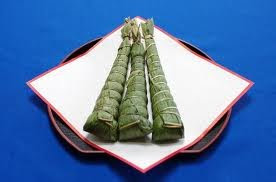
Like the Festival on May 5, the chimaki also come from China.
Zongzi (or simply zong) (Chinese: 粽子)
is a traditional Chinese food, made of glutinous rice stuffed with different fillings and wrapped in bamboo or reed leaves. They are cooked by steaming or boiling.
© More in the WIKIPEDIA !
- - - - - Haiku by Matsuo Basho - - - - -
粽結ふ片手にはさむ額髪
chimaki yuu katate ni hasamu hitai gami
wrapping rice dumplings
with one hand she puts back
her fallen hair
Tr. Barnhill
Barnhill explains the point of the haiku:
"Basho gives a haikai twist to the courtly tradition of a woman's hair draping down the sides of her face and put back behind her ears when she became involved in some aristocratic activity."
Written i 元禄4年.
Sarumino
This image refers back to a scene in the Tales of Genji (Genji Monogatari 源氏物語).
wrapping dumplings
with one hand brushing back
her bangs
Tr. Reichhold
. WAGASHI - Sweets and Haiku .
. . . . .
明日は粽難波の枯葉夢なれや
asu wa chimaki Naniwa no kareha yume nare ya
by tomorrow
the Chimaki leaves from Naniwa will become dry
and become a dream . . .
MORE
with a discission of this hokku
. Food Haiku by Matsuo Basho 松尾芭蕉 .
.............................................................................
折釘に掛た所が粽哉
. orekugi ni kaketa tokoro ga chimaki kana .
Kobayashi Issa, Chimaki and hooked nails
.............................................................................
Gion matsuri 祇園祭り Gion Festival, Kyoto
July
Many yamahoko festival floata feature a special CHIMAKI talisman for good luck.
. Gion Chimaki 祇園ちまき Chimaki for the Gion Festival .
.............................................................................
quote
Chimaki shinji 粽神事
A festival held at the Hikawa Jinja in Ōmiya City, Saitama Prefecture, on June 5.
The ritual consists of offering rice cakes (chimaki) during the Tango no sekku (Boys' Festival).
People collect thatch plant leaves from a nearby marsh, arrange them into pieces of equal length, then wrap the rice cakes with them and furthermore wrap these in straw. The two layers of wrapping are said
to resemble Yin and Yang (onmyō, onyō).
Along with other offerings (shinsen), thirty chimaki cakes are presented to the main shrine (honsha), five to each of the three sessha (auxiliary shrines), and twenty are presented to the massha (branch shrine). Depending on whether destined for the main shrine, auxiliary shrines, or branch shrines, the number of cakes wrapped in straw varies. The cakes are said to have the power to ward off evil spirits and epidemics.
The original festival day was the fifth day of the fifth month of the lunar calendar.
source : Mogi Sakae, Kokugakuin, 2007
.................................................................................
The Boy's festival comes with many more kigo about special rituals and ceremonies, performed on May 5.
Check them out here
. Ceremonies at the Boy's Festival
:::::::::::::::::::::::::::::::::::::::::::::::::::::::::::::::::::::::::::::::::::::::::::::::::::
Here is more about the carp as an animal:
The CARP Cyprinus carpio
The carp can become quite large, up to 120 cm long with a weight of 25-30 kg. It is silvery, with the back darker than the belly. The fins are greyish-green, the tail fin has two distinct lobes. There are 4 threads on the upper lip of the mouth.The carp prefers to live in stagnant or slowly flowing water with many plants and a sandy or muddy bottom. It feeds on plant material as well as on small animals such as insect larvae, molluscs and crustaceans. Larger carp also hunt small fish and salamanders.The carp is most active at dusk. Breeding takes place from April to July, depending on water temperature.
Symbolism:
In the Far East the carp is a symbol of good luck and a long life. In mythology it is a riding animal and messenger of the gods. In some stories a message or seal is found in a carp's stomach. In Japan and also in China it is a symbol of intelligence and also of courage and endurance because it swims against the flow of the river. The Bambara of Sudan consider it a symbol of both material and spiritual fecundity.
Carp in a dream:
Seeing a carp in a dream is considered to be a sign of good luck. A carp in a dream can sometimes speak; when this happens it is believed that your soul is trying to speak to your conscious self.
http://www.dierinbeeld.nl/animal_files/fish/carp/

Photo Gabi Greve
*****************************
Worldwide use
*****************************
Things found on the way
LINK to Japan Times article
"Pictorial Banners in the Edo Period"
Japan Folk Crafts Museum.
KOI, Carps as Kimono Patterns
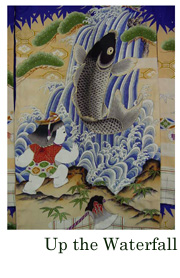
"Koi" (Carp) is what we call the head of fish-water fish because of its grand figure in the water. So it's true that there are some anglers who end up putting their fishing rods aside and admire the fish swimming so gracefully. Then they'd always go "I should have caught it before the fish swim out of view..." "Koi" has wild aspects as well. Once the fish puts on full stream, you'll be astonished by the speed and a lot of splash. I hope you'll see "Koi" swimming against the rushing stream with your own eyes. I wonder if you've ever see "Koi" swimming up a waterfall like in the pattern of Kimono. There might be some exaggeration, but people would picture that pattern for the wish of "success in life".
That was especially put into young boys and there is a special day for them, 5th of May, the day we put up carp streamers called "Koi-Nobori"(which is on sale). But now let me tell you that there's another special day for young girls as well on the 3rd of March, the day on which we set up dolls in various Kimono costumes and girls get dressed in Kimono they are proud of.
http://www.yamatoku.jp/classic/topic.asp
source : xxx
furafu ふらふ
the colorful carp streamers of Tosa, Shikoku
. . . CLICK here for Photos !

Hiroshige, 100 Views of Edo
.......................................................................

source : www.recipe-blog.jp/profile/20653
and some sweet carp streamers for the kids . . .
*****************************
HAIKU
kaze fukeba kuru ya tonari no koi-nobori
when the wind blows
they come this way, neighbours
carp streamers
Takahama Kyoshi
xxxxxxxxxxxxxxxxxxxxxxxxxxxxx
Some famous and international ku connected with this subject. Carp streamers even in Honolulu.
http://haiku.cc.ehime-u.ac.jp/~shiki/shiki.archive/
bright banners in May
flapping in the gusts --
neighbors stop to stare
…..Zeyda-
Carp streamers
Over Honolulu
Where East meets West.
…..Takashi
Out off the closet
Carp hoisted high, black and scarlet-
Waft of mothballs.
…..Takashi
Son was born at last
After the two daughters-
Carp streamers.
…..Takashi
:::::::::::::::::::::::::::::::::::::::::::::::::::::::::::::::::::::::::::::::::::::::::::::::::::
Some old masters' haiku:
ki gakurete meiyo no ie no nobori kana
Buson
Hidden among the trees
The house of honour-
The streamers.
..........................................................
kojiki machi towa miezarishi nobori kana
Issa
The slums
don't look like that-
the streamers
Here I want to add one episode of my experience with the carp streamers. A poor farmer in the neighbourhood finally had his first son born, father almost 50 years. So they bought the most expensive carp streamer for more than twothousand dollars and put it up in front of the house, where the money would have been better spend repairing the roof. But that could wait, the joy and honour showing the boy’s birth was much bigger.
That is the atmosphere Issa wants to express, I think.
Gabi Greve
..........................................................
- - - - - Chris drake wrote:
君が代は 乞食の家も のぼり哉
kimi ga yo wa kojiki no ie mo nobori kana
this peaceful realm --
even at beggar houses
Children's Day banners
I did use the current name of the 5/5 festival, Children's Day.
I realize it's not perfect, but I used it because I thought things would get too complicated if I mentioned all the various customs related to the Tango no Sekku festival complex. I also wanted to avoid the misleading term Boy's Festival, which is commonly encountered, since the Tango festival was traditionally not just for boys, except perhaps within the warrior class. Among commoners, especially in rural areas, the village young men's and young women's associations usually held celebrations, 5/5 was often considered "women's house day," and the placement of sweet flag leaves on roofs and sweet-flag baths were both for girls as well as boys. This is presumably why the Japanese government now uses the term Children's Day -- since in the Edo period the 3/3 Doll festival was held for purification and not just for girls and the 5/5 Tango festival was mainly for maintaining good health and protection against summer diseases and not just for boys. Therefore I was using Children's Day descriptively, not as a name used in Issa's time. I agree that Children's Day is a little confusing, just as the historical reality is a bit confusing.
Chris Drake
- Read his full discussion of this poem :
. Issa and the Kojiki beggars .
kimi ga yo wa kojiki no ie mo nobori kana
in this peaceful realm
even at beggar's houses
there are festival streamers . . .
Tr. Gabi Greve
The cut marker KANA is at the end of line 3.
**********************************
Related words
. WASHOKU
kashiwamochi, kashiwa mochi 柏餅 mochi wrapped in oak leaves
a symbol for the continuation of a family tree
***** Golden Week
oogon shuukan 黄金週間 (おうごんしゅうかん)
goorudin uiiku ゴールデンウィーク
National Holidays of Japan WKD Reference
The end of April through around May 5th is called "Golden Week" in Japan since there are a couple of holidays during this time. Many businesses close for about a week to 10 days depending on the calender. Many people take a vacation and travel around the country or abroad.
April 29:
The Emperor's Birthday (天皇誕生日, Tennō Tanjōbi), until 1988
Greenery Day (みどりの日, Midori no Hi), from 1989 until 2006
Showa Day (昭和の日, Shōwa no Hi, Shoowa no hi), since 2007
May 3 : Kenpoo-kinenbi 憲法記念日 Constitution Memorial Day
May 4 : Midori-no-hi みどりの日 Green Day (Greenery Day)
May 5 : Kodomo-no-hi こどもの日 Children's Day
© More in the WIKIPEDIA !
gooruden uiiku daidokoro ni wa sara no yama
.. .. .. Golden Week -
.. .. .. in the kitchen
.. .. .. a mountain of plates
Gabi Greve, Monday May 9, 2005, after so many visitors for almost two weeks ...
Golden Week -
the mind cluttered
by trivia
Gabi Greve, May 1, 2008
xxxxxxxxxxxxxxxxxxxxxxxxxxxxxxxxxxxxxx
***** Kodomo no Hi - Children's Day, May 5th.
On this day, Japanese families pray for the healthy growth of children. Children's Day is also called Tangono-sekku, and historically it was the day to celebrate and pray for the health of boys. Japanese families with boys hang up carp streamers (Koinobori) outside and display May dolls (Gogatsu Ningyo) inside their houses.
http://gojapan.about.com/cs/japaneseholidays/a/goldenweek.htm
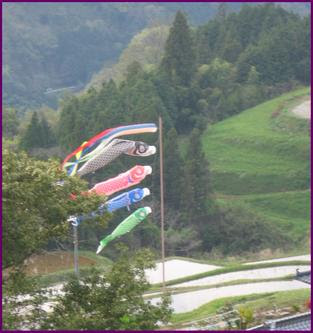
Carp streamers and terraced rice fields
© Gabi Greve, 2007
:::::::::::::::::::::::::::::::::::::::::::::::::::::::::::::::::::::::::::::::::::::::::::::::::::::
Carp (higoi, koi) family Cyprinidae fish Goldfisch, Karpfen

Kintaro, the Golden Boy, on a Carp Streamer
Photo Gabi Greve
Kintaro, the Golden Boy
Daruma Museum
:::::::::::::::::::::::::::::::::::::::::::::::::::::::::::::::::::::::::::::::::::::::::::::::::::::
. Tango no sekku 端午の節句 Tango festival for the Boys .
:::::::::::::::::::::::::::::::::::::::::::::::::::::::::::::::::::::::::::::::::::::::::::::::::::::
Seishoo koo 清正公 Seisho Ko
覚林寺 Temple Kakurin-Ji
1-1-47 Shirokanedai, Minato-ku, Tokyo
This temple was established by Saint Nichiren in 1631.

- quote -
This temple houses a memorial tablet of Kato Kiyomasa, a prominent warrior and feudal lord who served the Toyotomi and Tokugawa Clans, from the Azuchi-Momoyama Period (the 16th Century) to the beginning of the Edo Period (the 17th Century). The statue has been worshipped as the "honorary Seisho-ko of Shirokane."
The Seisho-ko Festival is held on May 4th and 5th every year and many stalls that are open at night line the streets.
- source : www.att-japan.net/en -
. Tokyo and Edo Folk Art and Toys 江戸玩具 .
. Koi 鯉 carp toys from Japan .
:::::::::::::::::::::::::::::::::::::::::::::::::::::::::::::::::::::::::::::::::::::::::::::::::::::
[ . BACK to WORLDKIGO . TOP . ]
[ . BACK to DARUMA MUSEUM TOP . ]
:::::::::::::::::::::::::::::::::::::::::::::::::::::::::::::::::::::::::::::::::::::::::::::::::::::


 Posts
Posts




18 comments:
fixated
on flying fish kites -
a four year old
Shane Gilreath
Look at his haiga too:
http://pg.photos.yahoo.com/ph/worldkigo/album?.dir=9260&.src=ph
......................................................................
.
Warriors (tsuwamono)
and more about musha ningyo dolls of famous warriors for Boy's Festival Decorations
:::::::::::::::::::::::::::::::::::::::::::::::::::::::::::::::::::::
.
Look at some carp streamers from Tsuyama Town, April 2007
.
Who is the character shown on some koinobori?
This is the Strong Golden Boy, Kintaro.
GABI
hello, found this site by accident but so interesting all the goodies on it! Please can you help? I'm from South Africa and I would really like to buy some of these cap streamers for a project. Could you help me with some names of places I could maybe contact through the web to buy them at a good price?
Thanks you so much!
michelle
oops, make that carp streamers...
Hi Michelle,
if you google around, I am sure you will find some stores who sell worldwide.
I do not know of any particular shop.
for example
http://www.google.co.jp/search?hl=en&q=%22carp+streamer%22+store
GABI
I think koinobori tradition is so beautiful. I know a family with two girls and two boys. The youngest boy was just born last week, and I'd like to give the family a gift that incorporates the koinobori. The father's mother is Japanese and lives with the family, so I'd like to stay close to the tradition, but at the same time would like to include the family's daughters in the gift. Would it be appropriate to get four carp for each of the children, three for the father and two sons, just one for the newest son, or six for each member of the family? Also, what is the traditional order of colors? Thanks for your insight!
Carp streamers fly over Kumamoto river
Thousands of carp streamers are now flying over a river in a spa town in Kumamoto
Prefecture, southwestern Japan.
A tourist association in Ogunimachi puts the streamers on display every year, ahead of the Children's Day holiday on May 5th.
The traditional event is carried out to ensure the healthy growth of children.
Volunteers from outside the town joined residents on Thursday to get the streamers up. More than 100 people took part.
About 200 ropes span the river, flying 3,500 streamers. They will be on display until May 6th. The streamers will be lit up every night.
http://www3.nhk.or.jp/daily/english/20120330_13.html
Blue carp streamers to be sent to disaster area
Citizens of western Japan are preparing to send blue carp streamers to Miyagi Prefecture to mourn children who perished in the March 11th disaster.
Dozens of people in Anan City, Tokushima Prefecture, gathered at a community hall on Wednesday to pack 60 of the streamers, from about 700 stored for community festivals.
They were responding to an appeal from a disaster-hit area in Miyagi.
Carp streamers are traditionally displayed in Japan around Children's Day on May 5th to pray for the healthy growth of children.
The gifts will be sent by the end of this month.
A man who helped with the packing said he will be happy if the carp streamers encourage people in Miyagi.
http://www3.nhk.or.jp/daily/english/20120419_09.html
山峽の村一竿の鯉幟
sankyoo no mura ichizao no koi nobori
in the gorge
one pole in the village
with a carp streamer
Jinguuji Taikichi 神宮寺 泰吉
.
Kobayashi Issa
山颪家々の幟に起る也
yama oroshi ya-ya no nobori ni okiru nari
yama-oroshiie-ie no nobori ni okoru nari
mountain windstorms
inside streamers at every house --
summer festival
Read the comment by Chris Drake
Kobayashi Issa
門の木にくくし付たる幟哉
kado no ki ni kukushi-tsuketaru nobori kana
one end tied
to a tree by the gate --
children's festival streamer
This hokku is from the fifth month (June) in 1818, when Issa was living in his hometown. It evokes the Tango Festival, often known as the children's festival, although the samurai class thought of it as the boys' festival and displayed armor and military banners to try to persuade boys to want to become good warriors. In Issa's time the main part of the festival took place on lunar 5/5, which was June 8 in 1818. Anciently it seems to have been a time when female shamans did purifications, and this was combined with ceremonies imported from China that involved prayers for protection against epidemics during the hot summer months ahead. Prayers for children to grow up strong and healthy became prominent in Japan, and in Edo and Issa's native Shinano region, commoners raised windsock-like streamers in the shape of a carp swimming upstream to the tops of high poles above their houses.
Instead of using a pole, the people in this hokku tie their streamer -- probably in the shape of a large black or red carp -- to a tree near their gate or door. Perhaps they are too poor to buy a special pole, or perhaps they -- and apparently Issa -- are fascinated by the image of a fish swimming in a tree. In any case, they've taken the string attached to the small hoop at the front end of the streamer that represents the mouth of the carp and tied the string around the trunk or a limb of a tree standing near the street, where everyone can see it. When a breeze blows, the streamer billows out horizontally, and the carp seems to be swimming vigorously in a river of green leaves.
Chris Drake
Kobayashi Issa
君が代は乞食の家ものぼり哉
kimi ga yo wa kojiki no ie mo nobori kana
this age of peace --
even at beggar houses
Children's Day banners
... The first line of the hokku contains a complex phrase that has been interpreted in many different ways: kimi ga yo. The word kimi appears often in ancient waka, where it means 1) "you" when referring to a lover or respected person, 2) a powerful person or local lord, or 3) the emperor. The most famous use of the phrase is in Kokinshu waka 343, which is a poem praying for the very long life (yo) of an esteemed person. Later, during the medieval period, the waka's first line was changed slightly to kimi ga yo, and its words became a popular song sung at parties and ceremonies, such as weddings, where kimi, 'you,' referred to the newly married couple or the person being feted. In Issa's time, as he surely knew, it was even sung as a kouta song sung in amusement districts as an auspicious blessing song for an esteemed "you." By Issa's time the phrase had also gained a new political meaning. In Kyoto and among supporters of the revival of the emperor's ancient power, kimi ga yo was taken to mean 'the reign of the current emperor,' but far more commonly it meant 'the reign of the current shogun.' The shogun was regularly referred to as kimi both by the samurai class and by commoners around the country, and 'the current shogun's reign' usually included the sense of 'in which the realm is at peace.' The reign of local domain lords (daimyo) was also referred to by local people as kimi ga yo. Therefore it is very likely that in this hokku and elsewhere Issa is following the most common usage of his age and referring to the so-called "Tokugawa peace" under the shogunate, the actual rulers of Japan. ...
Read the full comment of Chris Drake
.
kujiranobori, kujira nobori 鯨のぼり streamers in the form of a whale
from Sadowara 佐土原 - Miyazaki 宮崎県 Kyushu .
.
A brief history of Japanese armour.
.
Rekishi Nippon (Japanese history)
.
The earliest Japanese armours were solid metal cuirasses made up of several sections of plate — often roughly triangular in form — which were tightly laced together and usually lacquered against rust. It is not clear what they were originally called; some suggest the term kawara — which means “tile” — and others suggest it was simply yoroi, meaning “armour.” This style of armour has come to be called a tankô, which means “short armour.” It was hinged on one side or even hingeless and sprung closed, opening up the center front. The heyday of the tankô was the fourth through sixth centuries. Various additions came and went, including lame-constructed skirt plates and shoulder guards.
more about Japanese History
.
rekishinihon.com/2015/05/16/a-brief-history-of-japanese-armour/
.
奈良県 Nara 天川村 / 天河 Tenkawa
. the Demon Zenki 前鬼 and his wife Goki 後鬼 .
oni no shison 鬼の子孫 / onisuji 鬼筋 descendants of the Oni
Near the temple 安生寺 Ansho-Ji there are five families, who do NOT prepare chimaki 粽 ritual rice dumplings for the Boy's festival on May 5th and hishimochi 菱餅 red and white dumplings for the Girls's festival on May 3.
These families claim to be descendants of the Demons (Zenki and Goki). The Chimaki look like the tsuno 角 horns of an Oni and the Hishimochi look like oni no shita 鬼の舌 the tongue of an Oni, thus they feel it an insult against the ancestors to prepare them.
During the Setsubun rituals, they never chant
oni wa soto 鬼は外 but only fuku wa uchi 福は内.
.
https://kappapedia.blogspot.jp/2017/04/oni-wa-soto.html
.
Post a Comment