:::::::::::::::::::::::::::::::::::::::::::::::::::::::::::::::::::::::::::::::::::::::::::::::::::::
fugu 河豚 / 鰒 / 鯸 / 魨 blowfish, puffer fish
***** Location: Japan
***** Season: Various, see below
***** Category: Animal
*****************************
Explanation
河豚、the pig of the sea, as the kanji may be interpreted.
kigo for all winter
Fugu, Spheroides and Tetraodontiformes family. puffer fish Kugelfisch
The fish is about 30 cm long, the mouth quite small and the belly can be blown up in case of need, to make the animal look much bigger. The poison in his liver is deadly, otherwise it is a delicacy. The ovaraies (fugu no ko) are especially valued. Dried and blown up, he makes a lovely (?) souvenir of Western Japan and Kyushu, where he is most delicate.
Gabi Greve

buying a stamp -
even at the post office
I meet my fugu
.................................................................................
many kigo with the blowfish
fugu choochin 河豚提燈(ふぐちょうちん)fugu as a lampion decoration
see photo below
fugu 河豚 (ふぐ) / 鰒(ふぐ)
blowfish, pufferfish, puffer, globefish, swellfish
mafugu 真河豚(まふぐ)Takifugu porphyreus
namerafugu 滑河豚(なめらふぐ)fam. Tetraodontidae
torafugu 虎河豚(とらふぐ)"tiger fugu", Takifugu rubripes
akame fugu 赤目河豚(あかめふぐ)"fugu with read eyes"
Takifugu chrysops
komon fugu 小紋河豚(こもんふぐ)"fugu with small patterns"
Takifugu poecilonotus
goma fugu 胡麻河豚(ごまふぐ)"fugu with sesame seed pattern"
Takifugu stictonotus
kita makura, kitamakura 北枕(きたまくら) "pillow in the north"
Canthigaster rivulata
(kitamakura is used as a pillow facing north, only for placing a dead body.)
Pillow (makura) and haiku
harisenbon, hari senbon 針千本(はりせんぼん)
"one thousand needles". Balloon porcupinefish
Diodon holocanthus
sabafugu, saba fugu 鯖河豚(さばふぐ)"mackerel fugu"
Lagocephalus wheeleri
ginga fugu 銀河河豚(ぎんがふぐ)"galaxy fugu"
kusa fugu, kusafugu 草河豚(くさふぐ)"plant fugu"
Takifugu niphobles
ginfugu 金河豚(きんふぐ)"golden fugu"
Auriglobus modestus
hakofugu, hako fugu 箱河豚(はこふぐ)
Ostracion immaculatus
oman fugu 巾著河豚(おまんふぐ)Kinchaku fugu
umi suzume 海雀(うみすずめ)"sparrow of the sea"
Lactoria diaphana
itomaki fugu 糸巻河豚(いとまきふぐ)"reel fugu"
Kentrocapros aculeatus
.................................................................................
humanity kigo for all winter
fugunabe, fugu nabe blowfish stew 河豚鍋(ふぐなべ)
fugujiru, fugu jiru 河豚汁 (ふぐじる) blowfish soup
fugutojiru ふぐと汁(ふぐとじる)、fugutoojiru ふぐとう汁(ふぐとうじる)
..... fuku ふく, fukuto ふくと, fukube ふくべ
fukujiru 河豚汁
other famous fugu dishes as kigo
fuguchiri 河豚ちり(ふぐちり)
tetchiri てっちり
fugu meat in boiling water
. . . CLICK here for Photos !
hirezake 鰭酒(ひれざけ)
ricewine with soaked blowfish fins

teppoonabe 鉄砲鍋(てっぽうなべ)"gun hodgepodge"
Some kind of russian roulette when eating this poisonous fish together with a friend.
fugu no yado 河豚の宿(ふぐのやど)
restaurant that serves fugunabe
fugu no tomo 河豚の友(ふぐのとも)
friend to eat blowfish with
fugu no doku 河豚の毒(ふぐのどく)blowfish poison
fugu atari 河豚中り(ふぐあたり)blowfish poison poisoning
It was quite deadly in the Edo period.
fugu tsuri 河豚釣(ふぐつり)fishing for fugu
fugu ami 河豚網(ふぐあみ) net for fishing fugu
observance kigo for mid-spring
. Fugu Kuyoo 河豚供養 Memorial Service for Pufferfish .
At the end of the Fugu season
April 29. Especially in Shimonoseki at Haedodomari 南風泊
Small torafugu baby tiger pufferfish are let to swim in the sea.
:::::::::::::::::::::::::::::::::::::::::::::::::::::::::::::::::::::::::::::::::::

Blowfish as a lamp, with a thousand needles
(hari senbon はりせんぼん)
http://www.geocities.co.jp/HeartLand-Himawari/5315/fugu.htm
:::::::::::::::::::::::::::::::::::::::::::::::::::::::::::::::::::::::::::::::::::::::::::::::::::::

Fugu Sashimi, a delicacy
http://www.rakuten.co.jp/uokatsu/590013/#569379
Is the evil blowfish - also known as puffer, globefish, or swellfish - in danger of extinction?
In Japan, eating the honorable fugu (blowfish) is the ideal of gourmet dining-and the
cooking version of Russian roulette. According to Japan Economic newswire, a Japanese wholesaler exported the first 90 kg of vacuum-packed fugu to Hong Kong in October 1995. Hong Kong is the second market to import fugu from Japan. New York, which started importing the fish in 1989, currently sells about 1 tons of fugu every year, according to the wholesaler. Fugu's trade volume is rising because of people's curiosity in eating such fish.
In Japan, eating fugu has been the gastronomic version of Russian roulette for centuries. "His chopsticks roll to the table from nerveless fingers; he pales; his breathing labors." Dining on fugu
is often the subject of traditional senryuverse.
Last night he and I ate fugu;
Today I help carry his coffin.
"It's a terrible death," a Japanese cook said. "Although you can think clearly, you cannot speak or move and soon cannot breathe."
Why the Japanese should make a ritual eating deadly poisonous fish is difficult for foreigners to comprehend. For many the elegant, death-defying event is a status symbol, and disciples say that consumption of the meat produces a pleasant, warm tingling.
Nonetheless, fugu ovaries, intestines and livers can be so deadly that if even touch of them is left in the fish, the diner dies, sometimes in minutes.
In the medieval era, the Tokugawa shogunate regime strictly banned blowfish consumption. But it became popular again around the end of the regime in the mid-19th century as the government lost control over the people. Kiichi Kitahara, the owner of Blowfish museum in Osaka, noted as follows: "Human beings are funny. They want to eat what is forbidden. The history of blowfish is the history of prohibition by authorities. If blowfish weren't poisonous, they might not be so popular."
Read a lot more interesting information about the fugu.
http://www.american.edu/projects/mandala/TED/blowfish.htm
:::::::::::::::::::::::::::::::::::::::::::::::::::::::::::::::::::::::::::::::::::::::::::::::::::::
Japanese Link about the Fugu
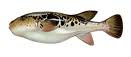
. トラフグ Torafugu, the Tiger Blowfish
http://homepage3.nifty.com/shokubun/fugu1.html
Onsen Torafugu 温泉トラフグ grown in a hot spring
. . . CLICK here for Photos !
In Tochigi, the mountain community Nakagawa Machi 那珂川町 is growing torafugu in the salty water of a local onsen, in large basins at an abandoned school. Before preparing them as food, they are put in a special container with high salt percentage, to make them swim faster and later taste better when eaten, (ajiage 味上げ).
They also prepare Onsen Torafuju Manju rice cakes with the imprint of a fugu and fugu goods are sold in the village.
:::::::::::::::::::::::::::::::::::::::::::::::::::::::::::::::::::::::::::::::::::::::::::::::::::::
dried blowfish, hoshi fugu 干河豚 (ほしふぐ)
kigo for all summer
..... hoshifugu 乾河豚(ほしふぐ)
"salted blowfish", shio fugu塩河豚(しおふぐ)
sarashiboshi さくら干し(さくらぼし)
noshifuguのし河豚(のしふぐ)
:::::::::::::::::::::::::::::::::::::::::::::::::::::::::::::::::::::::::::::::::::::::::::::::::::::
more
In the Kansai region the slang word teppō, teppoo, (鉄砲) meaning rifle or gun, is used for the fish. This is a play of words on the verb ataru (当たる), which can mean either to be poisoned or to be shot. In Yamaguchi Prefecture, the pronunciation fuku is common instead of fugu. The former means good fortune whereas the latter is a homonym for disabled. The Tsukiji fish market fugu association holds a service each year at the height of the fugu season, releasing hundreds of caught fugu into the Sumida River. A similar ceremony is also held at another large market in Shimonoseki.
A rakugo, or humorous short story, tells of three men that prepared a fugu stew but were unsure as to whether it was safe to eat. To test the stew, they gave some to a beggar. When it did not seem to do him any harm they ate the stew. Later, they met the beggar again and were delighted to see that he was still in good health. After that encounter, the beggar, who had in fact not eaten the stew but hidden it, knew that it was safe and he could eat it. The three men had been fooled by the wise beggar.
© More in the WIKIPEDIA !
Since there was no help against the poison, the fish was also
species of Takifugu, Lagocephalus, or Sphoeroides) or porcupinefish of the genus Diodon.
2 Familien. Fam. Tetraodontidae und Fam Balistoidei .
fugu, akamefugu, mafugu, sangatufugu (Takifugu pardalis)
Wird bis zu 14 Zentimeter lang.
http://www.pref.iwate.jp/~hp5507/h19osakanazukan/page126.htm
shirosabafugu (Lagocephalus wheeleri Abe, Tabeta and Kitahama)
http://www.fishing-forum.org/blog/arara/cat35/cat28/
shoosaifugu (Takifugu snyderi)
http://www.fishing-forum.org/blog/arara/cat35/cat28/
torafugu „Tiger-Kugelfisch“ (Fugu rubripes, tiger blowfish)
Die Eierstöcke können bis zu einem Kilogramm wiegen.
Die Leber und Eierstöcke enthalten das Giftテトロドトキシン tetrodotoxin
http://en.wikipedia.org/wiki/Fugu
In Osaka, there is a special station lunchbox with fugu.
2007年3月19日に "大阪特選ふぐづくし"

In Osaka, Kishiwada, there is a fugu museum. fugu no kan フグの館
Osaka Fugu Hakubutsukan ふぐ博物館
大阪府岸和田市北町10番2号
since Showa 39.
See Comment Below.
*****************************
Worldwide use
*****************************
Things found on the way
The fugu is very popular in Shimonoseki, Japan. An fast train is named after it, the Fugu Express. It looks like a Fugu lampion (fugu choochin 河豚提灯) like in the top picture.

http://nnrf63.hp.infoseek.co.jp/topix20.html
.................................................................................

fugu whistle from Shimonoseki 下関のふぐ笛
..........................................................................

fugu clay bell フグ土鈴 from Enoshima / Kanagawa
. Kanagawa Folk Art - 神奈川県 .
..........................................................................

fugu hime daruma 河豚姫だるま Princess Daruma with Fugu design
Look at more local dolls from Mojigaseki gallery in Fukuoka :
source : mojigaseki gallery
. Fukuoka Folk Art - 福岡県 - Daruma Muesum .
fugu soup -
I find some Daruma
while I slurp
Gabi Greve
fugu daruma 河豚だるま blowfish Daruma
a pun with FUKU

..........................................................................
MORE
. Folk Toys from Yamaguchi / Shimonoseki .
*****************************
HAIKU

source : wakizaka san
あら何ともなや昨日は過ぎて河豚汁
ara nani tomo ya kinoo wa sugite fukutojiru
1677
. Matsuo Basho - Archives of the WKD .
well, nothing happened -
even though yesterday I ate
fugu soup
Tr. Addiss
oh, nothing's happened to me!
yesterday has passed--
fugu soup
Tr. Ueda
well--nothing's happened
and yesterday's come and gone!
blowfish soup
Tr. Barnhill
well nothing happened
yesterday has passed away
with globefish soup
Tr. Reichhold
well, nothing happened -
and yesterday's come and gone!
blowfish soup
fugu soup
Tr. Gabor Terebess
quote
Oh, without any incident
yesterday has passed--
a globefish soup party
Of course, safely cooking globefish needs a professional technique even in our days, because otherwise the diner risks illness and even death. Basho’s haiku informs us that people of his day could take pleasure in gastronomic delights such as globefish, at the risk of their life. It speaks of peaceful urban life which allowed the temptation for danger, such was the degree of security of the time.
source : Ban’ya Natsuishi
:::::::::::::::::::::::::::::::::::::::::::::::::::::::::::::::::::::::::::::::::::::::::::::::::::::::
親分と家向あふて鰒と汁
oyabun to ie muki-oute fukuto-jiru
across the street
a godfather's house --
blowfish chowder
Tr. Chris Drake
Read more about the Oyabun/Kobun group relations and
. Kobayashi Issa and the Fugu Soup .
:::::::::::::::::::::::::::::::::::::::::::::::::::::::::::::::::::::::::::::::::::::::::::::::::::::::
逢(あは)ぬ恋おもひ切ル夜やふくと汁
awanu koi omoikiruyo ya fukutojiru
Unrequited love
He has decided to give up
On that night - fugu soup!
Tr. Shoji Kumano
I cannot see her tonight.
I have to give her up
So I will eat fugu.
Tr. in wikipedia
fugujiru no ware ikite iru nezame kana
Fugu soup;
I awoke
And found myself alive!
Tr. Shoji Kumano
fugujiru no teishu to miete jooza kana
At a fugu soup table
He must be the host,
Sitting at the head.
- Tr. Shoji Kumano
. Yosa Buson 与謝蕪村 in Edo .
..........................................................................
fugu soup;
even my chopsticks
hesitate
source : Don Baird - Buson Study Group
:::::::::::::::::::::::::::::::::::::::::::::::::::::::::::::::::::::::::::::::::::::::::::::::::::::::
chrysanthemum:
the last-ing taste of
blowfish flesh
Chibi
Look at the dish here:
http://worldkigodatabase.blogspot.com/2005/03/chrysanthemum-kiku.html
xxxxxxxxxxxxxxxxxxxxxxxxxxxxxx
河豚喰えば佛も我もなかりけり
fugu kueba hotoke mo ware mo nakarikeri
eating blowfish
being a Buddha, being myself
who cares ?
(Free translation by Gabi Greve.
Hotoke can mean a Buddha and is also used for the corpse of a dead person.)
http://www.shiomura.com/shiori.html

http://plaza.harmonix.ne.jp/~mitsue-o/html/k-what.htm
:::::::::::::::::::::::::::::::::::::::::::::::::::::::::::::::::::::::::::::::::::::::::::::::::::::

キタマクラばかり釣り上げ波止残暑
kitamakura bakari tsuriage hato zansho
all I fish out
is deadly blowfish -
remaining heat on the pier
Hashimoto Mariko 橋本まり子
. susami town haiku, 2004
*****************************
Related words
***** WINTER FOOD with Blowfish
:::::::::::::::::::::::::::::::::::::::::::::::::::::::::::::::::::::::::::::::::::::::::::::::::::::
WASHOKU ... Japanese Food SAIJIKI
. ANIMALS in all SEASONS
SAIJIKI
:::::::::::::::::::::::::::::::::::::::::::::::::::::::::::::::::::::::::::::::::::::::::::::::::::::


 Posts
Posts



18 comments:
The WIKIPEDIA
Porcupinefish are fish of the family Diodontidae, (order Tetraodontiformes), also commonly called blowfish (and, sometimes, "balloonfish" or "globefish").
They are sometimes confused with pufferfish. Porcupinefish are closely related to pufferfishes but porcupinefish have spines on their body.
Porcupinefish have the ability to inflate their body by swallowing water (or air) and become round like a ball. This increase in size (almost double vertically) reduces the range of potential predators to those with much bigger mouths. A second defense mechanism is provided by the sharp spines, which radiate outwards when the fish is inflated.
Some species are poisonous, having a tetrodotoxin in their skin and/or intestines. As a result, porcupinefish have few predators: adults are rarely eaten except by sharks and orcas, though juveniles are also preyed on by tuna and dolphins.
MORE
http://en.wikipedia.org/wiki/Porcupinefish
...................................
BLOWFISH
The Tetraodontidae is a family of primarily marine and estuarine fish. The family includes many familiar species which are variously called puffers, balloonfish, blowfish, bubblefish, globefish, swellfish, toadfish, and toadies.[1] They are morphologically similar to the closely related porcupinefish, which have large conspicuous spines (unlike the small, almost sandpaper-like spines of Tetraodontidae).
The scientific name, Tetraodontidae, refers to the four large teeth, fused into an upper and lower plate, which are used for crushing the shells of crustaceans and mollusks, their natural prey.
The skin and certain internal organs of many Tetraodontidae are highly toxic to humans, but nevertheless the meat of some species is considered a delicacy in Japan (as fugu) and Korea (as boh-guh).
The Tetraodontidae contains at least 121 species of puffers in 19 genera.
They are most diverse in the tropics and relatively uncommon in the temperate zone and completely absent from cold waters. Puffers are mostly found in coastal regions though some are oceanic (e.g., Lagocephalus lagocephalus) or live in the deep sea (e.g., Sphoeroides pachygaster).
A large number of puffers are found in brackish and fresh waters: at least 39 marine species enter brackish or freshwater to feed or breed (e.g., Arothron hispidus), and a further 28 species are completely freshwater fish in distribution and never enter the sea (e.g., Colomesus asellus).
Tetrodotoxin is a powerful neurotoxin that can cause death in nearly 60% of the humans that ingest it. A human only has to ingest a few milligrams of the toxin for a fatal reaction to occur. Once consumed the toxin blocks the sodium channels in the nervous tissues, ultimately paralyzing the muscle tissue.
Curiously, the toxin seems not to be synthesized by the fish itself, but by bacteria associated with the fish. The fish has a mutation in its own sodium channels which makes it resistant to the effect of the toxin.
MORE
http://en.wikipedia.org/wiki/Pufferfish
::::::::::::::::::::::::::::::::::::::::::::::::::::::::::::::::::::::
after pufferfish soup
soon fans
are flitting
fugu kuute shibaraku oogi zukai kana
.鰒くふてしばらく扇づかひ哉
by Issa
Pufferfish soup (fukuto-jiru) is a winter season word.
Tr. David Lanoue http://cat.xula.edu/issa/
sitting cross-legged
a monkey joins too...
pufferfish soup
agura shite saru mo za toru ya fukuto-jiru
.胡坐して猿も座とるや鰒汁
by Issa, 1814
Pufferfish soup (fukuto-jiru) is a winter season word.
Tr. David Lanoue
http://cat.xula.edu/issa/
..............................
鮑 the kanji can also be used for awabi, abalone.
Kishiwada Journal;In Japan, Deflating a Poisonous Pufferfish Legend
By NICHOLAS D. KRISTOF , 1996
For countless centuries, one of the greatest and costliest Japanese delicacies has been fugu, or pufferfish. It is renowned for the possibility that it will leave the diner flopping on the floor, gasping for breath, and soon as dead as the fish itself.
A single fugu contains enough poison to kill 30 people, although no fish is on record for staging quite such a massacre. There is no antidote, and so -- human nature being what it is -- the only food regarded as more alluring in Japan than raw fish is poisonous raw fish.
The problem is that these days, knowledge of fugu and training of chefs has improved so much that a diner stands an excellent chance of surviving the meal. In each of the last two years, only one person has died from fugu poisoning, and that takes some of the interest out of the food.
"The fugu problem has come to an end," Kiichi Kitahama, director of a museum devoted to fugu, declared as he sat in an office cluttered with scientific and medical analyses of pufferfish. The museum is in a warren of zigzag alleys in this coastal town of Kishiwada, on the Osaka Bay in Western Japan -- a region that consumes 70 percent of the nation's fugu.
Mr. Kitahama, who also runs a fugu restaurant (no casualties so far, except for the fish) says that fugu has become so mundane a food that he will close the museum, making it a victim of the improved survival rate.
"I'm closing the museum because it had only one goal, which was to stop fugu poisoning," Mr. Kitahama said, surrounded by baleful-looking pufferfish preserved and mounted throughout his restaurant and museum. "Now there are very few poisoning cases, so the goal has been basically accomplished."
Mr. Kitahama said he started the museum after 176 people died of fugu poisoning in a single year, 1958. The idea was to promote knowledge of fugu and training of chefs so fugu could be prepared safely.
To be sure, fugu consumption is as great as ever these days, for people do not seem to mind eating a fish dinner that they will probably survive. But the risk has diminished to the point that it is now possible to eat fugu absentmindedly.
Mr. Yoshida's trust is considerable, because, he said, he had eaten fugu liver -- one of the deadliest parts. Selling or serving the liver is illegal in Japan, but customers sometimes ask for a bit because it is said to be the tastiest part and to do wonders for men.
"If you eat the liver, you get stronger and more virile," Mr. Yoshida said proudly. "I know it's supposed to be dangerous, but if the chef serves it, I'd trust him."
A tiny amount of liver also sometimes gives a numbing sensation, a very mild form of the paralysis that can also kill. Some diners find this thrilling, a kind of fishy high.
Half of the cases of fugu poisoning involve liver, 7 percent the skin, and 43 percent the ovaries, according to the Fugu Research Institute, run by Mr. Kitahama in conjunction with his fugu museum. Few people eat the ovaries on purpose, but fugu testicles are regarded as a great delicacy, perhaps the best way for a man to become more virile.
The catch is that fugu are sometimes hermaphrodites with both ovaries and testicles. Thus cooks sometimes mistakenly offer ovaries as testicles, unless they are well versed in fugu private parts.
The Japanese fascination with fugu is a bit odd because in most respects Japan is a risk-averse country. Nominally to protect the health of the Japanese people, although perhaps as a form of protectionism, the Government even bans such common American medications as Tylenol.
The poison in pufferfish, which are also called blowfish or swellfish because when threatened they expand into an ominous round ball, is called tetrodotoxin. This toxin is also in some newts found on the West Coast of the United States and in the Carolinas. Some deaths have been reported among people swallowing the newts in America.
To a foreign palate, it is not obvious why people spend $40 to $300 per person for a dinner of fugu. The raw fugu slices, or sashimi, have an interesting texture but little taste, and fugu testicles are disconcertingly mushy as well as tasteless.
Before they are allowed to prepare fugu, Japanese chefs must pass a rigorous examination that insures their familiarity with fugu sexual anatomy. Fugu restaurants like Zuboraya in Osaka dispose of toxic organs in special locked barrels that are taken away to be burned by specialists in hazardous waste.
Kiyoharu Hayashi, the head chef at Zuboraya, whose three outlets go through 4,400 pounds of pufferfish on a busy day, insisted that restaurant patrons face no danger. With a dig at Britain's problems with mad cow disease, he mused, "Maybe now fugu is safer than hamburger."
人鬼をいきどほるかよ鰒の顔
hito oni wo ikidooru ka yo fugu no kao
are you mad
at the human goblins?
face of the pufferfish
Kobayashi Issa
Issa spells fugu ("tetrodon" or "pufferfish") using the Japanese character for awabi ("abalone").
(Tr. David Lanoue)
.
presenting itself
to Musashi Plain...
the pufferfish
musashi no e makari-idetaru fukuto kana
.むさしのへまかり出たる鰒哉
by Issa, 1811
A fish vendor has brought this ocean catch inland. Issa spells fugu ("tetrodon" or "pufferfish") using the Japanese character for awabi ("abalone").
Tr. David Lanoue
.
ふぐさしや笹の色増す夜の雨
fugu sashi ya sasa no iro masu yoru no ame
blowfish sashimi—
bamboo grass deepen their colors
in the night rain
Murazawa Kafu 村沢夏風
Tr. Fay Aoyagi
.
fugu nori Daikoku ふぐ乗り大黒 Daikoku on a fugu puffer fish
If you eat a puffer fish, the poison might kill you. (fugu ni ataru.)
This is a pun with fuku ni ataru 福に当たる大黒, to be lucky when you meet Daikoku.
This doll brings luck to the merchants.
This is the only clay doll with this combination.
Kobayashi Issa
京にも子分ありとや鰒と汁
miyako ni mo kobun ari to ya fukuto-jiru
and two more about fukuto
across the street
a godfather's house --
blowfish chowder
how much
does your boss eat?
blowfish chowder
even in Kyoto,
they say, he has followers --
blowfish chowder
Read the comment by Chris Drake
Kobayashi Issa
誰やらが面にも似たる鰒哉
dare yara ga tsura ni mo nitaru fukuto kana
someone I know
has a similar face...
pufferfish
The person's face is puffy and bloated--not a complimentary portrait!
.
David Lanoue
.
Ariake fukuchoochin ありあけ福ちょうちん / 有明 福ちょうちん ふぐ提灯
"lucky lantern" of a puffer fish
from Fukuoka
.
Kobayashi Issa
ももしきの大宮人や鰒と汁
momoshiki no oomiyabito ya fukuto-jiru
for a great courtier
of the imperial palace...
pufferfish soup
It's not clear whether Issa is depicting an actual courtier or speaking metaphorically: suggesting that eating the winter delicacy makes one feel like a courtier.
David Lanoue
.
Kobayashi Issa
鰒汁やせ中にあてる箱根山
fugu shiru ya senaka ni ateru hakone yama
pufferfish soup--
turning my back
to Mount Hakone
Pufferfish soup, a winter season word, was a luxury dish. Here, Issa suggests that he's more interested in his soup than in viewing Mount Hakone--a peak south of Edo (today's Tokyo). In a haiku written a year later (1814), he turns his back to Cape Izu while slurping his soup.
David Lanoue
.
A legend from Minato ward, Tokyo
dochuu no fugu 土中の河豚 a Fugu blowfish in the earth
On the 17th day of the second lunar month in 1725 during the construction of a new building at Zojo-Ji they found a very large living fugu 河豚 puffer fish in the ground!
.
https://edoflourishing.blogspot.com/2018/12/minato-ward-legends.html
.
Enoshima no fugu choochin 江の島ふぐ堤灯 pufferfish lantern from Enoshima
fugu chochin
Kanagawa
.
https://omamorifromjapan.blogspot.com/2011/08/kanagawa-folk-toys.html
.
Yamanashi 上野原市 Uenohara city 秋山村 Akiyama village
If there is hayariyamai はやり病 an epidemic in the area, people hang surumeika スルメイカ squid at the entrance.
.
https://heianperiodjapan.blogspot.com/2020/01/surume-squid-legends.html
.
Amabie アマビエ with a fugu !
.
#amabie
.
Amabie and Epidemics
https://kappapedia.blogspot.com/2020/03/amabie-and-epidemics.html
.
Illustration of Armor from the fifth volume of
"Rakuyoshu" 落葉集 -(Fugu no Zu 武具之図)
.
It is an elaborate design, and there is a play on words involving the words
armor (bugu) and puffer fish (fugu). T
.
https://washokufood.blogspot.com/2009/08/kurofune-monaka.html
.
Post a Comment