5/17/2012

Leather Haori

[ . BACK to Worldkigo . TOP . ]
:::::::::::::::::::::::::::::::::::::::::::::::::::::::::::::::::::::::::::::::::::::::::::::::::::::

Leather haori jacket (kawabaori)

***** Location: Japan
***** Season: All winter
***** Category: Humanity


*****************************
Explanation

kawabaori 皮羽織 (かわばおり) leather Haori coat
... kawabaori 革羽織(かわばおり)(kawa-baori)

fuyubaori, (fuyu haori) 冬羽織 (ふゆばおり) haori coat for winter
... awasebaori 袷羽織(あわせばおり)
... wata-irebaori 綿入羽織(わたいればおり)haori with cotton padding

chabaori 茶羽織(ちゃばおり)"tea haori coat" for ladies
(also called 半反羽織, since is is rather short)

kawagoromo 皮衣(かわごろも)clothing from leather
... kawagoromo 裘(かわごろも), kawaginu かわぎぬ

kawa tebukuro 皮手袋 leather gloves

. Warm things in Winter .

.......................................................................

haori 羽織 Haori coat, Haori jacket,
Japanese-style half coat

Japanese Haori Coat, Haori Kimono Jacket


Haori is a lightweight coat worn over kimono. It does not close in front, so it can be used as a jacket.

:::::::::::::::::::::::::::::::::::::::::::::::::::::::::::::::::::::::::::::::::::::::::::::::::::::


source : www.toraichi-shop.com

made from sheep skin
During the Edo period, they were used by the Daimyo and his men on horseback.
The firebrigade of Edo also used them for their protection.


source : onihei.cocolog-nifty.com

Different patterns for the fire brigade of Edo.

:::::::::::::::::::::::::::::::::::::::::::::::::::::::::::::::::::::::::::::::::::::::::::::::::::::


kaji shoozoku 火事装束 protective cloths for the firebrigade
kaji zukin 火事頭巾 protective hood for fire

. WKD : Fire in Edo.

:::::::::::::::::::::::::::::::::::::::::::::::::::::::::::::::::::::::::::::::::::::::::::::::::::::

. ABC List of Edo craftsmen 江戸の職人 .


source : ニュース和歌山2014年
A store that sells many things, among them Haori coats, in Wakayama around 1757.

haoriya 羽織屋 making Haori coats
紋羽織屋 / 紋付羽織屋 making Haori with a family crest 


. kamon 家紋 family crest .


. kappaya 合羽屋 making raincoats .

*****************************
Worldwide use

Leder-Haori-Jacke

*****************************
Things found on the way


Leather Goods 皮細工  kawazaiku

. Daruma and Leather Goods .

:::::::::::::::::::::::::::::::::::::::::::::::::::::::::::::::::::::::::::::::::::::::::::::::::::::

Samurai Leather
For over 600 years Himeji has been famous for it’s traditional white leather processing. The soft, supple, white leather was once used to cover samurai armor, parts of helmets and the edging of various armor parts too. The same white leather was used to make gloves for archers and swordsmen, tabi socks for the affluent, and strong bags carried by wandering swordsmen.
Today, the traditional leatherworks are used for bags, wallets and purses.
My new wallet (seen here, sitting on a sheet of hand processed deerskin) is hand made by the traditional leather workers, and features the crests of the various lords of Himeji Castle, Hashiba, (Toyotomi), Kuroda, Honda, Sakai, Ikeda, Sakakibara, and Matsudaira.
- source : SamuraiHistory - facebook


:::::::::::::::::::::::::::::::::::::::::::::::::::::::::::::::::::::::::::::::::::::::::::::::::::::::

torenchikooto トレンチコート trenchcoat, trench coat

トレンチコートいつも椅子から落つるなり
torenchikooto itsumo isu kara otsuru nari

my trenchcoat
always slips
from the chair . . .


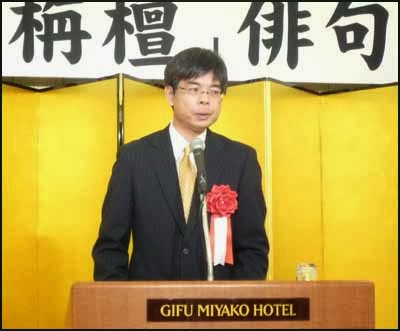
Katoo Kanabun 加藤かな文 Kato Kanabun (1961 - )

The cut marker NARI is at the end of line 3.


*****************************
HAIKU


haiku by Kobayashi Issa

皮羽織見せに行也としの市
kawa-baori mise ni yuku nari toshi no ichi

showing off
his long leather jacket
at the New Year's market


Toshi means the coming new year. Special, temporary New Year's markets selling decorations, calendars, presents, and other items at low prices for use at New Year's were set up in certain temples and shrines on 12/25-6 and almost everywhere from 12/27 until New Year's Eve, when everything was sold off at even lower bargain prices.

The subject who wears the haori jacket isn't given, but it seems more likely to be a person Issa sees than Issa himself. The nari indicates either
1) exclamation or strong emphasis or
2) supposition ("seems; is said to be").
Issa would probably use it for himself only if he were amazed at what he was doing and were looking at himself objectively, perhaps to make fun of himself, or, on the other hand, if he were strongly asserting that this is absolutely what he was doing. There seems to be amazement and exclamation in this hokku, but it appears to come from the fact that a style-conscious, comparatively young man is wearing a fairly unusual and attention-drawing Edo-style leather jacket in Issa's rural hometown and displaying himself rather than buying New Year's items.

The social context also suggests something similar. Leather haori (loose leather jackets hanging almost down to the knees, with the front left mostly open) were first worn for protection by firefighters, and then, a few decades before 1824, when this hokku was written, they became a symbol of advanced style among swaggering toughs and other fashion-following men who considered themselves dandies, though occasionally style-conscious women in Edo wore them, too. This fashion trend caused leather haori jackets and all other leather goods to become very expensive.

In spite of the high price and sophisticated designs on the leather haori jackets, they also had some of the same cultural meaning that black leather jackets had in middle and late 20th-c. US culture. Making a guess based on this historical context, the man in Issa's hokku probably isn't a Hell's Angel type, but he's likely to be comparatively young, and he's more interested in showing himself off as a man about town to the big crowd in the market than he is in getting ready for New Year's. Since he has enough money buy an expensive leather jacket, perhaps he's not even interested in buying the relatively cheap articles in the market at all.

In 1830, six years after this hokku was written, the government outlawed leather haori jackets and ordered commoners to wear cotton happi cloaks instead. Presumably the shogunate considered the use by commoners of large amounts of leather, a luxury good until then used mainly by the warrior class (with the exception of leather socks), to be blurring the class border between the warrior class and commoners. Also, the new Edo custom of wearing lots of leather led to competition between young toughs and sometimes to street violence.

At the time Issa wrote this hokku he was 62, so, without any other supporting evidence, it seems doubtful he was stepping out and trying to make an expensive fashion statement as an alpha male and declaring that his fashion is his main reason for going to the market. The other hokku in his diary about New Year's markets in this year also seem to be about other people, not Issa himself.

Chris Drake

.................................................................................

kawa haori mise ni yuku nari toshi no ichi

showing off
my leather coat...
year's end fair

Tr. David Lanoue


:::::::::::::::::::::::::::::::::::::::::::::::::::::::::::::::::::::::::::::::::::::::::::::::::::::

老骨をばさと包むや革羽織
rokotsu o basato tsutsumu ya kawabaori

my old bones
wrapped so snuggly -
this leather haori coat


. 芥川龍之介 Akutagawa Ryunosuke .


:::::::::::::::::::::::::::::::::::::::::::::::::::::::::::::::::::::::::::::::::::::::::::::::::::::

革羽織古めかしたる寒かな  
kawabaori furumekashitaru samusa kana

my leather haori coat
is already so old -
this cold


. Natsume Soseki 夏目漱石 .


*****************************
Related words

. short, light summer coat 夏羽織 natsubaori .


- - - - - MATSUO BASHO - - - - -

別れ端や笠手に提げて夏羽織
. wakareba ya kasa te ni sagete natsu-baori .

time to say good bye -
the traveller's hat in my hand
and my summer coat on

Tr. Gabi Greve


Written about 1684 貞亨元年, Basho age 41 or later

Some explain this as Basho taking leave of his summer robe and friends at the same time. The season would then be early autumn.
It could also be the "change of robes" for summer robes on the first day of the fourth lunar month, thus a kigo for summer, and Basho would be taking leave of his warm winter coat, getting ready for a journey in summer.

- - - - - - - - - -


花に酔へり羽織着て刀さす女 
hana ni yoeri haori kite katana sasu onna

drunk by cherry blossoms
a lady wearing a haori coat
and a sword

Tr. Gabi Greve

Written about 天和元年 , Basho 38 to 40.
At that time, ladies never wore haori coats or had a sword in the sash. That was samurai wear.
Maybe someone was using this a costume? When drunk with blossoms, all things seem possible.
The meaning is not quite clear.


- - - - - - - - - -


風薫る羽織は襟もつくろはず 
. kaze kaoru haori wa eri mo tsukurohazu .
remembering Ishiyama Joozan 石山丈山 Jozan in Kyoto


- - - - - - - - - -


きてもみよ甚兵が羽織花衣
. kite mo miyo jinbe ga haori hanagoromo .


- - - - - - - - - -

別れ端や笠手に提げて夏羽織 
. wakareba ya kasa te ni sagete natsu-baori .

time to say good bye -
the traveller's hat in my hand
and my summer coat on

Tr. Gabi Greve

Written about 1684 貞亨元年, Basho age 41 or later

Some explain this as Basho taking leave of his summer robe and friends at the same time. The season would then be early autumn.
It could also be the "change of robes" for summer robes on the first day of the fourth lunar month, thus a kigo for summer, and Basho would be taking leave of his warm winter coat, getting ready for a journey in summer.


. Matsuo Basho 松尾芭蕉 - Archives of the WKD .


:::::::::::::::::::::::::::::::::::::::::::::::::::::::::::::::::::::::::::::::::::::::::::::::::::::

***** . Warm Robes in Winter .


***** . toshi no ichi 年の市 last market of the Year .
..... kure no ichi 暮の市(くれのいち) Year-end market
..... kure ichi 暮市(くれいち)
shiwasu no ichi 師走の市(しわすのいち) December market
saimatsu oo-uridash 歳末大売出しYear-end sale
sekki ichi 節季市(せっきいち)seasonal market


inden 印伝, short for indengawa 印伝革
. Deerskin goods from Yamanashi .


::::::::::::::::::::::::::::::::::::::::::::::::::::::::::::::::::::::::::::::::::::::::::::::::::::: 

[ . BACK to DARUMA MUSEUM TOP . ]
[ . BACK to WORLDKIGO . TOP . ]

:::::::::::::::::::::::::::::::::::::::::::::::::::::::::::::::::::::::::::::::::::::::::::::::::::::

5/12/2012

Yellow Rose (yamabuki)

[ . BACK to WORLDKIGO . TOP . ]
Tamagawa, see below
::::::::::::::::::::::::::::::::::::::::::::::::::::::::::::::::::::::::::::::::::::::::::::::::::::: 

Yellow Mountain Rose (yamabuki)

***** Location: Japan
***** Season: Late Spring
***** Category: Plant


*****************************
Explanation


http://www.paghat.com/kerria.html

Kerria japonica . Yamabuki  山吹
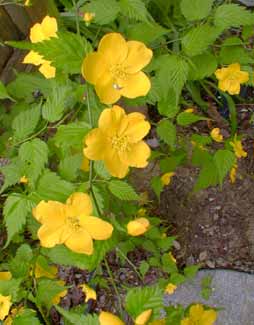
litterally means "mountain breath". These bright yellow flowering bushes grow wild all over Japan, especially favoring riversides and gorges. Other translations are "Mountain rose, wild rose, Easter rose".

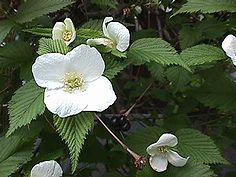
white mountain rose : shiro-yamabuki 白山吹
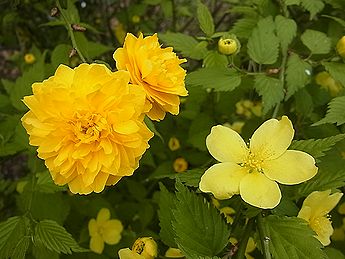
double-flowering mountain rose :
yae-yamabuki 八重山吹
dark yellow mountain rose : ko-yamabuki 濃山吹
mountain rose with leaves : ha yamabuki 葉山吹


The flowers have five petals, while the doublel-flowering looks like a ponpon with many petals.
They paint whole mountain ranges in bright yellow in late spring. Since olden times, these flowers have been a part of Japanese poetry, especially the Manyo'shu and the Tale of Genji. See later.

The bright yellow has been used to describe the yellow color of gold, especially the gold plates of Japanese money during the Edo period. "Yamabuki-iro" is the color of gold and bribes.


http://www.pierre-marteau.com/currency/coins/japanese.html

Below I quote a link about this kind of Japanese Money.

Gabi Greve

xxxxxxxxxxxxxxxxxxxxxxxxxxxxx

Double-flowering yellow mountain rose


White mountain rose


Look at more pictures here:
http://www.hana300.com/yaeyam.html

::::::::::::::::::::::::::::::::::::::::::::::::::::::::::::::::::::::::::::::::::::::::::::::::::::: 

kigo for all winter

kare yamabuki, kareyamabuki 枯山吹 (かれやまぶき)
withered yellow rose bush


::::::::::::::::::::::::::::::::::::::::::::::::::::::::::::::::::::::::::::::::::::::::::::::::::::: 


Yamabuki (Kerria japonica)
By LINDA INOKI

Murasaki had prepared the floral offerings.
She chose eight of her prettiest little girls to deliver them,
dressing four as birds and four as butterflies.
The birds brought cherry blossoms in silver vases,
the butterflies yamabuki in gold.

From "The Tale of Genji" by Murasaki Shikibu,
translated by Edward G. Seidensticker (Penguin Books)

The simple, pure-yellow flowers of the yamabuki are borne in arching sprays with tender, bright-green leaves, and can still be found growing wild in the mountains. In literature, its Japanese name is sometimes translated as "mountain rose" or "yellow rose," although the original implies a mountain breeze or spray.
William Kerr, the first plant hunter to live in China, introduced the shrub to the West in the early 1800s, where the double variety was affectionately called "bachelor's buttons," because of its showy spring display.

© The Japan Times: Apr. 12, 2001
http://www.japantimes.co.jp/cgi-bin/getarticle.pl5?fl20010412li.htm

xxxxxxxxxxxxxxxxxxxxxxxxxxxxx

More Links about this plant:
http://www.hort.uconn.edu/plants/k/kerjap/kerjap1.html
http://home.hiwaay.net/~oliver/kerria.html
http://www.manntaylor.com/plantweek51.html

..................................................................


The shrub is especially associated with the Ide Tamagawa 井出 玉川, a river near Kyoto, which was well-famed for Yamabuki that flourish along its banks. Flower-viewing excursions were arranged among courtiers & courtesans specifically to observe Yamabuki in spring along the Ide Tamagawa. These excursions could be very expensive, & men who idled away their time in pleasure district activities were said to be "scattering gold coins as the Yamabuki scatters golden petals."

Hiroshige in 1830 illustrated the Kerria Rose overshadowing two frogs, in one of a famous series of plant portraits accompanied by the opening lines of poems. The jist of the poem that accompanies the famous picture can be paraphrased: "Frogs are calling in the spring rain, when the Yamabuki fails to shelter them.

"Why does the Kerria fail as a rain-shelter for frogs? Perhaps literally because the frogs are active so early in the spring that the Kerria hasn't yet regained all of its sheltering leaves. But the poem alludes to a mino which is a raincoat made of grass, punning this with the same word that means "seed" or "fruit." The Yamabuki is proverbially believed to be sterile, thus cannot provide the frog with a raincoat (mino) because it has no fruits (mino).

The pun is no mere jest, however, for it embodies a Buddhist sense of mono-no-aware, the sadness of things. So the poem's sentment could be rephrased: "The Yamabuki has flowers like the brocade robes of the wealthy, yet it is so poor it cannot afford even a grass raincoat."

In another story about Oota Dookan and a fair maiden, we read this song:

The Yamabuki enriches our house with flowers,
yet there is sadness here,
for these riches are an illusion,
and our flower has no mino (fruit)

Read a lot more about the Mountain Rose here:
http://www.paghat.com/kerria.html


. Oota Dookan 太田道灌 Ota Dokan .
(1432-1486)

.. .. .. ..

Here is another short quote concerning the above print from Hiroshige,
from a long essay about Haiku by Haruo Shirane

... the poetic essence of the kawazu, or frog, a seasonal word for spring, was song, usually calling for its mate, standing beneath the yamabuki (kerria), the bright yellow mountain rose, found on the banks of a river or stream, with its petals reflected in the clear water.

http://www.columbia.edu/cu/ccba/cear/issues/fall99/text-only/shirane.htm


Ide no Tamagawa 井手の玉川 in Kyoto


quote
Ide Tamagawa Screens by Kano Tanshin Morimasa
The Ide Tamagawa scenery has long been extolled in waka poetry, and in particular the waka poems of the late Heian period poet Fujiwara Shunzei were often the basis for such paintings.
... This painting extracts only the bird and flower motifs from the Ide Tamagawa imagery that typically also included figural forms, and further recomposes the image to include grasses and flowers unrelated to the original poem.

source : cool_japan/culture


こまとめてなを水かはんやまぶきの
花のつゆそふ井での玉河


koma tomete nao mizu kahan yamabuki no
hana no tsuyu soo Ide no Tamagawa


Pulling up my horse
after having passed the banks
I see the petals
of Yamabuki roses
in Ide’s Tamagawa


Fujiwara no Shunzei 藤原俊成 (1114 - 1204)

source : mu_tamagawa.html


. The six Tamagawa (Jewel Rivers 玉川) .

*****************************
Worldwide use


*****************************
Things found on the way


Read some detailed information about Japanese Money.
http://www.pierre-marteau.com/currency/coins/japanese.html


My story about the Color YELLOW in traditional Japanese kimono
and yellow Daruma.


- Yellow Daruma Dolls -l


*****************************
HAIKU


Picture and Hokku by Matsuo Basho

ほろほろと山吹散るか滝の音 
horo horo to yamabuki chiru ka taki no oto
horohoro, horo-horo

Petals of the mountain rose
Fall now and then,
To the sound of the waterfall.
Tr. Blyth


the petals temble
on the yellow mountain rose -
roar of the rapids
- haiku.insouthsea.co.uk/

quote
yamabuki flowers
falling scatteringly;
sound of waterfall


Petals of yamabuki, a kind of bright-yellow globeflower, are falling as if they are allured by the sound of a waterfall. The image of yamabuki is actually transformed into the image of the sound of a waterfall. The charm of this haiku lies in the juxtaposition of the heavy sound and movement of falling water with the light sound and movement of falling yellow flowers.
source : TOSHIMI HORIUCHI , 2001


Written in 1688 貞享5年
Oi no Kobumi
At the waterfall of Nijikoo no Taki 西河の滝 Nijiko no Taki. This is upriver from Yoshinogawa 吉野川. Near the bottom of the fall is an abundance of the yellow mountain roses.

This hokku has the cut marker KA at the end of line 2.


source : odn.ne.jp/j-kingdom


petals of mountain roses
fall ever so gently -
sound of this waterfall

Tr. Gabi Greve


quote
Nijiko is an area of the Yoshino River known for powerful rapids. In the haibun “Petal
by Petal,” where Basho¯ refers to a waka by Ki no Tsurayuki:

At Yoshino River,
the mountain roses at the riverbank
in the blowing wind:
even the reflections in the depths
are scattered


(yoshino-gawa / kishi no yamabuki / fuku kaze ni
soko no kage sae /utsuroinikeri).

source : Barnhill - haikupedia.ru


MORE
- hokku about waterfalls by
. Matsuo Basho 松尾芭蕉 - Archives of the WKD .


. Matsuo Basho in Yoshino 吉野山 .

.............................................................................


山吹や笠に挿すべき枝の形
yamabuki ya kasa ni sasu beki eda no nari


a mountain rose -
I should stick it in my hat
just like a branch

Tr. Barnhill

Written in 元禄4年, Basho age 44
At a dwelling in Akasaka, Edo 赤坂の庵.


A hat with a flowering branch or blossoms (hanagasa 花笠) is often used for festivals in Japan, and also in spring for cherry blossom viewing. Basho seems in a festive mood when he observes the yellow yamabuki.


MORE - hokku about the traveler's hat of
. Matsuo Basho 松尾芭蕉 - Archives of the WKD .


. kanzashi かんざし / 簪 hairpin .


:::::::::::::::::::::::::::::::::::::::::::::::::::::::::::::::::::::::::::::::::::::::::::::::::::::


. WKD : Kobayashi Issa 小林一茶 .


yamabuki ni te o kazashitaru itachi kana

in yellow roses
shading his eyes to gaze ..
a weasel

Issa
Tr. David Lanoue


yamabuki ya mazu o-saki e to tobu kawazu

yellow rose
please, you go first
frog jumping

Issa
Tr. David Lanoue

..........................................................................


Another haiku by Issa with a "yellow voice"
There is also an animal
ko-oo 黄鶯 "yellow uguisu" コウライウグイス


鶯や黄色な声で親をよぶ
uguisu ya kiiro na koe de oya o yobu

nightingale--
with a shrill voice
calling mother

Tr. David Lanoue


The young uguisu
Calls its parents
With a yellow voice.

Tr. Blyth


the Bush Warbler
with a yellow voice/call
calls for its parents


Japanese English: Language and Culture Contact
source : James Stanlaw


The youngest nightingale that can rejoice
calls to its parents in a yellow voice.


Issa must have been in deep meditation and he heard the nightingale rejoicing and calling to its parents in a yellow voice.
Issa is saying something about his silence. When you are in silence and a cuckoo from the bamboos starts singing, it deepens your silence.
source : shiromani


Continued here

. YELLOW and Haiku .

. Voices of animals in haiku .

:::::::::::::::::::::::::::::::::::::::::::::::::::::::::::::::::::::::::::::::::::::::::::::::::::::::::::::::::


山吹や 井出を流るる 鉋屑
yamabuki ya Ide o nagaruru kannakuzu

these yellow roses -
wood shavings are flowing down
the river Ide

Tr. Gabi Greve

The cut marker YA is at the end of line 1.


. Yosa Buson 与謝蕪村 in Edo .


*****************************
Related words

kigo for late spring

***** yamabukisoo 山吹草 (やまぶきそう) "Yamabuki plant"
kusa yamabuki 草山吹(くさやまぶき)
Chelidonium japonicus


:::::::::::::::::::::::::::::::::::::::::::::::::::::::::::::::::::::::::::::::::::::::::::::::::::::

kigo for late summer

***** kusanooo, kusa no oo isoo くさのおう "king of plants"
..... 白屈菜(くさのおう) 草の黄(くさのおう)"yellow plant"
tamushi soo 田虫草(たむしそう)
Chelidonium majus, bloodroot
© More in the WIKIPEDIA !


***** . PLANTS in all seasons . . . SAIJIKI  


***** . Colors used in Haiku .


:::::::::::::::::::::::::::::::::::::::::::::::::::::::::::::::::::::::::::::::::::::::::::::::::::::::::::::::::::::::::::

[ . BACK to DARUMA MUSEUM TOP . ]
[ . BACK to WORLDKIGO . TOP . ]

:::::::::::::::::::::::::::::::::::::::::::::::::::::::::::::::::::::::::::::::::::::::::::::::::::::::::::::::::::::::::::

5/04/2012

Shikimi skimmia

[ . BACK to Worldkigo . TOP . ]
:::::::::::::::::::::::::::::::::::::::::::::::::::::::::::::::::::::::::::::::::::::::::::::::::::::

Skimmia (shikimi)

***** Location: Japan
***** Season: Various, see below
***** Category: Plant


*****************************
Explanation

Skimmia
is a genus of four species of evergreen shrubs and small trees in the Rue family, Rutaceae, all native to warm temperate regions of Asia. The leaves are clustered at the ends of the shoots, simple, lanceolate, 6-21 cm long and 2-5 cm broad, with a smooth margin. The flowers are in dense panicle clusters, each flower small, 6-15 mm diameter, with 4-7 petals.
The fruit is red to black, 6-12 mm diameter, a fleshy drupe containing a single seed. All parts of the plant have a pungent aroma when crushed.

The botanical name, Skimmia, is a Latinization of
shikimi (シキミ, 樒), which is the Japanese name for Illicium religiosum as well as an element in

miyama shikimi (ミヤマシキミ, 深山樒), the Japanese name for Skimmia japonica.

© More in the WIKIPEDIA !

:::::::::::::::::::::::::::::::::::::::::::::::::::::::::::::::::::::::::::::::::::::::::::::::::::

kigo for late spring

shikimi no hana 樒の花 (しきみのはな) shikimi blossoms
..... shikisoo no hana 莽草の花(しきそうのはな)
..... kooshiba no hana こうしばの花(こうしばのはな)
..... koo no ki no hana こうの木の花(こうのきのはな)
hanashiba はなしば、hana no ki はなの木(はなのき)
hana shikimi 花樒(はなしきみ)
Skimmia japonica

It grows in mountain regions and blossoms in April. The blossoms are quite fragrant.
Its fruit in autumn is like a star. It is used in offerings for Buddhist and Shinto rituals.


In rural Japan, shikimi trees are planted next to the family graves in front of the home. They look fresh and green all the time and can be used for seasonal offerings.


quote
Skimmia japonica
is a shrub that is popularly cultivated as an ornamental plant in gardens and parks. Its flower can be cream-yellow to white. The fruit is a small round berry that ranges in color from purple to red. It can tolerate frost and droughts. It has been hybridized with Skimmia anquetilia to create Skimmia × confusa. It is suitable for Bonsai.

This species is native to Japan. It is also grown in Chinese gardens. This species has many cultivar forms.
© More in the WIKIPEDIA !


:::::::::::::::::::::::::::::::::::::::::::::::::::::::::::::::::::::::::::::::::::::::::::::::::::

kigo for all winter

miyama shikimi 深山樒 (みやましきみ) Skimmia Shikimi
lit. "Shikimi of the deep mountain"


. Plants - SAIJIKI .


*****************************
Worldwide use


*****************************
Things found on the way


quote
Illicium anisatum
commonly known as the Japanese star anise, is a tree similar to Chinese star anise. It is highly toxic, therefore it is not edible; instead, it has been burned as incense in Japan, where it is known as shikimi (樒). Cases of illness, including serious neurological effects such as seizures, reported after using star anise tea may be a result of using this species.


I. anisatum is native to Japan. It is similar to I. verum, but its fruit is smaller and with weaker odor, which is said to be more similar to cardamom than to anise. While it is poisonous and therefore unsuitable for using internally, it is used for treatment of some skin problems in traditional Chinese medicine.
© More in the WIKIPEDIA !


*****************************
HAIKU


むら雨や墓のしきみも夏木立
murasame ya haka no shikimi mo natsu kodachi

rain shower--
the grave's shikimi branches, too
are summer trees


Kobayashi Issa

Branches of the shikimi tree are placed on Buddhist graves. In my vision of this haiku, the rain is causing these branches to bud. Shinji Ogawa doubts that Issa intended the above reading of shikimi.
He writes that shikimi can mean "threshold" (usually pronounced shiki-i). He visualizes the haiku in the following way: "Viewing the grave as a house, Issa saw the summer tree as the threshold."
Tr. David Lanoue


:::::::::::::::::::::::::::::::::::::::::::::::::::::::::::::::::::::::::::::::::::::::::::::::::::


狼に墓の樒の乱されし 
ookami ni haka no shikimi no midasareshi

the wolves
have thoroughly destroyed
the shikimi around the grave


石井露月 Ishii Rogetsu (1873-1928)

. Wolf (ookami) .


*****************************
Related words

***** . SAIJIKI - PLANTS .


[ . BACK to WORLDKIGO . TOP . ]
:::::::::::::::::::::::::::::::::::::::::::::::::::::::::::::::::::::::::::::::::::::::::::::::::::::

. . . . . . . . . . . . . . . . . . . . . . . . . . . . . . .