:::::::::::::::::::::::::::::::::::::::::::::::::::::::::::::::::::::::::::::::::::::::::::::::::::::
Spider Lilies (higanbana, manjushage)
***** Location: Japan
***** Season: Mid-Autumn
***** Category: Plant
*****************************
Explanation
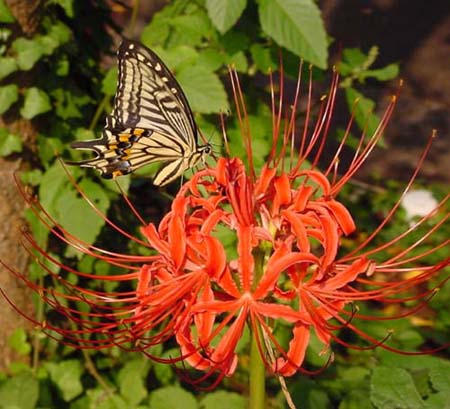
http://www.city.narita.chiba.jp/DAT/LIB/WEB/1/9_2.jpg
Quote:
This flower is native to Japan. In Japanese, it is called "higanbana" which translates roughly to "the flower that blooms during the (fall) equinox". In English it is called the "red spider lily," or the "hurricane lily". (The latter name because it blooms following the rains brought by Gulf Coast hurricanes in August and September). Its Latin (botanical) name is "Lycoris radiata". It is a beautiful flower in any language.
http://www.zanthan.com/japan/nihongo/archives/000767.html
xxxxxxxxxxxxxxxxxxxxxxxxxxxxx
This hauntigly beautiful flower is native to China and has been introduced to Japan early, since we know of poems about it in the famous Manyoo-shuu poetry collection.
The stem contains some eatable proteins, therefore it was planted in great numbers on the narrow paths between the rice fields (aze-michi) to be used as an emergency food in case the rice harvest was not as bountiful as expected. It also contains a toxic agent against the mice, so it was planted to protect the rice fields.
In autumn, when our rice fields are all golden, it makes a most spectacular sight as a red border contrast between the fields. After the flowers on their single stems grow up to about 40 cm, the red flowers open up over night, clustering together in lavish red spots. Once the flowers are all gone, thick green lancet-like leaves appear and can be seen until spring.
This flower has many names in Japanes, some say more than nine hundred. Here are just a few of them.
The word “Manjushage” 曼珠沙華 is taken from a line in the Buddhist Lotus sutra, refering to a red flower in Sanskrit prononciation.
manjusage まんじゅさげ
“higan-bana” 彼岸花、flower of the autumn equinox.
“doku-bana” 毒花, poisonous flower (as we have seen above, it contains poison)
kitsunebana 狐花(きつねばな)"fox flower"
“shibito-bana” 死人花, the flower of the dead.
sanmaibana 三昧花(さんまいばな) "samadhi flower"
shitamagari したまがり
sutegobana 捨子花(すてごばな)"abandoned child flower"
“yuurei-bana” 幽霊花, flower that looks like a ghost, a phantom.
“tengai-bana” 天蓋花、flower that looks like the ceiling decoration (tengai) of a Buddhist inner sanctuary.
“yome no kanzashi” , flower that looks like a gourgeous hairpin decoration of a bride.
In haiku, this surprising grow of a dark-red passion should be expressed with this kigo. Also the Buddhist connotation from the Lotus sutra and the co-incidence of the autumn equinox, when they grow around the private graves of the family ancestors of rural areas is expressed. It is customary to visit the family ancestors grave during spring and autumn equinox, as well as during the Bon festival in August, to pray for the protection of the family. In autumn, enjoying the higan-bana, the equinox flowers, is a great joy during these trips.
Gabi Greve

http://imaginatorium.org/sano/pics/b04305.jpg
ooo ooo ooo ooo ooo ooo ooo ooo ooo
Some more pictures of this flower.
http://home.hiroshima-u.ac.jp/forum/29-6/photo.html
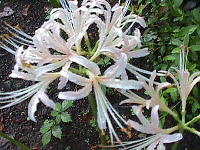
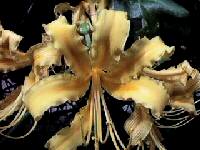
Various colors of spider lilies.
White: http://www.kumamotokokufu-h.ed.jp/kumamoto/sizen/image/00higan1.jpg
Yellow: http://www.kumamotokokufu-h.ed.jp/kumamoto/sizen/image/higany.jpg
Look at some more here:
http://www.kumamotokokufu-h.ed.jp/kumamoto/sizen/higanban.html
Beautiful rural scenes around Hinata Yakushi Temple in Isegahara,Kanagawa pref.
http://www.geocities.jp/takeshifumio/higanbana2.jpg
Look at all these beautiful pictures here:
http://www.geocities.jp/takeshifumio/higanbana_1.htm
:::::::::::::::::::::::::::::::::::::::::::::::::::::::::::::::::::::::::::::::::::::::::::::::::::::
Koma Shrine 高麗神社、巾着田の彼岸花
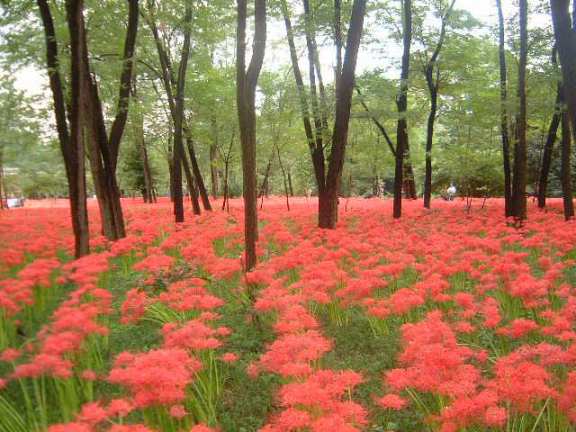
is famous for a large field of Spider Lilies (higanbana). They grow in a light forest, like a red carpet when they are all in full bloom
http://www.komakusa.net/photo/auto/images/DSCF0036.jpg
Check the changing photos on this page.
http://www.komakusa.net/photo/auto/
Another great picture

and many more
http://www2u.biglobe.ne.jp/~shinithi/higannbana-3/kintyak.html
Look at the forest with the red carpet
http://www.nextftp.com/oume-hotaru/zarigani/mannju/DSCF0005.jpg
Another page with beautiful photos
http://www.nextftp.com/oume-hotaru/zarigani/mannju/mannju.htm
*****************************
Worldwide use
It comes in bright red, white or light yellow. Also called “storm lily” or “cluster amaryllis”.
On the following LINK you can read a lot more and enjoy more pictures.
Brian Chandler even has a little photo gallery here.
http://imaginatorium.org/sano/higanb.htm
*****************************
Things found on the way
Spider Lily is the common name for a number of different plant species within the family Amaryllidaceae which belong to the following genera:
Crinum, a genus of about 180 species of perennial plants found along the sides of streams and lakes in tropical and subtropical areas worldwide, including South Africa
Hymenocallis, a genus of plants in the family Amaryllidaceae
Lycoris (plant), a genus of 13–20 species of flowering plants in the family Amaryllidaceae, formerly often treated in the family Liliaceae
© More in the WIKIPEDIA !
. . . CLICK here for Photos of crinum lilies !
. . . CLICK here for Photos of Hymenocallis !
*****************************
HAIKU
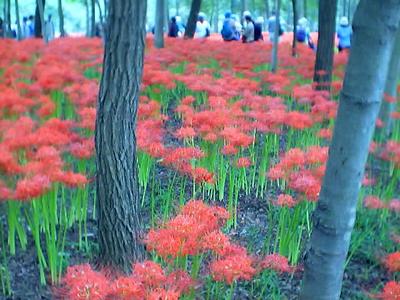
as many spider lilies
as many people:
along the river
Photo and Haiku by Chibi
http://groups.yahoo.com/group/happyhaiku/message/945
red lace
of the spider lilies:
crowds admire
Daruma's color
shows
Chibi
http://groups.yahoo.com/group/Darumasan-Japan/message/612
:::::::::::::::::::::::::::::::::::::::::::::::::::::::::::::::::::::::::::::::::::::::::::::::::::::
tsukinukete tenjoo no kon manjushage
つきぬけて天上の紺曼珠沙華
山口 誓子 Yamaguchi Seishi
up into the sky
a penetrating azure--
red spider lily
(tr. T. Kodaira & H. Marks)
http://home.att.ne.jp/star/biling-haiku/top-haiku-archive.htm
:::::::::::::::::::::::::::::::::::::::::::::::::::::::::::::::::::::::::::::::::::::::::::::::::::::
竹林を出れば白雲曼珠沙華
chikurin o dereba haku-un manjushage
out of the bamboo grove
there are white clouds
there are spiderer lilies
. Kaneko Tohta, Kaneko Tota 金子兜太 .
:::::::::::::::::::::::::::::::::::::::::::::::::::::::::::::::::::::::::::::::::::::::::::::::::::::
曼珠沙華孤立無援は好きですか
manjushage koritsu mu-en wa suki desu ka?
oh amaryllis,
so lonely and isolate,
are you there by choice?
(translated by Christpher Dale)
Looking askance at the bustle of the world, drinking deeply of the morning dew, in the corner quietly loitering, there is a definite air of satori about the solitary flower, "so lonely and isolate", in this scene.
"Manjushage" is one of many names for "higan-bana", the cluster amaryllis, so-called because it flowers around "aki no higan", the autumnal eqinox. As if by volition, it always sprouts in the same place every year, be it from amidst a bunch of weeds, or in the shade of a tombstone, and so the author wonders if, in this case, the isolation from the world is self imposed.
Quoted from this bilingual haiku page
http://www.guy5.com/haiku1208b/world-5.html
xxxxxxxxxxxxxxxxxxxxxxxxxxxxxxxx
autumn shower
cooled flame of fire,
passed away
World Tempos Jounal
http://home.alc.co.jp/db/owa/PH_DIARY?stage=show&diary_sn_in=269
xxxxxxxxxxxxxxxxxxxxxxxxxxxxx
yellow rice-fields -
cluster amaryllis paint
red borders
Gabi Greve
:::::::::::::::::::::::::::::::::::::::::::::::::::::::::::::::::::::::::::::::::::::::::::::::::::::
歩き続ける 彼岸花 咲き続ける
aruki-tsuzukeru higanbana saki-tsuzukeru
I keep walking
the spider lilies
keep blooming
. Santooka 種田山頭火 Taneda Santoka .
From a discussion at the Translating Haiku Forum
utsuri kite/ o-higanbana no/ hana zakari
Taneda Santoka (Taneda Santooka 種田山頭火(たねだ さんとうか)
Having moved in and settled down,
I'm surrounded by flowers of the opposite shore/
flowers of the autumnal equinox.*
*opposite shore (Higan)--Buddhistic term.
autumnal equinox (Higan/Shuubun-no-hi)--day on the calendar.
Tr. Takashi Nonin at Terebess Asia Online
................................. Comment by Larry Bole
This translation seems way too wordy to me. The problem is in deciding what to include in the translation, and what to consign to an explanatory footnote.
The flower in question is lycoris radiata, commonly known as red spider lily; but since it is part of the amaryllis family, I have also seen it called amaryllis.
Here are a couple of attempts at translation I have made:
settled in among
flowers of the other shore...
autumn equinox
settled in and surrounded
by red spider lilies--
autumn equinox
There is another translation of this haiku I have found:
(First days in the Gochuu-an)
moving in
higan lilies
at their best
tr. Burton Watson
Is Mr. Watson's translation too minimalist?
I have also come across a couple of nicknames for the red spider lily, as found in the following exerpt:
"Japanese people had long loathed higanbana because it grows in cemeteries, blooms in autumn (a season when, according to Buddhist teachings, people enter a world of death from the world of life), and its bulbs contain a toxin that affects the nerve system. In fact, higanbana has been nicknamed shibitobana (dead person's flower) and jigokubana (flower of the hell). Legend goes that people who eat higanbana in hunger are destined to die due to the toxin."
Kansai in Focus
... ... ...
> moving in -
> spider lilies by the graves
> at their best
>
"by the graves" gives a bit of the actual association the Japanese have about this flower.
Gabi Greve
... ... ...
Les herbes folles
se couvrent d'automne
je m'assieds
from the Atlan/Bianu 2002 anthology
http://epha-ta.hautetfort.com/
:::::::::::::::::::::::::::::::::::::::::::::::::::::::::::::::::::::::::::::::::::::::::::::::::::::

trying to catch
all of the sunshine
all at once
Gabi Greve, September 2009
*****************************
Related words
***** . Autumn Equinox
***** Spring equinox, vernal equinox
:::::::::::::::::::::::::::::::::::::::::::::::::::::::::::::::::::::::::::::::::::::::::::::::::::::
. Lilies and Kigo .
... ... The World Kigo Database
:::::::::::::::::::::::::::::::::::::::::::::::::::::::::::::::::::::::::::::::::::::::::::::::::::::


 Posts
Posts





3 comments:
.
Spider Lilies and small life
Gabi Greve, Autumn 2007
they are beatiful
一面に祖霊一面の曼珠沙華
ichimen ni sorei ichimen no manjushage
everywhere there are
ancestor sprits - everywhere there are
spider lilies
Morio Suzume 森尾雀子
MORE
about the ancestral spirits
.
Post a Comment