:::::::::::::::::::::::::::::::::::::::::::::::::::::::::::::::::::::::::::::::::::::::::::::::::::::
Fog, Mist and more hazy words
Nebel, Dunst
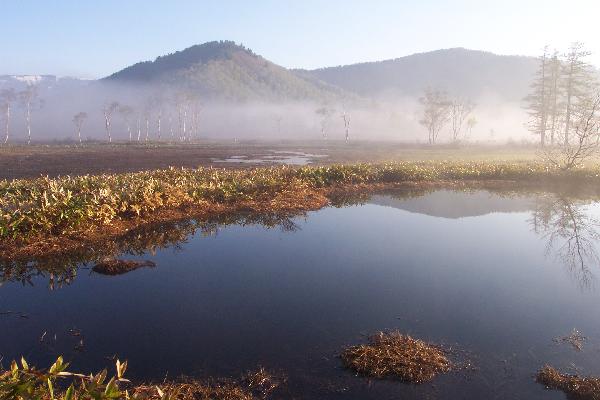
http://iyashi.midb.jp/search/?id=2&mode=word
Oze Swamp in Spring
*****************************
Explanation
Fog and mist are well known phenomen, mostly during the whole year, but seasonally special in some areas. The Japanese kigo are well defined, but their translation in English might not bring the same familiar seasonal ring.
As a general rule, the Japanese words kasumi and oboro are haze and mist of spring, whereas kiri is the fog of autumn and winter.
Smog usually builds up in the summer months in big cities.
Misty memory, hazy mind and such use of adjectives are not considered kigo.
For more details, read the extensive explanations here, page 191 - 194:
Haiku World: An International Poetry Almanac
William J. Higginson
All these kigo belong the the category of HEAVEN (天然).
Let us look at the physical nature of these phenomen first.
Fog, mist and haze are not precipitation as they don't fall to the ground. Reduced visibility near the ground is caused by tiny particles suspended in the air. Water droplets that cause a moderate reduction in visibility are called mist. Those causing a serious visibility problem are called fog. Mists and fogs often form over seas, rivers, and lakes. Particles of dust, smoke or salt that affect the clarity of the air are collectively known as haze.
Fog - visibility below 1,000 m (1,100 yards) - mainly affects aircraft.
Thick fog - visibility 50-200 m (55 - 220 yards) - dangerous for road traffic.
Dense fog - visibility below 50 m (55 yards) - seriously disrupts all forms of transport.

.. .. .. Three types of Fog
Radiation fog occurs when the land radiates heat into space and the air rapidly cools to the dew point. Radiation fog tends to collect in valleys and other ‘frost hollows' causing motorway pile-ups sometimes because drivers do not slow down enough in foggy conditions.
Sea fog - often known as 'steam' fog (over fresh water) or sea smoke (over the sea) forms when cold air is over much warmer water. This is the same effect as cold air turning to steam over a hot bath or hot sink. There needs to be about 9 degrees C difference for this to happen. True steam occurs when the temperature is 100 degrees C.
Advection fog occurs when warm moist air is cooled by a cooler surface, such as over a cool sea in the spring. Fog banks are common in the northwest Atlantic where they form over cold, shallow, offshore waters, such as the Grand Banks of Newfoundland. It also happens when warm moist air blows over a cold sea or lake.
Smog: (smoke-laden fog)
Dirty fog produced by air pollution in cities, and often occurring beneath a temperature inversion. The action of sunlight can produce photo-chemical smog.
http://www.bbc.co.uk/weather/weatherwise/factfiles/basics/precipitation_fog.shtml
Weather Terms Glossary
http://www.bbc.co.uk/weather/weatherwise/glossary/
The great Smog of London in 1952
http://weather.about.com/library/weekly/aa121402a.htm
Links about FOG
http://weather.about.com/sitesearch.htm?terms=fog&SUName=weather&TopNode=4018&type=1
Links about HAZE
http://weather.about.com/sitesearch.htm?terms=haze&SUName=weather&TopNode=4018&type=1
Links about MIST
http://weather.about.com/sitesearch.htm?terms=mist&SUName=weather&TopNode=4018&type=1
Malaysia haze
A smokey haze is creating profound problems in Malaysia, according to the Agence France Press. The haze, which is the result of forest fires on the nearby island of Sumatra, is delaying airline flights and creating health problems.
::::::::::::::::::::::::::::::::::::::::::::::::::::::::::::::::::::::::::::::::::::::::::::::::

Graves in Morning Mist
Read the Haiku Collection of Gabi Greve
http://happyhaiku.blogspot.com/2004/10/lonely-graves-in-mist.html
Now let us go back to the kigo related to these words.
**********************************
Spring
Mist, Spring mist, Spring mistiness ,
Spring haze, Spring haziness : kasumi 霞
According to Higginson
Spring haziness focusses on obscured vision at night, whereas Spring haze refers to any haze or mist, usually during daytime hours.
(To complicate things, some refer to haze as "thin mist").
harugasumi 春霞(はるがすみ)spring haze
muragasumi 叢霞(むらがすみ)spots of haze
yaegasumi 八重霞(やえがすみ)many layers of haze
yokogasumi 横霞(よこがすみ)horizontal haze
evening haze : kasumi yo 霞夜
morning haze: asagasumi 朝霞
.... ariakegasumi 有明霞(ありあけがすみ)
hirugasumi 昼霞(ひるがすみ)haze during daytime
yuugasumi 夕霞(ゆうがすみ)haze in the evening
banka 晩霞(ばんか)haze at night
haze in the offing : kasumi no oki 霞の沖
kasumi no umi 霞の海(かすみのうみ)sea, ocean in haze
kasumi no nami 霞の浪(かすみのなみ)waves in haze
kasumi no fumoto 霞の麓(かすみのふもと)
foot of the mountain in haze
kasumi no tani 霞の谷(かすみのたに)valley in haze
kasumi no soko 霞の底(かすみのそこ)
haze at the bottom of the valley
kasumi no sora 霞の空(かすみのそら)sky in haze
kasumi no obi 霞の帯(かすみのおび)belt of haze
thin spring haze : usugasumi 薄霞
veil of haze : kasumi-gakure 霞隠れ
haze in the distance : too-kasumi 遠霞
wild plants in the haze : kusa kasumu 草霞む
kasumi shiku 霞敷く(かすみしく)haze is spreading
..... kasumi wataru 霞渡る(かすみわたる)
kasumi tanabiku 霞棚引く(かすみたなびく)haze is hanging
kasumi tatsu 霞立つ(かすみたつ)haze is building up
Mist could also be used as a translation for for the above terms.
In the following MIST seems the appropriate translation:
sleeves of mist : kasumi no tamoto 霞の袂
kasumi no koromo 、霞の衣(かすみのころも)
kasumi no sode 霞の袖(かすみのそで)
nets of mist : kasumi no ami 霞の網
. Saho-Hime 佐保姫 Princess Sahohime
and the spring mist and wind
..............................................................
sitting on a
blanket of mist,
stone buddha
Robert Wilson
.........................................................................
Spring haziness, Spring mistiness , haze, hazy
oboro 朧
kigo with OBORO are usually refering to evening and night phenomenon.
When the temperatures rise during daytime, some moisture in the air shows a hazy landscape in the evening, especially when the moon is bright.

hazy moon : oborozuki, tsuki oboro 朧月(all spring)
hazy evening : oboroyo 朧夜
hazy moonlight evening : oborozukiyo 朧月夜
looking hazy : oboro meku 朧めく
distant mulled sound of the temple bell : kane oboro 鐘朧, kane kasumu 鐘霞む
Here the feeling of haze includes the deep sound of a distant Japanese temple bell.
The hazy Spring moon, the cloudy moon in a veil of clouds is a well-loved expression in Japanese literature since ancient times.

http://www.asahi-net.or.jp/~nr8c-ab/zzz.htm
おぼろ月松出ぬけても出ぬけても
oboro-zuki matsu denukete mo denukete mo
hazy moon--
the pine passing through
passing through
Issa
http://cat.xula.edu/issa/searchissa.php?colors=T&show_c=T&haiku_id=081.15a
**********************************
Summer
summer fog, summer mist :
natsu no kiri, natsugiri 夏霧
summer haze, summer mist : natsugasumi 夏霞
Thick fog often builds in the Sea of Ohotsk in Hokkaido. To find their way ships use their horns and whistles.
fog at sea, sea fog : umigiri, jiri 海霧
ship's whistle in the fog, fog horn (foghorn),
Nebelhorn : muteki 霧笛
Look at a photo of the FOGHORN by Paul Conneally
**********************************
Autumn

http://www.uroncha.com/04wata/04wata11/0411-1.html
Fog : kiri 霧 (きり)
morning fog : asagiri 朝霧 (あさぎり)
evening fog : yuugiri 夕霧(ゆうぎり)
night fog : yogiri 夜霧 (よぎり)
usugiri 薄霧(うすぎり)light fog
noomu 濃霧(のうむ)thick fog
..... sagiri 狭霧(さぎり)
kiri no umi 霧の海(きりのうみ)fog on sea
kiri no tani 霧の谷(きりのたに)fog in the valley
kiri no tobari 霧の帳(きりのとばり)fog on the curtains
kiribusuma 霧襖(きりぶすま)fog on the sliding doors
kiri no magaki 霧の籬(きりのまがき)fog around the fence
kirisame 霧雨(きりさめ) "fog and rain"
kirishigure 霧時雨(きりしぐれ)"fog and sleet"
kirishizuku 霧雫(きりしずく) "fog and a drop"
a drop of dew in the fog
scent in the fog, smell :
kiri no ka, kiri niou 霧の香、霧匂う
The scent is often from fires burning fallen leaves or weeds.
.....
kiri ni noru metsuki shite iru karasu kana
looking to ride
the mist...
a crow
Tr. David Lanoue
雨を分て夕霧のぼる外山哉
ame o wakete yuugiri noboru toyama kana
pushing through rain
evening mist climbs
a low mountain
Tr. Chris Drake
This autumn hokku was written in 1792, probably when Issa was traveling around on the island of Shikoku. It is a highly tactile hokku, with the autumn evening mist rising upward against the momentum of the falling rain, and the physical contact between the flow of the mist and the flow countless raindrops in the opposite direction can be almost felt, as if the two were rubbing against each other (wakete, "push through," is often used when someone pushes through a group of people or a crowd). A feeling of exertion strangely mixes with a sense of lightness and effortless movement as the mist follows the slope of a nearby low mountain until it reaches either the mountaintop or the bottoms of the low-hanging rain clouds.
Chris Drake
. Kobayashi Issa 小林一茶 in Edo .
autumn sunset -
on the misty mountain
a final sunray
Gabi Greve
http://groups.yahoo.com/group/happyhaiku/message/638
..........................................................................
- - - - - Yosa Buson, 1769 - - - - -
朝霧や画にかく夢の人通り
asagiri ya e ni kaku yume no hitodoori
morning mist;
a dream in paints
of people passing
Tr. Haldane
Morning mist--
A dream-like picture drawn
Of pedestrian traffic
Tr. Nelson/Saito
quote
You will recall that Buson was a painter, and he often strives for painterly effects in his hokku, which makes them a bit artificial. It is worth remembering that Buson — not Bashō — was the favorite of Masaoka Shiki, the fellow who nearly destroyed hokku by his revisionistic creation of the haiku near the beginning of the 20th century. It was the “painter” aspect of Buson that Shiki liked, which contributed to Shiki’s notion that his new “haiku” should be a kind of illustration or sketch from life.
But let’s look now at Buson’s verse:
Morning fog–
A painting of people passing
In a dream.
It is really too intentionally beautiful for hokku, and is somewhat like an impressionist painting.
Literally, what Buson wrote was:
Asagiri ya e ni kaku yume no hito dōri
Morning-fog ya picture in painted dream ‘s people pass
So if we moved things around a bit, we could translate it more literally as
Morning fog:
Painted in a picture –
Dream people passing.
Either way, however, it does what hokku should not do — it pulls our attention in two different directions by comparing one thing with another. Instead of just telling us that people are passing in the morning fog, he goes beyond and tells us that it is like a picture of people passing in a dream — of dream-people passing. Any time we have to use the word “like” to explain something in hokku, it is a warning sign. Hokku should let things just be themselves, not be “like” this or “like” that.
source : David Coomler
. Yosa Buson 与謝蕪村 in Edo .
..................................................................
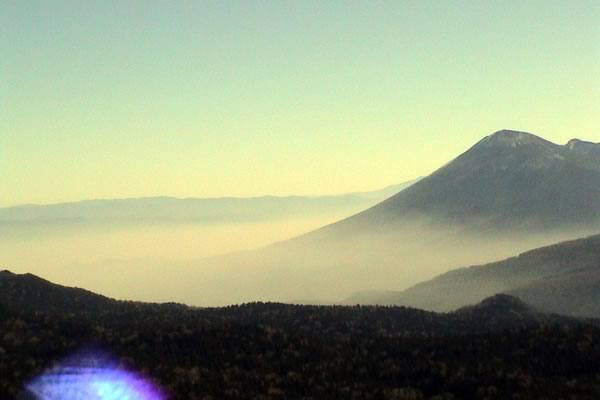
Look at a great collection of Morning Fog photos from Japan.
http://iyashi.midb.jp/search/?id=2&mode=word
asagiri ya shashin o mireba genki no deru
morning mist -
just looking at the photos
makes me happy
Gabi Greve
..........................................................................
Yuugiri, Yugiri, Evening Fog
is a famous character in the Genji Monogatari.
Fragment of the Takeya Edition of the Yûgiri Chapter of The Tale of Genji
http://www.emuseum.jp/cgi/bunsyutu.cgi?SyoID=5&ID=w027&SubID=s029&Link=w027x001

http://www.pref.kyoto.jp/2008genji/1183089639569.html : 夕霧(ゆうぎり)
夕霧や馬の覚し橋の穴
yuugiri ya uma no oboeshi hashi no ana
evening fog -
the horse remembers
the holes in the bridge
Issa
Tr. Gabi Greve
Discussing the translation
**********************************
Winter
winter fog : fuyugiri 冬霧 , fuyu no kiri 冬霧(ふゆぎり)
winter mist : fuyugasumi 冬霞
... fuyu no kasumi 冬の霞(ふゆのかすみ)
... fuyu kasumu 冬霞む(ふゆかすむ)、
winter haze : fuyu no moya 冬の靄
cold haze : kanai 寒靄
itegasumi 凍霞(いてがすみ)freezing mist
sumogu スモッグ smog
... enmu 煙霧(えんむ)
**********************************
New Year
hatsugasumi 初霞 (はつがすみ) first mist (of the year)
... niigasumi 新霞(にいがすみ)
:::::::::::::::::::::::::::::::::::::::::::::::::::::::::::::::::::::::::::::::::::::::::::
:::::::::::::::::::::::::::::::::::::::::::::::::::::::::::::::::::::::::::::::::::::::::::
More Haiku
草霞み水に声なき日ぐれかな
kusa kasumi mizu ni koe naki higure kana
grasses in mist
waters with silence;
evening
Tr. Michael Haldane
Grasses in a mist
and water flowing silently,
daylight fading!
Tr. anonymous
Grasses are misty,
The waters silent --
A tranquil evening.
Tr. anonymous
Misty grasses,
Quiet waters,
It's evening.
Tr. anonymous
The meadow is in mist
The water voiceless--
The sunset
Tr. anonymous
source : Terebess Asia Online (TAO)
:::::::::::::::::::::::::::::::::::::::::::::::::::::::::::::::::::::::::::::::::::::::::::::::::::::
Haze at a distance-
flock of storcks are threading
one's way southwards
Vasile Moldovan
:::::::::::::::::::::::::::::::::::::::::::::::::::::::::::::::::::::::::::::::::::::::::::
Some placenames in Japan contain fog and mist, since this is the main feature of the local weather.
Kasumi-ga-Ura 霞ヶ浦
Kasumigaura is located in the southeastern section of Ibaraki Prefecture.
As a single lake, Kasumigaura is second only to Lake Biwa in size in Japan, and provides the basis for the region's residential and industrial development.

About 200,000 years ago in the middle of the Pleistocene Epoch, the area surrounding Kasumigaura was a part of the ocean referred to as Old Tokyo Bay that extended across the Kanto region. Over time the shallow sea floor that accumulated in Old Tokyo Bay changed into land, forming a plateau 20-40m above sea level that extends across present-day Kasumigaura.
English Reference
:::::::::::::::::::::::::::::::::::::::::::::::::::::::::::::::::::::::::::::::::::::::::::::::::::::
. WKD : FOG in Kenya
:::::::::::::::::::::::::::::::::::::::::::::::::::::::::::::::::::::::::::::::::::::::::::::::::::::
California, USA
tule fog

quote
Tule fog
is a thick ground fog that settles in the San Joaquin Valley and Sacramento Valley areas of California's Great Central Valley. Tule fog forms during the
late fall and winter (California's rainy season)
after the first significant rainfall. The official time frame for tule fog to form is from November 1 to March 31.
This phenomenon is named after the tule grass wetlands (tulares) of the Central Valley. Accidents caused by the tule fog are the leading cause of weather-related casualties in California.
© More in the WIKIPEDIA !
tule fog
a cotton field as far as
I can't see
- Shared by Jimmy ThePeach -
Joys of Japan, 2012
:::::::::::::::::::::::::::::::::::::::::::::::::::::::::::::::::::::::::::::::::::::::::::::::::::::
. SAIJIKI - - HEAVEN in all seasons
[ . BACK to DARUMA MUSEUM TOP . ]
[ . BACK to WORLDKIGO . TOP . ]
:::::::::::::::::::::::::::::::::::::::::::::::::::::::::::::::::::::::::::::::::::::::::::::::::::::


 Posts
Posts



26 comments:
Smog and air pollution can be both a summer and winter kigo.
One reason for this dual season nature is that the inversion layers that trap the smog are strongest in both summer and winter months.
>
>gK
>
http://news.yahoo.com/s/afp/franceenvironmentweather;_ylt=AhlpEQa66lij6P.yzs383\
ewDW7oF;_ylu=X3oDMTBiMW04NW9mBHNlYwMlJVRPUCUl
......................................................................
Thank you, gK!
Gabi
Picture of mist at sea (jiri)
海霧(じり)が天心の六角堂を覆い隠してきました。。。。
Etsuko Yanagibori
For the past couple of nights, we have had thick fog here in Brussels, right in the city centre, where it normally does not reach. This was quite unusual, and I have been soaking it in -- almost literally!
fog in the city
now i cannot see
those i do not know
fog in the city
the silence
of the closed airport
fog in the park
heavy sky above
just like snow
sheer joy
enjoyed alone
foggy night
Isabelle Prondzynski
::::::::::::::::::::::::::::::::::::::::::::::::::::::::::::::::::::::
a fog descends to
drape the mountain ~
sunlight in the valley
Narayanan Raghunathan
::::::::::::::::::::::::::::::::::::::::::::::::::::::::::::::::::::::
dripping mist
pulls the sky
into the valley
first published in Bottle rockets – issue # 13
Kala Ramesh, India
::::::::::::::::::::::::::::::::::::::::::::::::::::::::::::::::::::::
. VOG (volcanic smog) in Hawaii .
non-seasonal topic
::::::::::::::::::::::::::::::::::::::::::::::::::::::::::::::::::::::
sheltered cows
from the fog,
the farmer reads
¤
les vaches
à l'abri du brouillard,
le fermier lit
¤
Marcel Peltier (Belgium)
February 2006
::::::::::::::::::::::::::::::::::::::::::::::::::::::::::::::::::::::
............ Fog Horn Haiku
> > foghorn --
> > surprise onomatopoeia
> > as she reads her poem
> >
> > -Deborah P Kolodji
> foghorn --
> my stone skipping
> twice
>
> chris e.
foghorn --
tripping
on the jetty
--Billie
Quoted from
http://groups.yahoo.com/group/simply_haiku/message/16244
.
those footprints
walk my dreams
into a mist
Dr.Vidur Jyoti, WHCindia, 2006
::::::::::::::::::::::::::::::::::::::::::::::::::::::::::::::::::::::
.
thick fog -
my camera does not see
the color behind
Pia
cold fog --
the balcony moss
all the greener
Isabelle
http://groups.yahoo.com/group/happyhaiku/message/3807
Dear gabi san thank you for oboro and gentle ways.
this is for you. I must remember to check with your kigo database.
I send a bow and warmth.
michele
----------------------------------------------
plainly hidden
behind this april mist
nothing
=============================
http://groups.yahoo.com/group/cherrypoetryclub/message/29590
at the gate
how many thousands of bushels
of far mist?
monzen ya nan man-goku no to^gasumi
門前や何万石の遠がすみ
by Issa, 1795
Issa asks how many "ten-thousands" (man) of koku might there be. 1 koku = 4.96 bushels.
Tr. David Lanoue / http://cat.xula.edu/issa/
Matsuo Basho
雲霧の暫時百景を尽しけり
kumo kiri no zanji hyakkei o tsukushi keri
with clouds and mist
in a brief moment a hundred scenes
brought to fulfillment
Tr. Barnhill
おぼろ夜の妙見社殿朱塗りにて
oboro yo no Myooken shaden shunuri nite
the vermillion red
of the Myoken Shrine building
on a hazy spring night
Matsumoto Yoohei 松本陽平 Matsumoto Yohei
MORE about shrine buildings
Matsuo Basho at Yamanaka Hot Spring
湯の名残り幾度見るや霧のもと
yu no nagori iku tabi miru ya kiri no moto
Yosa Buson and kasumi
高麗舟のよらで過ぎゆく霞かな
Komabune no yorade sugiyuku kasumi kana
and Korean Ambassadors
.
Kobayashi Issa
窓先や常来る人の薄霞
mado saki ya tsune kuru hito no usugasumi
outside the window
in thin mist someone
constantly approaching
snip
Mist in Japanese poetry is an image of approaching spring and the new year, but there doesn't seem to be any hint of celebration in this hokku. On one level, perhaps, the hokku is personal and psychological.
Read the full comment of Chris Drake . . .
.
Matsuo Basho
大比叡やしの字を引いて一霞
Oo-Hie ya shi no ji o hiite hito kasumi
this large mount Hiei -
a whiff of mist
like the letter SHI
MORE
about mount Hiei-Zan
Yosa Buson
よき人を宿す小家や朧月
yoki hito o yadosu ko-ie ya oborozuki
yoki hito よき人 "good people", persons of high rank
The small house must have looked especially luring and elegant in the spring moon.
Masaoka Shiki
長刀の影おぼろなり橋の月
naginata no kage oboro nari hashi no tsuki
the shadow of a halberd
in the haze -
moon on the bridge
MORE about naginata
Natsume Soseki 夏目漱石
霞みけり物見の松に熊坂が
kasumikeri monomi no matsu ni kumasaka ka
spring haze
at the "Lookout Pine"
it that Kumasaka ?
MORE
about Kumasaka, the robber
燈台はひくく霧笛は峙てり
toodai wa hikuku muteki wa sobadateri
the lighthouse
is low, the fog horn reaches
up to heaven
. Takahama Kyoshi 高浜 虚子 .
Lighthouse
- harugasumi -
古事記読む八方に濃き春霞
kojiki yomu happoo ni koki harugasumi
reading the Kojiki -
in all directions there is
thick spring haze
. Arima Akito 有馬朗人 .
. Kojiki -
- fuyugasumi -
遠しとは常世か黄泉か冬霞
tooshi to wa tokoyo ka yomi ka fuyugasumi
far away - does that mean
heaven or the nether world ?
mist in winter
Nakamura Sonoko 中村苑子(1913-2001)
Born in Shizuoka
yomi, the Nether World
muteki kinenbi 霧笛記念日day of the ships's fog horn (whistle)
Nebelhorn
created in 1879.The first lighthouse in Aomori, Tsugaru straight at 尻屋崎灯台, used it.
December 20
.
Calendar Days of Japan
.
Legends from Ehime
Mitsu Kaido 三津街道 Mitsu Highway
気車戻る三津街道や朧月
kisha modoru Mitsu Kaido ya oborozuki
the train comes back
on the old Mitsu Kaido -
hazy moon
. Masaoka Shiki 正岡子規 and 松山 Matsuyama .
.
https://edoflourishing.blogspot.com/2019/09/mitsu-kaido-highway.html
.
Post a Comment