. Legends about cats .
. Cats and Daruma san .
. Daruma as a cat 猫だるま .
:::::::::::::::::::::::::::::::::::::::::::::::::::::::::::::::::::::::::::::::::::::::::::::::::::::
Cat (neko)
***** Location: Japan
***** Season: Nonseasonal Topic
***** Category: Animal
*****************************
Explanation

http://darumasan.blogspot.com/2005/03/washi-japanese-paper_31.html
The cat, with no further explanation, is man's best friend during the whole year. There are however seasonal events in a cat's life that come as a kigo. Let us look at them.
.. .. .. Kigo for early spring:
love-season for cats, neko no koi 猫の恋、koi neko 恋猫
cat in heat, cats mate, neko sakaru 猫さかる
cat in spring, haru no neko 春の猫(はるのねこ)
philandering cat, ukare neko 浮かれ猫
"cats walking to their lovers", kayou neko 通う猫(かようねこ)
a cat's mate : according to the Chinese character it is written in, it can be the male or female partner,
neko no tsuma 猫の夫 (male) 猫の妻 (female)
cat going hunting for a girlfriend, imogari yuku neko
..... 妹がり行く猫(いもがりゆくねこ)
pledge of a cat, neko no chigiri 猫の契(ねこのちぎり)
pregnant cat, harami neko 孕み猫(はらみねこ)
kigo for late spring
mother cat giving birth, neko no san 猫の産(ねこのさん)
kitten, neko no ko 猫の子
small cat, koneko 仔猫(こねこ
parent of a kitten, neko no oya 猫の親(ねこのおや), oyaneko 親猫(おやねこ)
cat with kittens, komochi neko 子持猫(こもちねこ)
February 22 is "the Day of the Cat"
The Japanese cat's voice is "nyan!"
So, this is play of words, 2.22 (nyan, nyan, nyan)

- photo : Japan Lovers, facebook -
spring adventures -
getting old
gracefully
Gabi Greve, April 2015
.................................................................................

.................................................................................
kigo for all winter
kajike neko かじけ猫 (かじけねこ) cat is all stiff
(because of the cold)
haineko, hai neko 灰猫(はいねこ)neko in the ashes
(the hearth was a warm place in an old farmhouse)
kamado neko 竈猫(かまどねこ)neko in the hearth
hekkoi neko へっつい猫(へっついねこ)
kotatsu neko 炬燵猫(こたつねこ)cat in the kotatsu

My Cat Haiku Kun, by Gabi Greve
. Kotatsu, the heatable table
kotatsu neko -
another kigo
to brighten my day !
ooo ooo ooo ooo ooo ooo ooo ooo ooo
.. .. .. Plant Kigo for Autumn:
"toy for cats", neko jarashi, nekojarashi 猫じゃらし
giant foxtail, Chinese foxtail, Chinese millet
Setaria faberi, Setaria viridis.
giant bristlegrass, nodding foxtail
enokorogusa 狗尾草 , えのこぐさ "fox tail plant"
..... inukogusa 犬子草(いぬこぐさ)"small dog plant"
murasaki enokoro 紫えのころ(むらさきえのころ)violet
kin enokoro 金えのころ(きんえのころ) golden
hama enokoro 浜えのころ(はまえのころ)on the beach

Of the rice family, with a thin stem and a tail of about 10 cm. It is used to make cats or small dogs try to catch it.
During the Edo period, its name was "dog tail", but children also used it to play with cats, and with time the name changed.
*****************************
Worldwide use
Katze, Kater

門司ヶ関人形工房
*****************************
Things found on the way
Do not miss the Interview with Haiku kun
the honorable vice director of our World Kigo Database.
Japan Times, December 17, 2005
.................................................................................
Manekineko, the Beckoning Cat 招き猫
This is a special symbol for good luck in Japan and a nice present for the New Year.
Here is my story about this auspicious cat.
http://darumadollmuseum.blogspot.com/2005/01/cats-and-daruma.html
Gabi Greve

. Join the Manekineko on facebook ! .
.................................................................................

. neko Jizo 猫地蔵 Neko Jizo. "Jizo with Cat" .
.................................................................................

九谷焼鏑木商舗 Kutani ware - Kaburaki
. soroban 算盤 / 十呂盤 / そろばん Abacus calculator .
::::::::::::::::::::::::::::::::::::::::::::::::::::::::::::::::::::::::::::::::::
Japanese cats with NO tail . Find the Explanation here.
:::::::::::::::::::::::::::::::::::::::::::::::::::::::::::::::::::::::::::::::::::::::::::::::::::::
Nekomata – The Split-Tailed Cat
by Zack Davisson

Kamakura Period –
The Nekomata of the Mountains
Most Japanese yokai were born during the Edo period, but the nekomata has more ancient roots. Mention of the nekomata first appeared during the Kamakura period (1185-1333), where it was mentioned in the literary jottings of Yoshida Kenko in his scroll Tsurezure-gusa (徒然草; The Harvest of Leisure, also known as Essays in Idleness). Yoshida wrote “Deep in the mountains there is a creature called the nekomata. It is said that it feeds on humans.” At around the same period, Fujiwara Sadaie recorded in the scroll Meigetsuki (明月記; The Record of the Clear Moon, sometimes called Diary of the Clear Moon) that on August 8th in the first year of Tenpuku (1233) in Nanto (modern day Nara prefecture) a nekomata from the mountains killed and ate several people.
MORE
source : hyakumonogatari.com

Kaibyo: The Supernatural Cats of Japan
*****************************
HAIKU
- - - - - Matsuo Basho
麦飯にやつるる恋か猫の妻
mugimeshi ni yatsururu koi ka neko no tsuma
Has it been from love as well as barley rice
that it has grown so scrawny?
cat's mate.
Tr. Kawamoto
A cat's wife -
grown thin from love
and barley?
Tr. Shirane
from barley gruel
and from love it looses weight ?
the cat in love
Tr. Gabi Greve
Warum schreit die kleine Katze?
War der Brei ihr nicht sanft?
Oder ist sie verliebt?
Fur die Katzen-Zunft Messkirch
Am 21. Februar 1954 / Martin Heidegger
. Martin Heidegger .
This hokku has the question marker KA at the end of line 2.

source : itoyo/basho
Gunma, Temple 正幸寺 群馬県前橋市三河 正幸寺
麥めしにやつるゝ戀や里の猫
三日月や広いそらにも曲て置
source : satoneko.html
Written in 元禄4年, Basho age 48.
MORE
hokku about food by
. Matsuo Basho 松尾芭蕉 - Archives of the WKD .
MORE - about cats
張抜きの猫も知るなり今朝の秋
またうどな犬ふみつけて猫の恋
猫の恋やむとき閨の朧月
猫の妻竈の崩れより通ひけり
山は猫ねぶりて行くや雪の隙
. Matsuo Basho 松尾芭蕉 - Archives of the WKD .
:::::::::::::::::::::::::::::::::::::::::::::::::::::::::::::::::::::::::::::::::::::::::::::::::::::::
love season for cats -
the neighbours daddy too
returns in the morning
neko no koi - tonari no papa mo asa-gaeri
oo oo oo
cat and the mouse
taking a nap -
autumn solitude

See: Gabi Greve and Haiku Kun
If you want to see more of Haiku kun and his mother, check this:
Cats in Paradise, Japan
If you want to see more of Haiku kun, my sleeping cat, check this:
Haiku Kun, his Album.
:::::::::::::::::::::::::::::::::::::::::::::::::::::::::::::::::::::::::::::::::::::::::::::::::::::::
spring roof --
cats' community band
sawing the night in two
scrap-heap --
dining gracefully
a stray cat
Read more of Origa's haiku here:
http://thegreenleaf.co.uk/HP/Duets/Olga/00olgahaiku.htm
And check out Cat haiga ~ by Origa (Olga Hooper)
and more haiga
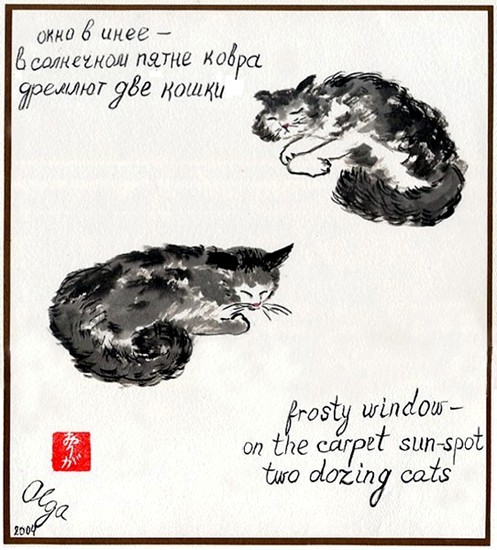
geocities.com/origaboston/OrigaHaiga
:::::::::::::::::::::::::::::::::::::::::::::::::::::::::::::::::::::::::::::::::::::::::::::::::::::
Muthurwa stalls-
houseflies buzzing on
a decomposing cat
Andrew Otinga
Kenya, February 2011
:::::::::::::::::::::::::::::::::::::::::::::::::::::::::::::::::::::::::::::::::::::::::::::::::::::

. . . CLICK here for more cat kokeshi dolls こけし !
:::::::::::::::::::::::::::::::::::::::::::::::::::::::::::::::::::::::::::::::::::::::::::::::::::::
- - - - - Kobayashi Issa - - - - -
嗅で見てよしにする也猫の恋
kaide mite kaide miru nari neko no koi
they sniff each other
sniff each other...
the lover cats
Tr. David Lanoue
年の内に春は来にけり猫の恋
toshi no uchi ni haru wa ki ni keri neko no koi
the year's not over
but spring comes anyway...
cats making love
Tr. David Lanoue
Robin D. Gill points out that the first 13 syllables of this haiku are taken from Ariwara-no-Motokata's waka--the first song of the ancient Kokinshuu collection.
Comment by Lary Bole, Translating Haiku:
I think this refers to the fact that due to adjustments that had to be made in the old Japanese lunar calendar, to keep it reasonably "accurate," sometimes the official day on which spring
started fell before the official start of the new year; so that sometimes a single year would have two official starts of spring, one near the beginning of the year, and one near the end. In an analogous way our modern calendar can sometimes have two full moons in the same month.
Jane Reichhold discusses this phenomenon in relation to the earliest known haiku written by Basho:
haru ya ko shi / toshi ya yuki ken / kotsugomori
Preface: "Today we have the first day of spring in spite of the date."
has spring come
or the year gone away?
end of December
Reichhold goes on to comment:
This is the oldest dated verse by Basho that we presently have. In his lifetime, the Japanese calendar was based on the phases of the moon so that the month began with the new moon, continued with the full moon on the 15th night and ended in the dark of the moon.
As with our solar calendar, adjustments had to be made to keep the calendar in sync with the skies. Thus, in 1663, instead of the first day of spring arriving on New Year's Day, as was normal, it was marked as beginning two days earlier.
Though this verse was written on what our calendar today would be the 7th of February, it referred to the last days of the old year, so it makes more sense to adjust the last line from "Second-Last Day" to end of December. This phenomenon had been commented on by poets since olden times as is shown by the link between Basho's verse and especially the one written by Ariwara Motokata (888-953) that opens the imperial anthology, Kokin Waka Shuu
(before the year ends / spring has already come / left-over days / how shall we name them? / the old or the new year?").
http://www.ahapoetry.com/basharc/abasbk1.htm
"年の内に春は来にけり一年を去年とや言はん今年とや言はん"
toshi no uchi ni haru wa ki ni keri
hitotose o nizo ya iwan
kotoshi to ya iwan
sniffing and looking
looking and sniffing
the lover cat
..........................................................................
. WKD : Kobayashi Issa 小林一茶 in Edo .
女猫子ゆへの盗とく逃よ
onna-neko ko yue no nusumi toku nige yo
female cat
stealing for your kittens
quick, run away!
Tr. Chris Drake
This hokku was written in the 8th month (September) of 1823, three months after Issa's wife Kiku wife has died. Issa sees a mother cat filching something (human food?), and he also seems to see that a human or dog or some other creature is approaching. He's obviously very concerned and warns the cat that she needs to leave what she's doing and return to her kittens immediately. It's hard not to feel that Issa's natural feeling for the cat and her kittens has been deepened by the loss of his wife and three infant children as well as by the bad health of his infant son Konzaburo, who will die in the 12th month of this year.
One puzzle is why Issa calls the mother cat simply "female cat." This is Issa's only hokku to use "female cat." In the previous two hokku in his diary he uses "mother cat."
Here's the previous hokku:
haha-neko ya nusumi shite kite ko o yobaru
mother cat
back with stolen goods
calls her kittens
The mother cat has apparently brought back some food and is making loud calls to her scattered kittens, so the use of "mother cat" is natural. Why, then, does Issa uses "female cat," literally "woman cat," in the first hokku above? Is he implying that a male cat is approaching and that he doesn't want the mother cat to forget about her kittens? September is the last month of the mating season, and even nursing cats are known to get pregnant. Or could Issa be suggesting that female cats and female humans are similar in the way they care for their young?
Chris Drake
庵の猫しゃがれ声にてうかれけり
io no neko shagare koe nite ukare-keri
husky-voiced
the cat in the house
floats elsewhere
This hokku is from the 2nd month (March) of 1817, when Issa was traveling around just east of Edo. He writes "the hut," a standard polite, humble expression meaning "the house," so he seems to be referring to one of the houses of his students or followers where he is staying temporarily during his trip. The cat could be either male or female, since both are in rut in spring, though females wail more when they are in heat, while males caterwaul continually for various females. In any case, the cat comes and goes, and even when it's home it makes guttural, feral sounds that seem husky-voiced to Issa. The cat is no longer simply domestic, and it "floats" or is carried away to another world by its overwhelming desire.
Chris Drake
oo-neko ya yobidashi ni kite tsukuri-goe
yama-neko mo tsukuri-goe shite shinobikeri
. SEE : tomcat's fake voice - Chris Drake .
*****************************
Related words
***** Voices of Animals, neko no koe 猫の声
. ANIMALS in all SEASONS - SAIJIKI

street performance in Edo 江戸の猫


source : rakuten.co.jp/haimuraya
猫飼好五十三疋 Cats and the 53 stations of the Tokaido
歌川国芳 Utagawa Kuniyoshi
.......................................................................

A cat dressed as a Buddhist monk
watches a rat in the claws of a hawk.
Okubo Tadanobu, 1765
:::::::::::::::::::::::::::::::::::::::::::::::::::::::::::::::::::::::::::::::::::::::::::::::::::::::::::::::::::::::::::
Samurai walking his cat

Oda Nobunaga and his cat

from the Sekighara no Neko Ningyo-Kan Museum
.......................................................................

mari neko まり猫 cat on a temari hand ball
Yamagata
:::::::::::::::::::::::::::::::::::::::::::::::::::::::::::::::::::::::::::::::::::::::::::::::::::::::::::::::::::::::::::
. Cats and Daruma san .
[ . BACK to DARUMA MUSEUM TOP . ]
[ . BACK to WORLDKIGO . TOP . ]
- #neko #manekineko #catneko -
:::::::::::::::::::::::::::::::::::::::::::::::::::::::::::::::::::::::::::::::::::::::::::::::::::::::::::::::::::::::::::


 Posts
Posts



16 comments:
the lover cat's
call is answered...
facing the river
koi neko ya kotaeru koe wa kawa mukau
恋猫や答へる声は川むかふ
by Issa, 1824
Unfortunately, his would-be mate is on the other side. This haiku recalls one written by Issa in 1812:
neko naku ya naka nagaruru sumida-gawa
cats' love calls--
between them flows
Sumida River
Tr. David Lanoue
http://cat.xula.edu/issa/
Haiku about Cats
http://www005.upp.so-net.ne.jp/miguru2/haiku9.htm
◆夏目成美
のら猫の真葛わけ入しみづ哉
◆松窓乙二
鶏追てすぐにこがるゝ男猫哉
◆田川鳳朗
京の夜にしてはさわがし猫の恋
かたみかとおもふほど也猫の五器
恋にうとき猫とはなりぬ物おそれ
犬猫や雛にかざれば陸まじき
◆卓池
五月雨や猫かりに来る舩の者
夜あらしや聞耳たつる猫の妻
◆寥松
玉子酒猫の五徳にゆだんすな
あさがほが在処へやりぬ猫の妻
かれ~や有明ごろの猫の声
◆長翠
猫啼て正月めきぬ初月夜
◆東皐
妻猫や濡し男猫をひたねぶる
越人が浮名に立そ猫の恋
◆五明
死だかとおもへば戻る男猫哉
どこでやら眉書れたる女猫哉
◆高井几董
ぬつくりと寐て居る猫や梅の股
売家のいせが軒ばや猫の恋
琴の緒に足繋がれつうかれ猫
河豚好む家や猫迄ふぐと汁
◆炭太祇
猫の妻かの生節を取畢
声真似る小者おかしや猫の恋
草をはむ胸安からじ猫の恋
おもひ寐の耳に動くや猫の恋
諌めつゝ繋ぎ居にけり猫の恋
噛れしが思ひもすてず猫の声
化猫も置手拭やむぎの秋
帰来て灰にもいねず猫の妻
濡れて来し雨をふるふや猫の妻
蝶飛ぶや腹に子ありてねむる猫
◆松岡青蘿
のら猫の罠にまたるゝ恋路かな
角はゆる迄啼つらん猫の恋
◆千代尼
声たてぬ時がわかれぞ猫の恋
ふみ分て雪にまよふや猫の恋
◆黒柳召波
春の雨あるじは猫でおはす也
早乙女やひとりは見ゆる猫背中
木づたひにいどみより来ぬ猫の夫
よく見れば乞るゝ妻やこちの猫
◆大島蓼太
濡たらば露とこたへよ猫の恋
鏡見ていざおもひきれ猫の恋
◆高桑闌更
一ッ家の猫も啼ゐる春辺哉
けふははや忘れにけりな猫の妻
◆加舎白雄
猫の恋六日年こし更にけり
氷ふむ猫やゆく~恋死ん
このほどやうとくなりゆく猫の妻
戸をあけてはなちやり鳧猫の恋
◆三宅嘯山
猫の声うかれ初けり寒の雨
やぶ入のたらずや猫のうつら顔
いつくしむ猫のつはりや物思ひ
板葺をうしとや猫の忍び足
屋根を追ふ日高の川や猫の恋
猫の恋かまはぬ事のいと憎し
◆加藤曉台
こひ猫やわが古寺になき別れ
◆中川乙由
ぬすみして見かぎられけり猫の恋
臘八や猫の座禅は時を知
うかれ出る猫や火燵も閉ぎ時
◆馬場存義
むめ折て赤手拭やしのび猫
天蓼にはな見顔なる小猫かな
子にめでゝ山猫うたふ火燵哉
雪の日や現にうごく猫の耳
http://www005.upp.so-net.ne.jp/miguru2/haikuindex.htm
the big cat
worn out from lovemaking
snores
ooneko ga koi kutabire no ibiki kana
.大猫が恋草臥の鼾かな
by Issa, 1822
Tr. David Lanoue
http://cat.xula.edu/issa/
fiery sunset --
even the cat watches
from the roof
Isabelle, Brussels
Happy Haiku
Neko Jinja, Neko-jinja 猫神社 / ネコ神社 cat shrines
for example
Miyagi - Tashirojima 田代島 Tashiro Island
Tokushima - 猫神社 - O-Matsu Daigongen お松大権現
MORE
Kobayashi Issa
のら猫の爪とぐ程や残る雪
nora neko no tsume togu hodo ya nokoru yuki
snow patches so hard
homeless cats sharpen
their claws on them
This hokku is from the 2nd month (March) of 1822, when Issa was traveling around meeting and staying with followers near his hometown. Issa's diary says a fair amount of both rain and snow fell during this month, and a lot of hard, frozen snow evidently still remains on the ground in spots that don't get much sunlight. Spring comes about a month later to Issa's mountainous hometown area than to Edo and other warmer areas on the coast, and after having lived in Edo for many years, Issa still seems to be a bit surprised at how long the snow remains. He seems to be even more amazed at the ability of homeless cats to survive winter in the Snow Country, as the area was and still is called.
While domesticated cats are sharpening their claws on boards and beams indoors, the homeless cats have to use patches of frozen snow. Nokoru yuki, remaining snow, is a vague phrase, but I take it to suggest snow patches in general and Issa to be referring to many striking scratch mark patterns left here and there by cats, as if the cats, too, were itching to be free of ice and snow. Issa may be suggesting that while the cats leave visible scratch marks, winter confinement and late springs leave other, invisible marks on the minds of the people who live here, including himself. This and other hokku make one wonder whether Issa didn't feel slightly homeless himself, even though he had returned to his hometown and received half of his father's house there to live in.
Chris Drake
福石猫 Cat Stone "Fukuishineko"
Onomichi (尾道) is famous for its Temple Walk and Path of cats.
Onomichi residents love cats. A lot of stones painted to look like cats are placed around the town. Shunji Sonoyama, an artist from Onomichi City, placed over a thousand cute fukuishineko stone cats, around temples in Onomichi.
There is a saying that your wishes would be realized when you stroke each cat three times.
Gotanjoji 御誕生寺 Gotanjo-Ji
nekodera 猫寺 "Cat Temple"
Fukui
萬象山御誕生寺
福井県越前市庄田町32−1−1
.
October 29
National Cat Day
was founded by celebrity human being Colleen Paige. It is a celebration that takes place on October 29th every year in the United States.
The National Cat Day website states that the holiday was first celebrated in 2005 "to help galvanize the public to recognize the number of cats that need to be rescued each year and also to encourage cat lovers to celebrate the cat(s) in their life for the unconditional love and companionship they bestow upon us." The day is supported by the American Society for the Prevention of Cruelty to Animals, a nonprofit organization which also works to encourage pet adoption.
An international cat day was created in 2002 by the International Fund for Animal Welfare
.
http://en.wikipedia.org/wiki/National_Cat_Day
"Neko Atsume" (Cats Gather)
is a popular new Japanese app.
.
https://www.google.co.jp/#q=Neko+Atsume
.
Life of cats
Hiraki Ukiyo-E collection
.
eko o kaburu 猫をかぶる
(to put on the cat):
to play the hypocrite, "To be a wolf in sheep's clothing."
and
nekojita 猫舌 (cat tongue):
a tongue which is very sensitive to hot foods.
and
nekoze 猫背 (cat back): a hunched or stooped profile (like a sitting cat); someone with bad posture.
and
neko no te mo karitai 猫の手も借りたい
(want to borrow even a cat’s hands): to be extremely busy or short-handed
and
neko no shippo 猫の尻尾 (cat’s tail):
something which doesn’t matter whether you have it or not (many native Japanese breeds of cat have very short tails).
.
look at the illustrations here
on facebook
.
https://www.facebook.com/japansociety/photos/a.10153394336833060.1073741841.7479618059/10153394336878060/?type=1&theater
>
EDO EDO
Edo-neko Ukiyoe Nekotzukushi- (Collected Woodblock Prints of Cats in Edo)
Shinichi Inagaki and Toshihiko Isao
.
neko no ekaki 猫の絵描き painter of cats
and
neko no nomi-tori 猫の蚤(ノミ)取り picking fleas from cats
.
neko cat with kumadori 隈取 kabuki make-up !
.
http://darumamuseum.blogspot.jp/2007/04/kabuki-daruma.html
.
草紙文様集 soshi mon'yoshu
歌川国芳や国貞の作品も!
江戸時代の草紙の袋に描かれた作品をまとめた「草紙文様集」がオモシロ
http://mag.japaaan.com/archives/35370
and
http://www.wul.waseda.ac.jp/kotenseki/html/bunko10/bunko10_08669/index.html
.
Legends about cats, bakeneko and nekotsuki
.
https://fudosama.blogspot.jp/2008/07/nekotsuki.html
.
Iwazaki Eiji -
“Waneko” Studies: A Journey into Japan’s Cat Lore
.
https://omamorifromjapan.blogspot.com/2020/09/neko-daruma-neko-cat.html
.
https://www.nippon.com/en/japan-topics/g01054/waneko-studies-a-journey-into-japan%E2%80%99s-cat-lore.html
.
Post a Comment